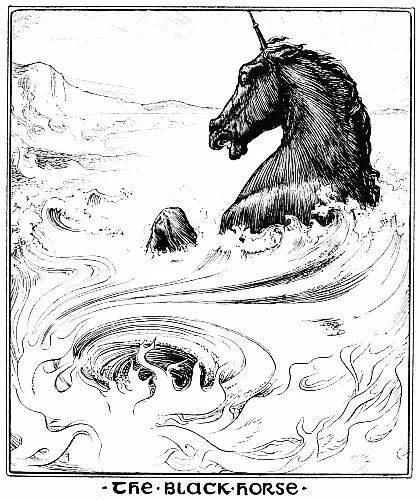
Batten: the enchanted Black Horse of the Menglay tale
Printed Black Horse caption and named story identify the water-emerging horse; this is the prince’s enchanted animal appearance. John Dickson Batten (1860–1932) credited by title page. Selected title-page edition 1895.
Overview
The rider exchanges his inherited limping white horse for a black steed said to reach any place he can imagine. In the Realm Underwaves he is compelled to fetch a Greek princess. The horse speaks, arranges the journey and refuses her own horseman while accepting its trusted rider. It later helps recover a wedding cup and undertakes a more dangerous ring quest through snow, ice and fire. Its struggle in a flaming lake leaves it exhausted, and the rider shelters it until it recovers. The creature’s speech and exceptional travel are explicit, while a fixed winged anatomy is not. The ring quest receives unusually concrete preparation: the horse requests an iron spike for every bone end before entering a lake four miles long and wide. The water ignites, and the anxious rider waits until sunrise, when the fire goes out and the horse emerges with only one spike remaining and the ring on its end. The journey back again crosses the mountains by great bounds. These dangers and the rider’s care give the animal helper a vulnerability absent from a simple description of limitless transport.
The princess delays marrying the undersea ruler through successive demands, including a castle which the horse provides by bringing a crowd of builders into view. She finally rejects that claimant and marries the rider who accomplished the tasks. After three years he remembers the neglected horse and finds it still where he left it. At the horse’s insistence he removes its head, then hears a human man greet him as brother-in-law and identify himself as the horse. He explains that the rider kept him until the appointed spell period ended, unlike earlier men who could not manage him. This restoration belongs to a distinct Scottish Gaelic story, not Norway’s Black Horse Prince of The Widow’s Son. The completed castle includes a well added after inspection. The princess points out a supposed fault, induces the undersea prince to lean forward and pushes him in; the story then proceeds to her marriage without explicitly reporting his death. At the later restoration the rider says he would prefer the horse to an unrelated man, emphasising affection for the companion rather than only gratitude for wealth. The restored brother-in-law connects the acquired objects with his father’s household and proposes a further wedding celebration there. Jacobs’s source note records MacLean’s 14 February 1862 collection from Roderick MacNeill of Menglay, who recalled learning the story in Barra around 1840; those recollections date transmission evidence rather than its oral origin.
Origins & earliest records
Jacobs identifies Campbell manuscript 53, volumeXI, with MacLean’s collection on 14February 1862 from Roderick MacNeill in Menglay; MacNeill reportedly learned it around 1840 from a Barra man. The selected print witness is 1895. Jacobs acknowledges omitting one Greek journey, distinguishing adaptation from manuscript completeness.
Records & interpretation
The spoken guidance, undersea travel, flaming-lake ordeal and restoration are narrative attestations. The detailed collection date and teller chain support textual provenance, not physical horse powers. Linguistic and geographic comparisons in the notes remain theories rather than proof of a universal horse deity.
In the literature
“a manger of red-hot coals at his head”
Tale XLIV, The Widow’s Son; The youth finds the black horse in the fourth room · George Webbe Dasent
The captive horse is prevented from eating until the youth moves hay to its head.
“I am the black horse”
The Black Horse; p.65, the restored man identifies the helper
After three years the rider remembers his neglected helper. The horse demands beheading and threatens him until he complies. A handsome man then greets the rider as brother-in-law, identifies himself as the horse and explains that retaining him let his spell’s allotted time run out. The caster and initial cause are not supplied.
Selected bibliography
Documented works and useful reading. This is not a list of every appearance.
- 01
More Celtic Fairy Tales: The Black Horse
Full selected episode and relevant editorial source note inspected; cited earlier collections remain attributed, not falsely claimed as newly read.
- 02
More Celtic Fairy Tales — The Black Horse
Joseph Jacobs, More Celtic Fairy Tales, New York:G.P.Putnam’s Sons; London:D.Nutt,1895. Selected dated title and named complete tale independently read. Compiler adaptations and indirect source credits retained.
Family & connections
A source-supported family tree or inspiration record has not yet been compiled for this profile. Related reading below indicates a connection in subject matter, not a proven lineage or creative influence.
Located primary passages
Specific passages supporting details in this entry, grouped by their published witness.
More Celtic Fairy Tales — The Black Horse
Joseph Jacobs, More Celtic Fairy Tales, New York:G.P.Putnam’s Sons; London:D.Nutt,1895. Selected dated title and named complete tale independently read. Compiler adaptations and indirect source credits retained.
- A dispossessed king’s son exchanges his limping garron for a horse able to reach any conceived destination. The Underwaves prince compels him to bring the Greek princess; the speaking horse stages a ride to carry her away. When she demands a family silver cup, the horse directs its removal from a gathering.
The Black Horse; pp.57–61, exchanged mount and coerced bride/cup tasks
- For the princess’s required ring, the horse crosses snow, ice and fire mountains, receives iron spikes at each bone end and enters a blazing lake. He emerges at sunrise exhausted with one spike bearing the ring, then recovers under the rider’s care. The lake ordeal is distinct from ordinary rapid travel.
The Black Horse; pp.61–63, mountain barriers and burning-lake ring
- The horse supplies craftsmen who complete the demanded castle overnight. At a newly dug well the Greek princess pushes the Underwaves prince in and chooses the actual performer of the tasks. The helper enables the successful rider’s marriage; the false claimant’s later fate is not separately narrated.
- After three years the rider remembers his neglected helper. The horse demands beheading and threatens him until he complies. A handsome man then greets the rider as brother-in-law, identifies himself as the horse and explains that retaining him let his spell’s allotted time run out. The caster and initial cause are not supplied.
The Black Horse; pp.64–66, delayed remembrance and beheading release
Complete tale and corresponding source/comparison note independently read; comparative theories and manuscript descriptions remain attributed. No verse, prayers or ritual formulas reproduced.
Primary source witness
Joseph Jacobs, More Celtic Fairy Tales, New York:G.P.Putnam’s Sons; London:D.Nutt,1895. Selected dated title and named complete tale independently read. Compiler adaptations and indirect source credits retained.
- Jacobs credits Campbell’s manuscript53 volumeXI: Hector MacLean collected Gaelic on14February1862 from Roderick MacNeill in Menglay, who reportedly learned it about1840 from a Barra man. Jacobs explicitly omitted one Greece visit. Campbell’s Asian-origin and wind/horse-sacrifice comparisons are quoted theories, not adopted proof.
Verifies1895 source credit and acknowledged editing, not independent manuscript inspection or proposed ancient diffusion.
References
Sources supporting this profile. Linked pages have their own scope and editorial standards.
- Primary textJacobs, More Celtic Fairy Tales: The Black Horse and source noteResearch access: 2026-10-05
Image credits
Historical illustrationBatten: the enchanted Black Horse of the Menglay tale
Printed Black Horse caption and named story identify the water-emerging horse; this is the prince’s enchanted animal appearance. John Dickson Batten (1860–1932) credited by title page. Selected title-page edition 1895.