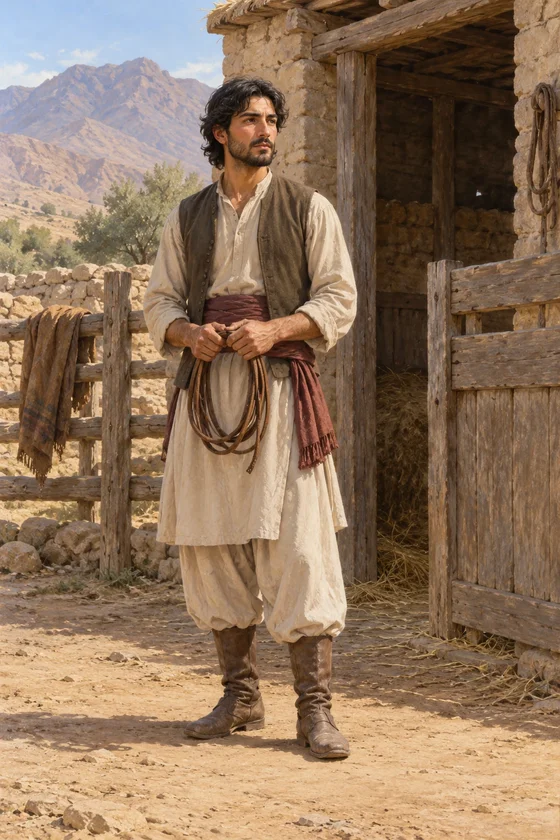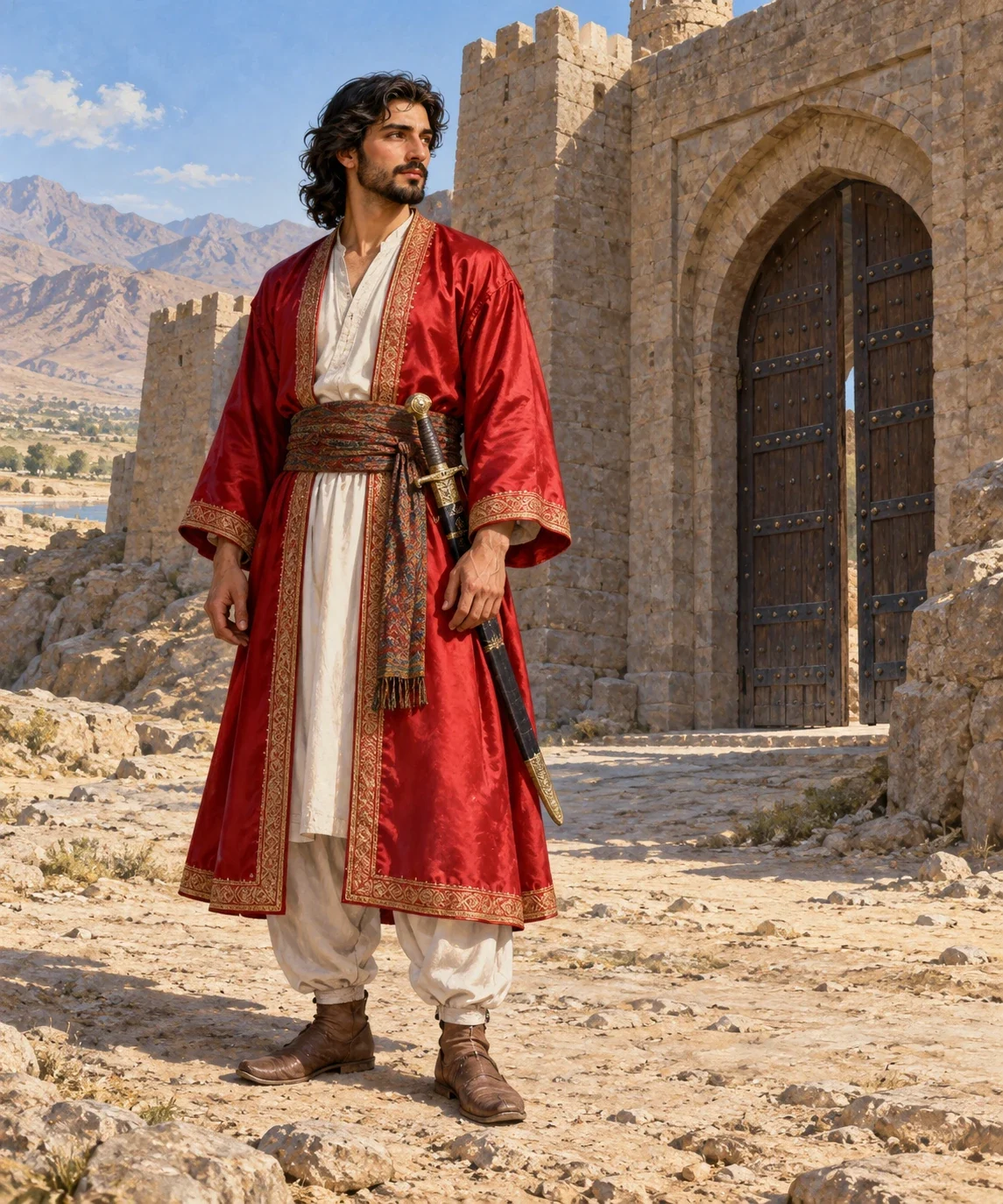
Portrayal of Bivaragh, Granaz’s Companion (Dames).
AI-generated portrayal of Bivaragh after forgiveness. Red silk follows the narrative; garment construction, appearance, sword styling and fort are interpreted.
Overview
Dames’s twentieth ballad introduces Bivaragh, son of Bahar, as the first-person teller of an adventure involving the daughter of the king of Qandahar. He sees her at a palace window; she invites him to approach, and he climbs the walls using iron pegs. After remaining with her, he leaves at her urging because she fears discovery. The poem names her Granaz. They travel on his black mare toward Sevi, where she asks about the forces of Chakur and Gwaharam. Although Bivaragh calls Chakur his friend and Gwaharam his enemy, they seek shelter with Gwaharam, who offers them a place within his fort.
Hospitality does not erase the rivalry. Bivaragh refuses the offered food, speaking of the difficulty of eating an enemy’s salt, while a shopkeeper supplies clothing and other goods. When the king’s army comes through the Bolan, the two chiefs consult and prepare scouts. Bivaragh volunteers to reconnoitre himself. In the enemy camp he reaches the ruler’s tent after a violent encounter, wakes the king and admits responsibility for the elopement. He places his life at the ruler’s discretion and appeals to royal forgiveness. The resolution comes through that personal negotiation rather than a decisive battle between the assembled armies.
The king consults his men, presents Bivaragh with a swift horse and clothes him in red silk. The army withdraws through the Bolan, and Bivaragh returns to the assembly at Sevi to report the outcome. His final statement celebrates living with Granaz without having drawn the Rinds and Lasharis into a costly battle. Dames proposes historical identifications and reports a later genealogical tradition in the prefatory note; those are attributed interpretations, not independently verified facts. A separate love-song placed under Bivaragh’s name is retained for comparison, but Dames considers its language later than this heroic narrative. Its gazelle, mare, flower and bee imagery is not converted into bodily transformations or added episodes of the same adventure.
Origins & earliest records
Bivaragh and the King of Qandahar’s Daughter, Dames XX, translated from Mayer’s text; original 1906 volume. The separate XXXVIII lyric has an explicitly questioned attribution/period.
Records & interpretation
Complete XX, pp. 48-51, all source and explanatory notes, plus complete XXXVIII and its attribution note, pp. 113-115; original source/translation and antiquity discussion retained.
Selected bibliography
Documented works and useful reading. This is not a list of every appearance.
- 01
Popular Poetry of the Baloches, Volume I
XX, Bivaragh and the King of Qandahar’s Daughter, pp. 48-51; XXXVIII, pp. 113-115, retained separately as attribution context. Title year retained despite catalogue-derived 1907 cache filenames; original Balochi not independently collated.
Family & connections
A source-supported family tree or inspiration record has not yet been compiled for this profile. Related reading below indicates a connection in subject matter, not a proven lineage or creative influence.
References
Sources supporting this profile. Linked pages have their own scope and editorial standards.
- Historical English translation/compilation of Baloch narrative poetryDames1906 original English narrative and editorial notesResearch access: 2026-10-18
Image credits
AI-generatedPortrayal of Bivaragh, Granaz’s Companion (Dames).
AI-generated portrayal of Bivaragh after forgiveness. Red silk follows the narrative; garment construction, appearance, sword styling and fort are interpreted.