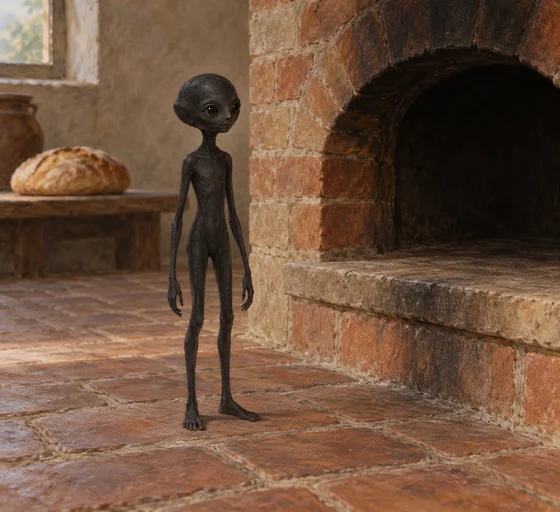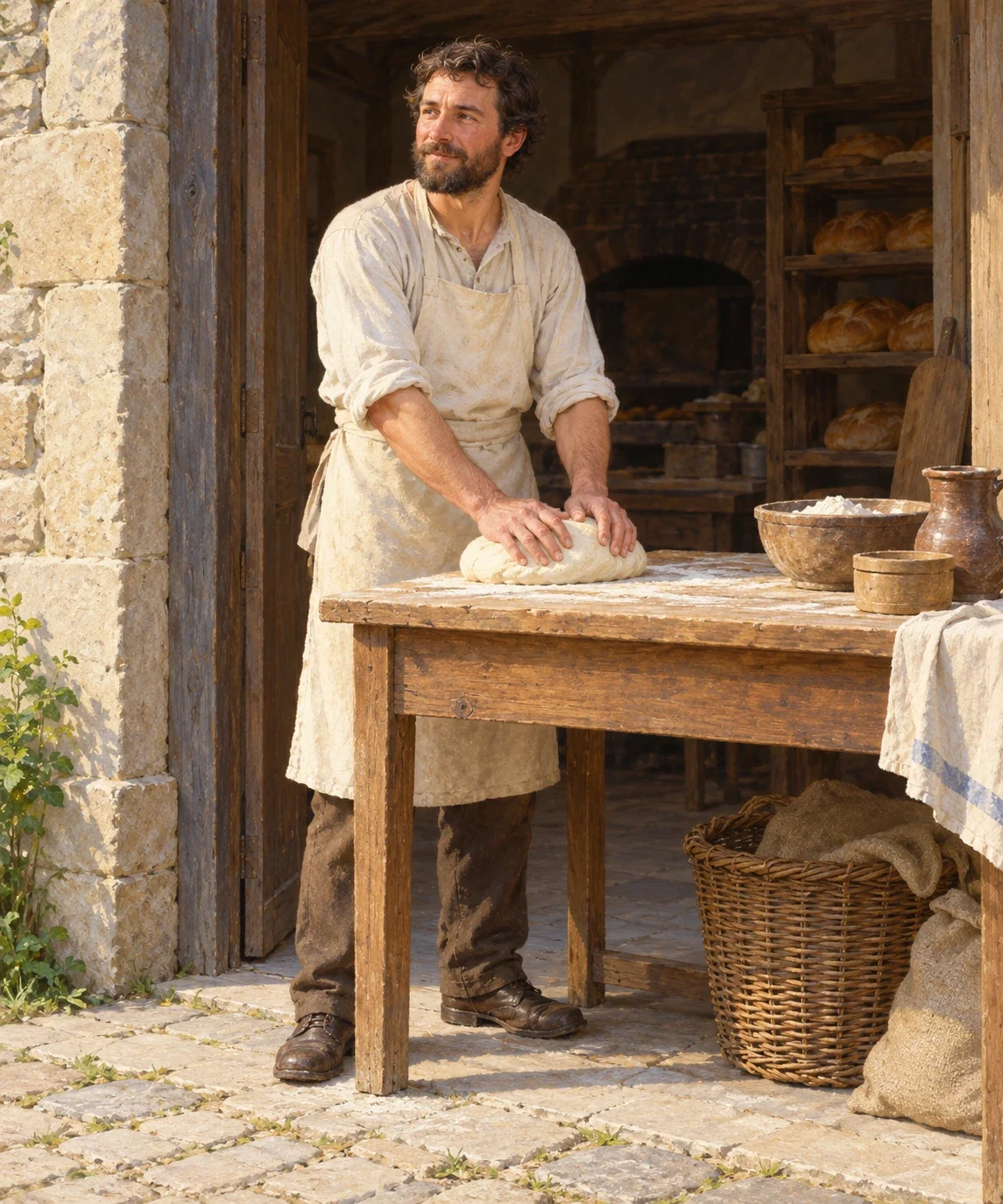
AI interpretation of De Morgan’s baker kneading dough at his doorway.
Overview
The baker begins with a violent temper: spoiled bread makes him rage so fiercely that his wife and daughters fear approaching him. When he throws a blackened loaf onto the floor and it breaks, a tiny imp emerges. The creature offers to live in the oven and guarantee perfectly baked bread. It warns that the bread will taste excellent but make its eaters unhappy and discontented; the baker can avoid this trouble by not eating it himself. He accepts. His next batch is perfect despite careless timing, demand becomes extraordinary and he alone remains cheerful as the village’s grievances multiply. The narrator emphasizes that he knows the cause, disregards his customers’ misery and laughs at their complaints.
His apparent immunity makes him a target. When he tells the doctor that neither of them has anything to complain of, the doctor and farmer drag him before the Justice. The Justice orders a public flogging, treating his earlier claim to happiness as an offense or falsehood. Others smash the bakery and break open the oven. The imp escapes unnoticed, and the villagers immediately regain their senses, though the Justice refuses to acknowledge his own responsibility. The injured baker returns home intending to expel the imp, only to find it already gone. He repairs the oven and resumes ordinary, fallible baking. Having learned that worse things can happen than burnt loaves, he becomes content to share other people’s chances without supernatural help. The ending reverses both his original rage and his willingness to profit from others’ unhappiness.
First appearances & development
The unnamed baker in The Bread of Discontent, pp.140–156 of Mary De Morgan’s1880 collection.
Canon & continuity
The Bread of Discontent is an authored story in Mary De Morgan’s The Necklace of Princess Fiorimonde and Other Stories, London: Macmillan & Co.,1880. The complete selected narrative, pp.140–156, and original title, dedication, contents and illustration list were read in the existing cached edition. The selected witness is authored literary fiction.
Selected bibliography
Documented works and useful reading. This is not a list of every appearance.
- 01
The Necklace of Princess Fiorimonde and Other Stories
Complete selected authored tale The Bread of Discontent, pp.140–156; original framing retained.
Family & connections
A source-supported family tree or inspiration record has not yet been compiled for this profile. Related reading below indicates a connection in subject matter, not a proven lineage or creative influence.
References
Sources supporting this profile. Linked pages have their own scope and editorial standards.
- Historical public-domain authored literary narrativeDe Morgan1880 — complete Bread of Discontent and original collection framingResearch access: 2026-10-23
Image credits
AI-generated literary interpretationAI interpretation of De Morgan’s baker kneading dough at his doorway.