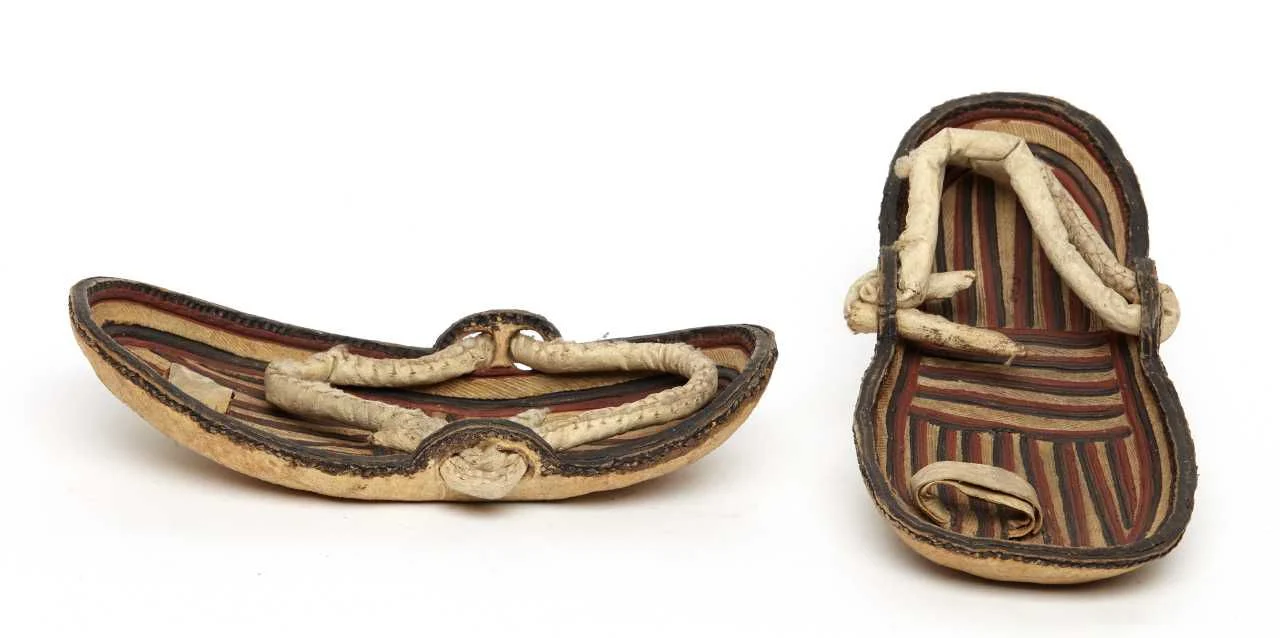
Two leather sandals with striped footbeds and pale padded straps on a white background.
Sandals catalogued with Baganda manufacture and collection context in Uganda. The museum records accession by exchange in 1934, not a creation date. Individual maker unspecified. Material-culture context from a documented object. Compressed for display.
Overview
The Buganda Kingdom's own published history separates three terms: Baganda for the people, Buganda for the kingdom and its territory, and the Kabaka for the royal institution. The same account presents Kintu and the beginnings of the clans as inherited tradition rather than documented chronology.
In the Kingdom's account, clan heads serve as keepers of tradition, and clans hold differing relationships with the throne. It records the 1966 attack on the royal palace and the kingdom's restoration in 1993.
UNESCO's barkcloth listing places the craft among Baganda in southern Uganda, where Ngonge-clan specialists repeatedly beat the inner bark of Ficus natalensis to make cloth. The listing notes royal and community ceremonial uses, nineteenth-century competition from cotton, and later efforts to promote the craft.
History & identity
Origin narratives centred on Kintu are presented by the Kingdom as inherited tradition; no dated origin is established in the selected sources.
Sources & representation
Buganda Kingdom history PDF (pp. 2–5, 14–16) and UNESCO barkcloth element description.
Selected bibliography
Documented works and useful reading. This is not a list of every appearance.
- 01
Brief History of the Kingdom of Buganda
Selected bibliography; Kingdom-published institutional history.
- 02
Barkcloth making in Uganda
Selected bibliography; UNESCO element page drawing on nomination material.
Language & cultural connections
Source-supported language and cultural connections have not yet been compiled for this profile.
References
Sources supporting this profile. Linked pages have their own scope and editorial standards.
- Institutional history (PDF), Buganda KingdomBrief History of the Kingdom of BugandaResearch access: 2026-10-06
- UNESCO intangible heritage listingBarkcloth making in Uganda - UNESCO Intangible Cultural HeritageResearch access: 2026-10-06
Image credits
Museum photograph of a catalogued objectTwo leather sandals with striped footbeds and pale padded straps on a white background.
Sandals catalogued with Baganda manufacture and collection context in Uganda. The museum records accession by exchange in 1934, not a creation date. Individual maker unspecified. Material-culture context from a documented object. Compressed for display.