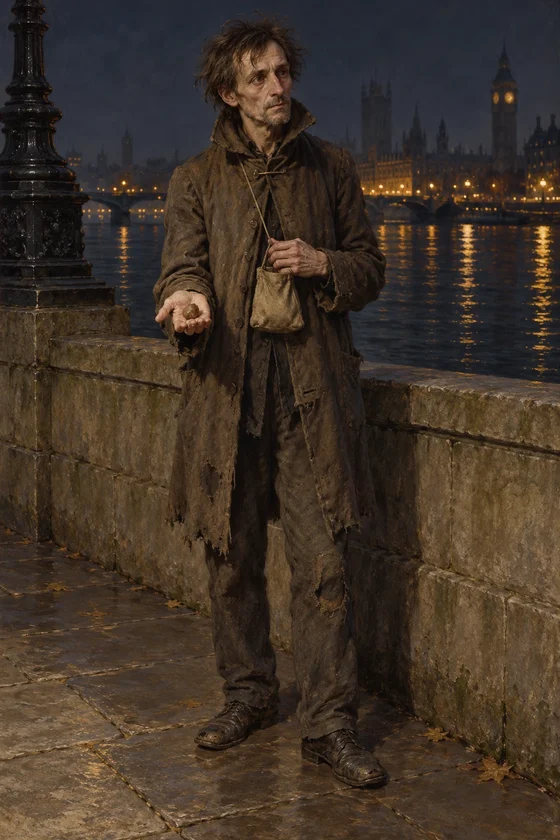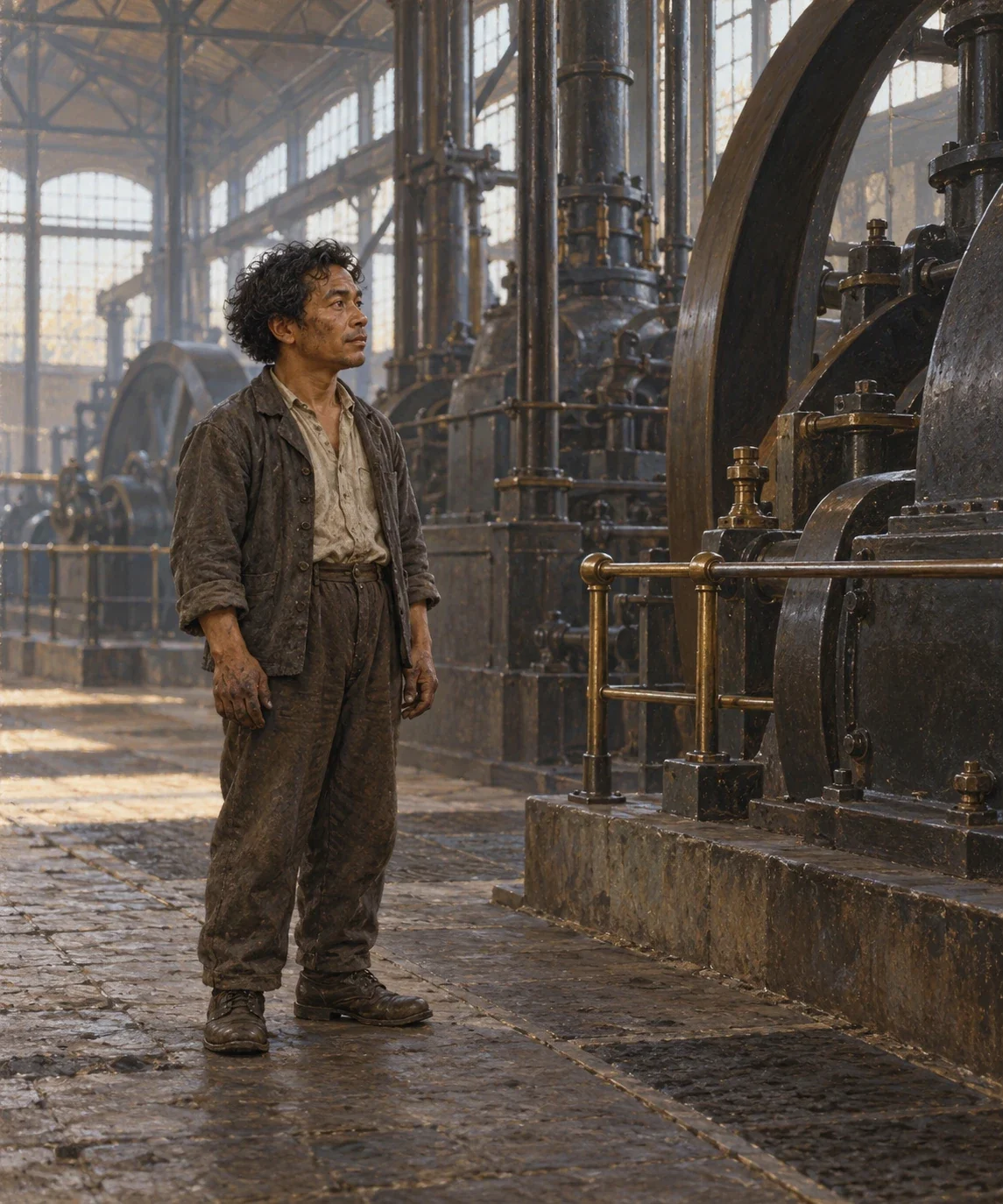
Original AI literary interpretation.
Overview
Azuma-zi is James Holroyd's helper in the Camberwell dynamo shed that powers an electric railway. He has arrived in London after work aboard the Lord Clive, loses his money and health, and becomes dependent on an employer who kicks, strikes and humiliates him. The text describes a short brown-skinned man with curly hair, cheap work clothes and coal grime. Its narrator also supplies racist bodily comparisons and speculative racial ancestry. Those claims are part of the story's colonial rhetoric, not evidence about a real population or a reliable identification of his community; his precise birthplace is not established.
The largest dynamo fascinates Azuma-zi. Its regular movement and sound appear to him more powerful and serene than the smaller machines, and he begins to treat it as a god. Holroyd's own boasting about its power and his repeated abuse contribute to the setting in which this belief develops. Azuma-zi cleans the machine, speaks to it and interprets changing sounds and an accidental shock to Holroyd as signs of protection and warning. The narration presents the noises through his interpretation; it does not demonstrate that the dynamo consciously speaks, judges or demands a victim. Its description of his mental state is likewise a fictional narrator's speculation rather than a clinical finding.
Azuma-zi attacks Holroyd, whose body is then found at the machine. The manager initially assumes suicide and does not suspect the helper, while the narration has shown the struggle and Azuma-zi's satisfaction in what he considers a sacrifice. When he later attacks the manager, the intended victim fights back. At the approach of another official, Azuma-zi breaks away, grasps the machine's terminals and is killed. The manager finally understands Holroyd's death and restores railway service. The closing religious language is grim irony: industrial routine resumes after both the exploited worker and his brutal employer die. The tale's abuse, murder and dehumanising narration remain separate parts of the account.
First appearances & development
Individual character in H. G. Wells’s authored English fiction; retained historical collection title, not a real case report.
Canon & continuity
Complete selected 41-paragraph tale including its narrative framing and ending; complete original title, dedication, acknowledgments and contents.
Selected bibliography
Documented works and useful reading. This is not a list of every appearance.
- 01
The Stolen Bacillus and Other Incidents
Selected tale: The Lord of the Dynamos. Retained dated title transcription; no independent physical-copy or first-appearance verification.
Family & connections
A source-supported family tree or inspiration record has not yet been compiled for this profile. Related reading below indicates a connection in subject matter, not a proven lineage or creative influence.
References
Sources supporting this profile. Linked pages have their own scope and editorial standards.
- Primary authored English fictionThe Lord of the Dynamos - complete historical authored textResearch access: 2026-10-21
Image credits
AI-generated illustrationOriginal AI literary interpretation.