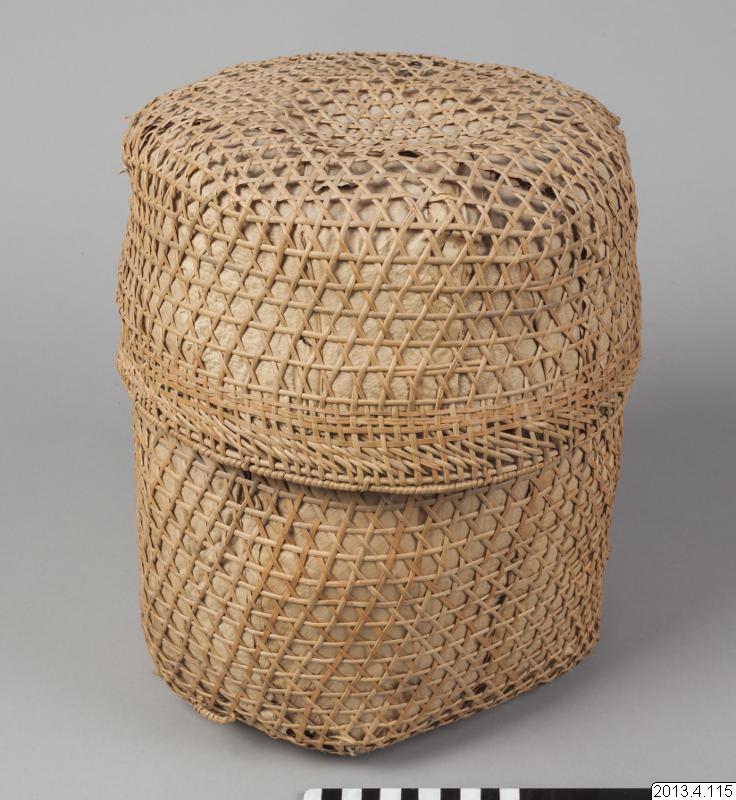
A complete pale woven basket with open latticework, a denser horizontal band and an inventory label beside the scale at the bottom.
Woven carrying basket catalogued as Aguaruna, from Amazonas, Peru. Donated by Bengt Arne Runnerström and acquired by the museum in March 2013; the record gives no maker or manufacture date. One material-culture object, not a depiction of the people. Compressed for display.
Overview
Awajún is an accepted self-name; Aguaruna is an older outside designation. Peru’s cultural ministry locates communities along northern Amazonian rivers and classifies their language in the Jíbaro family.
The ministry records Awajún and Wampis cooperation in forming the Consejo Aguaruna y Huambisa in 1977. Shared institutions do not erase their distinct identities.
UNESCO’s 2021 pottery inscription describes Dukúg women elders transmitting knowledge within families. Preparation, decoration and use of vessels connect practical skills with social relationships.
History & identity
No precise ancient origin is established here.
Sources & representation
Selected sourced accounts.
Selected bibliography
Documented works and useful reading. This is not a list of every appearance.
- 01
Awajún | BDPI
Selected bibliography.
- 02
Language & cultural connections
Source-supported language and cultural connections have not yet been compiled for this profile.
References
Sources supporting this profile. Linked pages have their own scope and editorial standards.
- Institutional accountAwajún | BDPIResearch access: 2026-10-07
- Institutional accountPottery-related values, knowledge, lore and practices of the Awajún people - UNESCO Intangible Cultural HeritageResearch access: 2026-10-07
Image credits
Museum photograph of one carrying basketA complete pale woven basket with open latticework, a denser horizontal band and an inventory label beside the scale at the bottom.
Woven carrying basket catalogued as Aguaruna, from Amazonas, Peru. Donated by Bengt Arne Runnerström and acquired by the museum in March 2013; the record gives no maker or manufacture date. One material-culture object, not a depiction of the people. Compressed for display.