
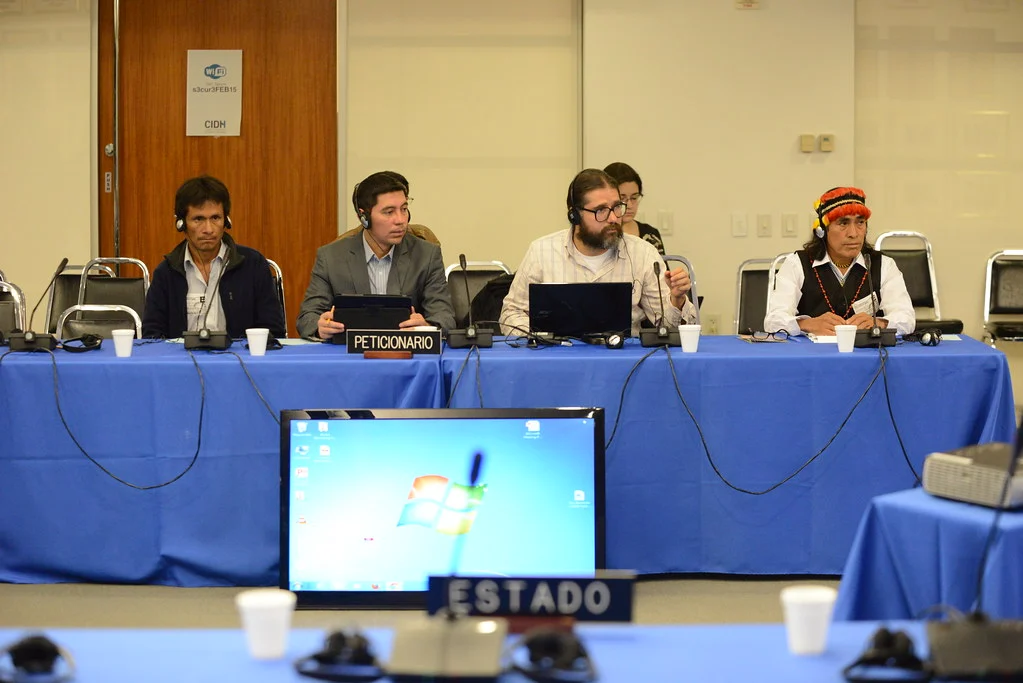
Four petitioners sit behind a blue-covered hearing table with headsets and microphones; Domingo Ankuash of Federación Shuar is seated at the right.
Petitioners at the CIDH hearing Ecuador: Pueblo Shuar on17 March2015. The source identifies, from left, Carlos Tendetza, Milton Vargas, Luis Corral and Domingo Ankuash; Ankuash is affiliated with Federación Shuar. Their participation does not imply a single position held by all Shuar communities.
Overview
CONAIE’s account places Shuar communities in Ecuador and Peru. Within Ecuador it identifies Morona Santiago, Pastaza and Zamora Chinchipe, alongside settlements in other Amazonian provinces and the coastal region. Its historical outline describes the development of federations from 1964 amid missionary activity, settlement pressures and changing relations with the state. These organizations are part of modern collective history, not evidence that Shuar identity began in that year. The older population estimate printed in the account is not treated here as a current count.
María Clara Sharupi Jua’s essay, dated in Quito on 14 May 2013, offers a first-person Shuar woman’s intervention in how that history is represented. She rejects derogatory labels and outside accounts that isolate sensational practices from their social meaning. She describes community leadership, unpaid responsibilities, mutual support among women and obstacles encountered when women take proposals to public institutions. Language, oral knowledge and written poetry belong to the same struggle for participation. Her movement between Shuar Chicham and Spanish is presented as lived experience, not a test that determines whether someone is authentically Shuar. These arguments are the named author’s perspective; they are not converted into a universal biography of all Shuar women.
Contemporary publication and public performance extend those conversations. Ecuador’s Casa de la Cultura reported a June 2022 Amazonian cultural event bringing food, crafts, small enterprises and literature into its Quito venue. Among the works presented was Sharupi’s Tarimiat, described by the institution as bringing Shuar narratives into Shuar and Spanish. The notice documents a specific public presentation. It does not establish that every version or edition has the same contents, and the complete book has not been read for this profile.
Education also involves material conditions as well as language. A June 2025 report from the intercultural bilingual education secretariat describes water-storage tanks, filters, maintenance training and infrastructure assessments for community schools. Its beneficiary table distinguishes Shuar schools from Achuar, Waorani and Andwa institutions, despite a heading emphasizing Shuar and Achuar. The report is evidence of a particular multi-community initiative, not proof that all schools have equal services. Read alongside Sharupi’s account, it shows why cultural continuity encompasses public participation, educational resources and decisions made by living communities, as well as the transmission of stories.
History & identity
Regional community histories precede twentieth-century federations; political nationality, language use and citizenship are not treated as identical categories.
Sources & representation
CONAIE geography/history sections; complete Sharupi essay through notes/date; complete Casa cultural-event notice; complete SEIBE report and beneficiary table. No book, audio or video completion claim.
Selected bibliography
Documented works and useful reading. This is not a list of every appearance.
- 01
Los desafíos de la Mujer Shuar desde su origen
Complete essay dated14May2013 read; later webpage update is not the essay date.
- 02
Tarimiat
Bibliographic reference from June2022 presentation report; full book and edition date not established here.
Language & cultural connections
Source-supported language and cultural connections have not yet been compiled for this profile.
References
Sources supporting this profile. Linked pages have their own scope and editorial standards.
- Indigenous organizationCONAIE: ShuarResearch access: 2026-10-05
- Community-authored essayMaría Clara Sharupi Jua: women’s challengesResearch access: 2026-10-05
- Cultural institutionCasa de la Cultura: Tarimiat eventResearch access: 2026-10-05
- Education institutionSEIBE: community-school water initiative,2025Research access: 2026-10-05
Image credits
Documentary photograph of named petitioners at a dated CIDH hearing concerning the Shuar peopleFour petitioners sit behind a blue-covered hearing table with headsets and microphones; Domingo Ankuash of Federación Shuar is seated at the right.
Petitioners at the CIDH hearing Ecuador: Pueblo Shuar on17 March2015. The source identifies, from left, Carlos Tendetza, Milton Vargas, Luis Corral and Domingo Ankuash; Ankuash is affiliated with Federación Shuar. Their participation does not imply a single position held by all Shuar communities.