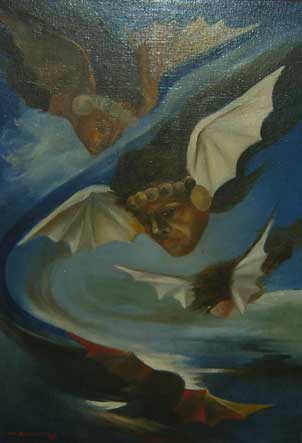
A sourced illustration has not yet been added. This gap is included in the coverage record.
Overview
Rosa Chihuaihuén of Picuta describes an anchimallen playing with children outside at midday, when the hot sun seems to stand still. The encounter is recognized afterward through children’s frightened waking, crying and sickness at night. Montecino and Conejeros print her account with its explanation of protective practices, while their footnote characterizes the being as small or duende-like. This is a locally credited understanding of harmful encounter, rather than an anonymous universal monster description.
A Chilean school-reading adaptation gives another portrayal: a child-sized being heard crying like a baby, fed milk, blood or honey, and kept to obey and protect its owner and livestock. It can become a briefly appearing sphere of light that disorients someone who sees it. The educational text cites a 2011 anthology; that anthology was not inspected directly. Its guardian role and luminous form are separately attributed rather than imposed on Chihuaihuén’s testimony.
Earlier named narratives in Guevara’s 1908 collection give the luminous companion a domestic setting. Longuitue recounts a girl, Hueilcao, silently watching her father prepare to check his animals at night. When her mother tells him to take his companion, the child fears she will be sent into the darkness. Instead, a small light rises from inside the house and follows her father: the narrator identifies it as an anchimallen. This episode does not say it harms the child.
Juan Venancio’s separate Reñaco/Cheñol account has a small fiery man jump across ditches and repeatedly frighten a mounted herder. When the man dismounts and ties his horse, the apparition flees towards another house. The herder returns home next day and becomes ill. A much darker paired Huitranalhue-and-Anchimallen tale by Melivilu of Maquehua describes purchased beings demanding relatives’ blood and a brother surviving to expose the arrangement. Its ending includes the accused sister’s execution; this is a narrated accusation and punishment, not evidence that a historical woman possessed supernatural killers. The helpful light, alarming little man and consuming pair remain distinct tellings.
Origins & earliest records
The inspected health-knowledge collection was first published by Ediciones CEM in August 1985 and credits Chihuaihuén’s Picuta contribution. The separate education ministry booklet dates to October 2017 and labels its bestiary an adaptation from a 2011 anthology. Those dates identify selected records and later reception; they do not establish the tradition’s earliest telling.
Records & interpretation
Montecino and Conejeros’s printed page 58 identifies the narrator and encounter; the original scan’s PDF page 57 was inspected. The ministry booklet’s printed page 31 gives the luminous protector portrayal. Historical plant preparations are mentioned as contextual testimony without reproducing instructions or presenting them as medical recommendations. The two witnesses have different purposes and descriptions. The three complete Guevara narratives were visually inspected in original scans, with teller and setting differences retained.
Selected bibliography
Documented works and useful reading. This is not a list of every appearance.
- 01
Mujeres mapuches: el saber tradicional en la curación de enfermedades comunes
Serie Mujer y Salud 2, Ediciones CEM; p. 58, Rosa Chihuaihuén of Picuta. First-edition colophon inspected.
- 02
Estándares de Aprendizaje: Lectura 6º básico
First edition October 2017; p. 31, Bestiario. Explicit pedagogical adaptation of Cal y Canto’s 2011 Amo leer anthology, not a new oral interview.
- 03
Psicolojía del pueblo araucano
Longuitue: Una niña que ve anchimallen, pp.339–340; Juan Venancio: Brujos de Reñeco, p.355; Melivilu: paired Huitranalhue and Anchimallen, pp.351–353, complete stories.
Family & connections
A source-supported family tree or inspiration record has not yet been compiled for this profile. Related reading below indicates a connection in subject matter, not a proven lineage or creative influence.
References
Sources supporting this profile. Linked pages have their own scope and editorial standards.
- ResearchMontecino and Conejeros (1985), Anchimallen, p. 58Research access: 2026-10-05
- ReferenceMINEDUC reading standards (2017), adapted bestiary p. 31Research access: 2026-10-05
- Primary textGuevara 1908: Longuitue: Una niña que ve anchimallen, pp.339–340; Juan Venancio: Brujos de Reñeco, p.355; Melivilu: paired Huitranalhue and Anchimallen, pp.351–353, complete stories.Research access: 2026-10-05
Image credits
A sourced illustration has not yet been added. This gap is included in the coverage record.