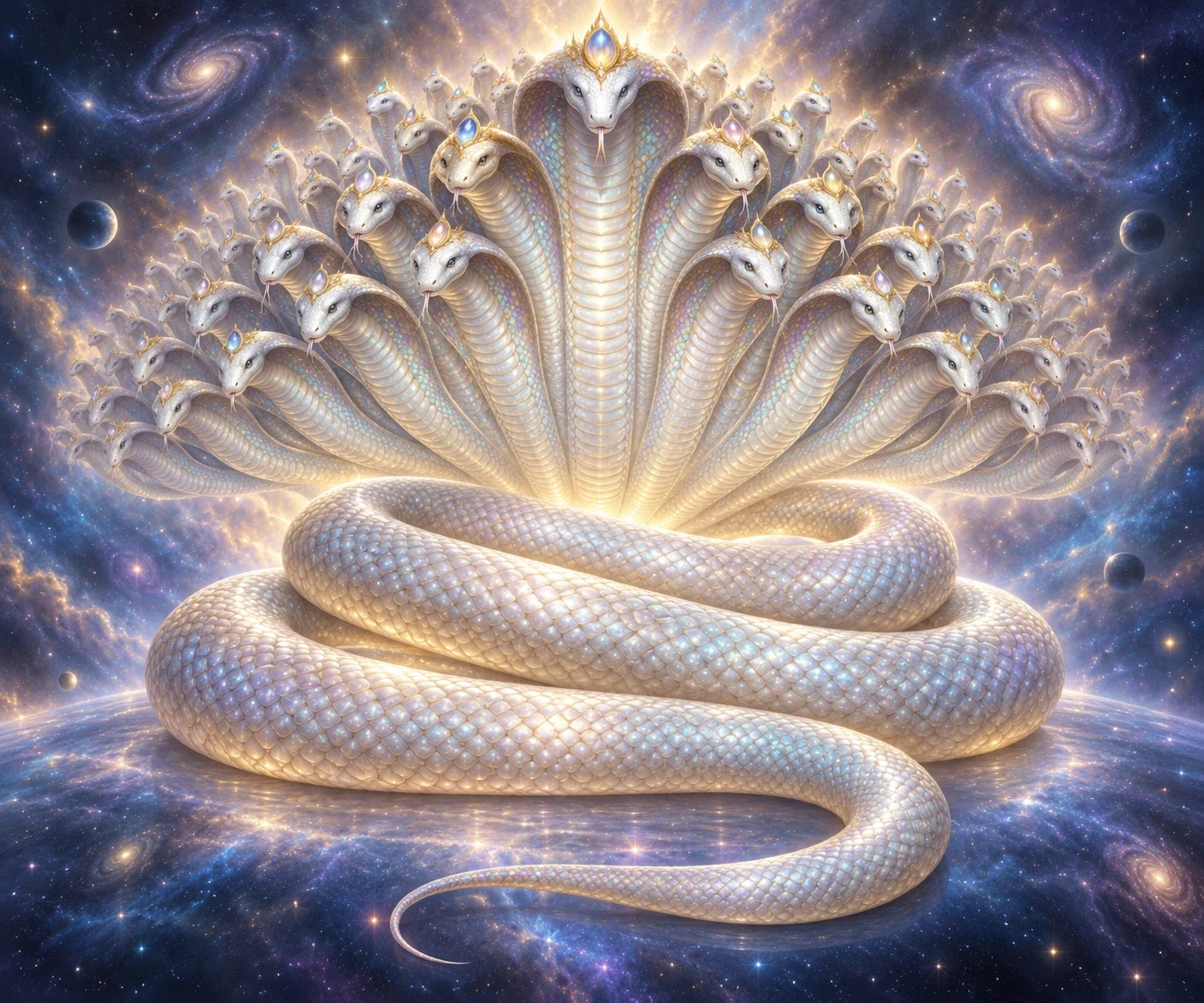
AI-generated symbolic interpretation of Ananta/Śesha in Wilson’s selected Vishnu Purana account; this finite image does not literally enumerate the thousand heads, and its cosmic setting is imagined.
Selected radiant serpent motif only, not full canonical iconography or a literal head-count diagram. Exact heads, jewel settings, coils, galaxies, planets, light and space are artistic inventions. No fixed seven-head substitution, game people, copied sacred artwork or authenticated ritual image is asserted.
Overview
Ananta is explicitly identified with Śesha in the selected chapter of the Vishnu Purana translated by H. H. Wilson. The account places this form of Vishnu below the seven regions of Patala and calls him an object of reverence for sages and gods. Śesha sustains the world upon his head and forms the foundation beneath the subterranean regions. These relationships identify a particular cosmic serpent within a religious account, rather than making every naga or every named serpent an interchangeable version of him.
His grandeur is expressed through a thousand heads and a thousand crest jewels whose light reaches the regions around him. The passage compares his radiance with white mountains and describes purple clothing, a white necklace, a single earring, a diadem and wreaths. It also gives him a plough in one hand and a pestle in the other, with Varuni attending as his embodied radiance. Wilson’s accompanying note explains that the description blends attributes of the serpent with those of Balarama or Sankarshana. The translation therefore combines different modes of representation; it does not provide a simple zoological body plan.
The serpent’s movements and breath have effects on the larger cosmos. When Ananta yawns, the earth trembles with its woods, mountains, seas and rivers. His breath disperses the fragrance of sandal paste prepared by the snake-gods’ wives. At the end of the Kalpa, destructive fire issues from his mouths and consumes the three worlds. Support, splendour and dissolution thus occur within the same account. These are narrated cosmological actions, not a physical explanation of earthquakes or a claim that living snakes possess similar powers.
The chapter ends by connecting Śesha with knowledge: the sage Garga gains instruction from him concerning astronomy, planets and auspicious or adverse heavenly aspects. Wilson’s note separately recalls the serpent supporting Vishnu during intervals between creations; that editorial explanation is distinguished from the chapter’s own description. This profile follows the complete selected chapter and all six notes in the hosted historical translation, labelled 1840 by its original index. No Sanskrit collation, earliest oral chronology or universal account of contemporary Hindu practice is established. Final Fantasy’s Ananta are a separately documented fictional people; their collective identity does not become this singular religious figure’s biography through a shared name.
Origins & earliest records
Vishnu Purana Book II chapter V, pp. 204–206 in the hosted Wilson witness, with all six attached notes. Historical translation date and underlying textual tradition are distinguished.
Records & interpretation
Complete selected chapter and all six attached notes read in the historical Wilson translation. Sanskrit original and physical printing not independently collated.
Selected bibliography
Documented works and useful reading. This is not a list of every appearance.
- 01
Vishnu Purana — Book II chapter V, pp. 204–206 and six notes
Selected historical translation and translator notes; no independent collation of the Sanskrit original or physical printing.
Family, evolution & connections
Ananta (Final Fantasy)
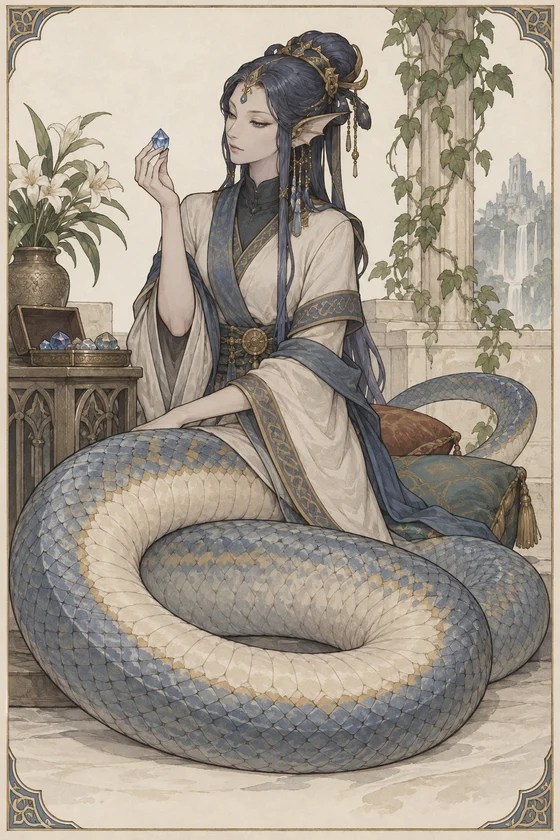
Ananta are serpent women associated with gemcraft and Lakshmi. Wilson’s selected Vishnu Purana chapter explicitly calls Śesha Ananta and presents a singular world-supporting cosmic serpent. The shared name supports comparison, while the fictional people and the religious figure retain distinct identities. These references do not establish a creator-consulted text, direct descent or shared biography.
References
Sources supporting this profile. Linked pages have their own scope and editorial standards.
- Historical religious-text translation with translator commentaryWilson translation — Vishnu Purana Book II chapter VResearch access: 2026-10-24
Image credits
AI-generated narrative interpretationAI-generated symbolic interpretation of Ananta/Śesha in Wilson’s selected Vishnu Purana account; this finite image does not literally enumerate the thousand heads, and its cosmic setting is imagined.
Selected radiant serpent motif only, not full canonical iconography or a literal head-count diagram. Exact heads, jewel settings, coils, galaxies, planets, light and space are artistic inventions. No fixed seven-head substitution, game people, copied sacred artwork or authenticated ritual image is asserted.