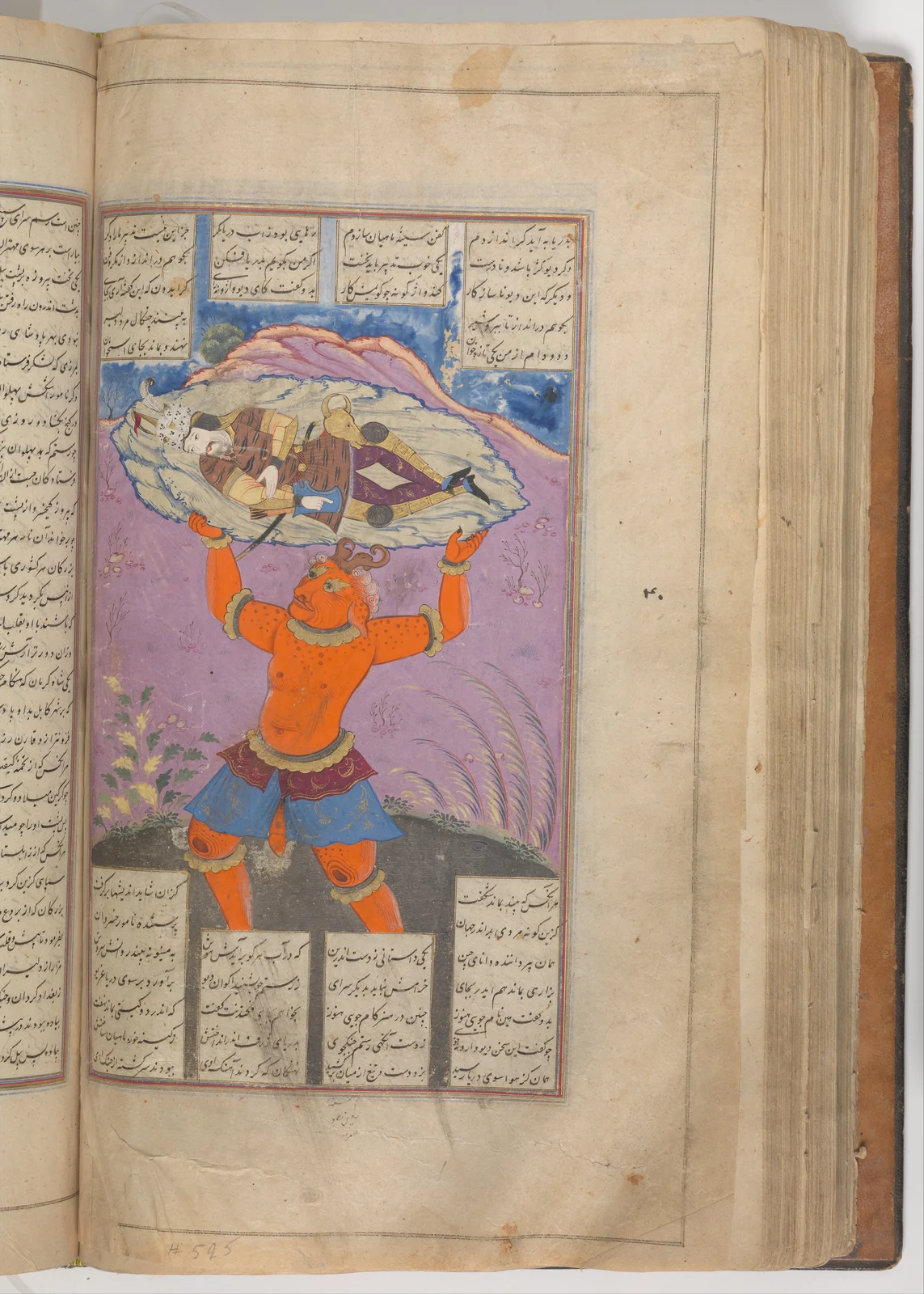
Mu’in Musavvir’s orange Akvān Div lifting sleeping Rustam on a slab of earth
The div carries Rustam and the ground on which he was sleeping, before the choice between mountain and sea. The orange body, curled horns, spotted skin and gold-edged eyelids belong to Mu’in Musavvir’s seventeenth-century representation. This is Akvān’s demon form, distinct from his wild-ass disguise in the narrative.
Overview
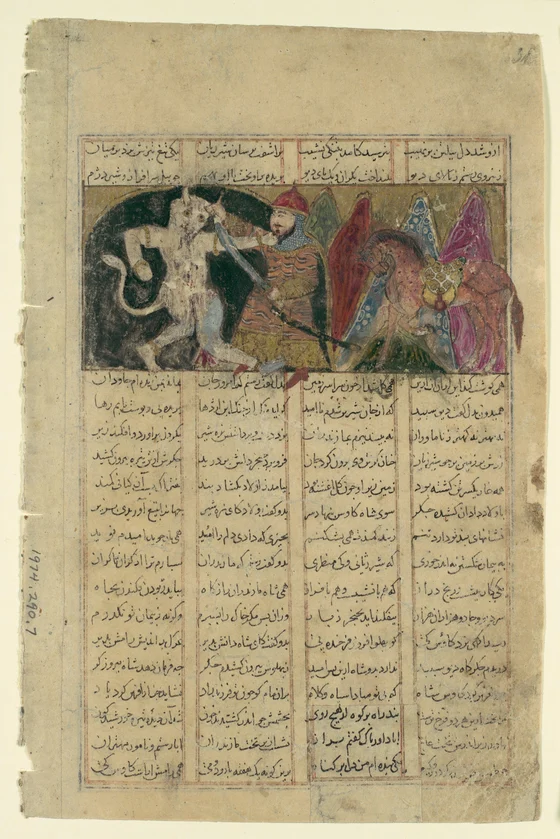
In James Atkinson’s Shahnama translation, reprinted in the 1909 Persian Literature anthology, a powerful wild ass attacks the king’s horses. Rustam’s noose, sword, spear and arrows repeatedly fail because the creature vanishes. Rustam identifies it as Akwán Díw. The exhausting pursuit ends when he sleeps beside a spring, leaving his horse Rakush to graze.
Akvān digs up the ground beneath the sleeping hero and carries both soil and man on his head. He offers a choice between mountain and sea. Knowing the demon will contradict an expressed wish, Rustam asks for the mountain and is thrown into the water. After swimming ashore, Rustam later meets Akvān again, catches him with a noose and severs his head. The specific onager disguise, disappearance and reversed-choice stratagem distinguish this named demon’s episode.
Origins & earliest records
Persian epic traditions; named source setting
Records & interpretation
Identified primary narrative or custodial object record directly read; image pixels verified only where explicitly noted.
Selected bibliography
Documented works and useful reading. This is not a list of every appearance.
- 01
Shahnama in Persian Literature, Volume1
Akwán Díw chapter
Family & connections
A source-supported family tree or inspiration record has not yet been compiled for this profile. Related reading below indicates a connection in subject matter, not a proven lineage or creative influence.
Primary records and illustrations
Shahnama in Persian Literature, Volume1
Persian epic traditions. Akwán Díw chapter
Actual passage or object record read directly. Museum image bytes not yet visually inspected for these new West Asian objects.
References
Sources supporting this profile. Linked pages have their own scope and editorial standards.
- Primary narrative in historical translationShahnama in Persian Literature, Volume1 — Akwán Díw chapterResearch access: 2026-10-05
Image credits
Historical manuscript illustrationMu’in Musavvir’s orange Akvān Div lifting sleeping Rustam on a slab of earth
The div carries Rustam and the ground on which he was sleeping, before the choice between mountain and sea. The orange body, curled horns, spotted skin and gold-edged eyelids belong to Mu’in Musavvir’s seventeenth-century representation. This is Akvān’s demon form, distinct from his wild-ass disguise in the narrative.