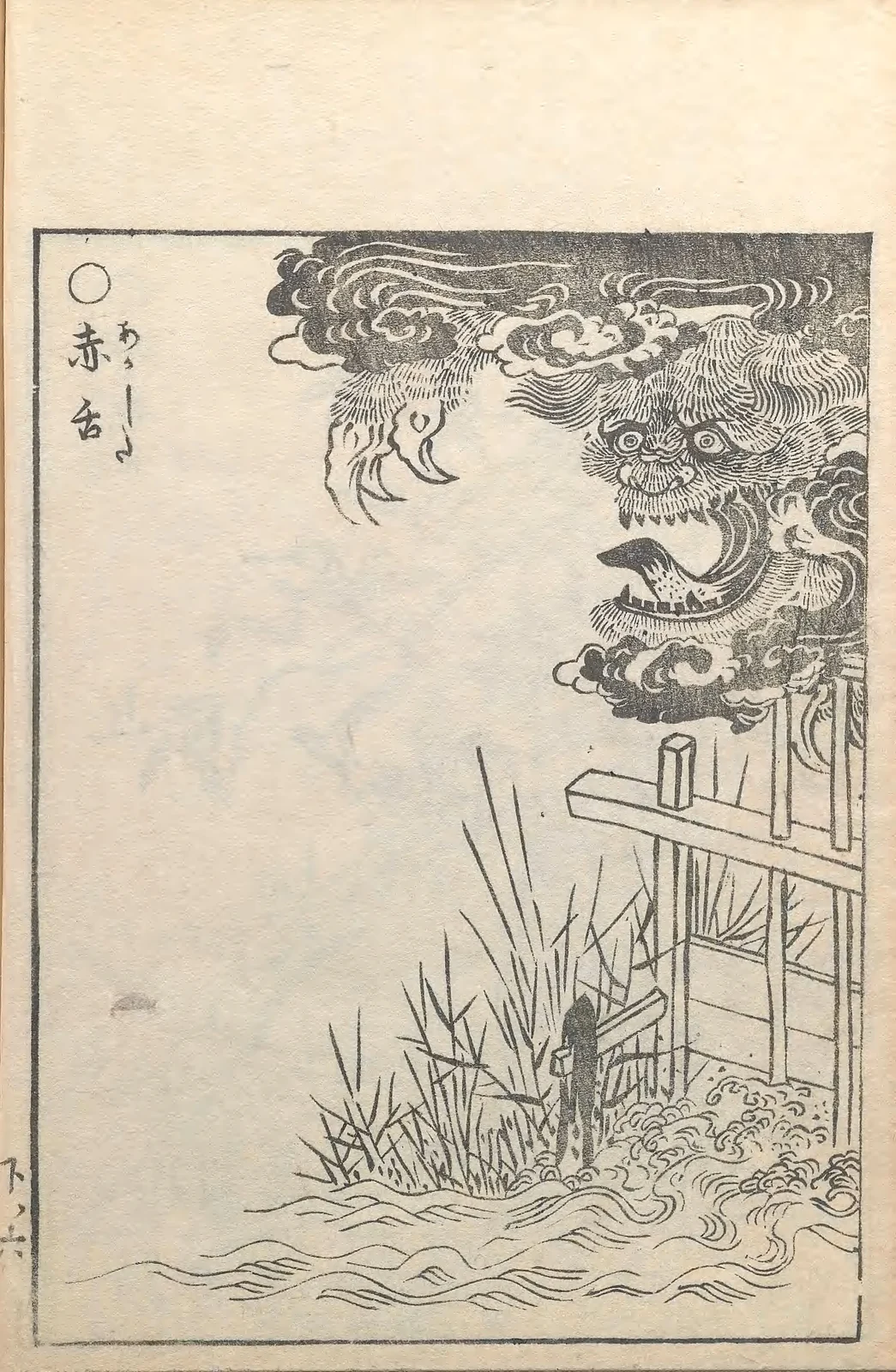
Akashita, named plate by Toriyama Sekien
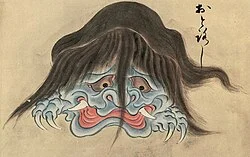
Named 赤舌; a hairy cloudlike face, open mouth, tongue and claw appear above a water gate. Visual inspection of the digitized plate and its printed label; image URL is copied from the actual IIIF manifest, not a guessed leaf reference.
Overview
Akashita, the red tongue, appears as a hairy-faced creature emerging from a dark cloud with its mouth and tongue prominently displayed. Sekien places the apparition above a sluice, while related earlier images do not always share that setting. The visible cloud conceals much of the body, so a complete anatomy cannot be confidently supplied. The name, face and tongue are stronger identifying features than any proposed story of its behaviour.
Interpretations link the image with water, speech, divination or verbal play, but Sekien provides no full explanatory caption for this plate. Those proposals should therefore be presented as readings of an enigmatic composition. The profile retains the sluice as a detail of his representation rather than a universal habitat. It does not turn a possible allegory about harmful words or water management into a verified oral tradition with a precise beginning.
Origins & earliest records
Selected historical witness: Gazu Hyakki Yagyō (1776) by Toriyama Sekien. The linked library record identifies a surviving printed edition; it does not establish when the belief first arose.
Records & interpretation
The historical illustration and individual contextual reference support this profile. Named motifs, local narratives and later explanations are distinguished; image-to-plate matching still needs review.
Selected bibliography
Documented works and useful reading. This is not a list of every appearance.
- 01
Gazu Hyakki Yagyō
Selected historical witness; individual illustration now checked in the separately linked primary scan. This edition is not a claim of the earliest oral attestation.
Family & connections
A source-supported family tree or inspiration record has not yet been compiled for this profile. Related reading below indicates a connection in subject matter, not a proven lineage or creative influence.
Primary records and illustrations
Gazu Hyakki Yagyō
Volume 3, Wind (風); digitized Smithsonian Libraries copy, 1805 edition. IIIF canvas index 17 (zero-based); GazuHyakkiyagyo3Tori_0018.jp2
Named 赤舌; a hairy cloudlike face, open mouth, tongue and claw appear above a water gate. Visual inspection of the digitized plate and its printed label; image URL is copied from the actual IIIF manifest, not a guessed leaf reference.
Encyclopedia background
An additional attributed reference, separate from the editorial profile above.
Read the open encyclopedia overview
Akashita (赤(あか)舌(した); lit. "red tongue") is a Japanese yōkai that appears in yōkai emaki in the Edo Period, among other places. They are depicted as a beast with clawed hands and a very hairy face covered with dark clouds, but its full body appearance is unknown. In its opened mouth is a big tongue. Sekien did not attach an explanatory note about this yōkai, but its origins are identifiable as Akaguchi which appears in older Edo period yōkai scrolls such as Bakemono no e. This yōkai is known interchangeably as Akaguchi and Akashita.
Text from Wikipedia contributors, “Akashita”. CC BY-SA 4.0. Extracted introduction; formatting changed. Retrieved 5 October 2026. The source article may have changed since retrieval.
References
Sources supporting this profile. Linked pages have their own scope and editorial standards.
- Primary illustration / library recordGazu Hyakki Yagyō — historical library editionResearch access: 2026-10-05
- Secondary referenceAkashita — contextual overview and bibliographyResearch access: 2026-10-05
- Primary illustrated plate / institutional digitizationGazu Hyakki Yagyō — directly inspected IIIF canvas index 17 (zero-based); GazuHyakkiyagyo3Tori_0018.jp2Research access: 2026-10-05
Image credits
Historical illustrationAkashita, named plate by Toriyama Sekien
Named 赤舌; a hairy cloudlike face, open mouth, tongue and claw appear above a water gate. Visual inspection of the digitized plate and its printed label; image URL is copied from the actual IIIF manifest, not a guessed leaf reference.