A sourced illustration has not yet been added. This gap is included in the coverage record.
Overview
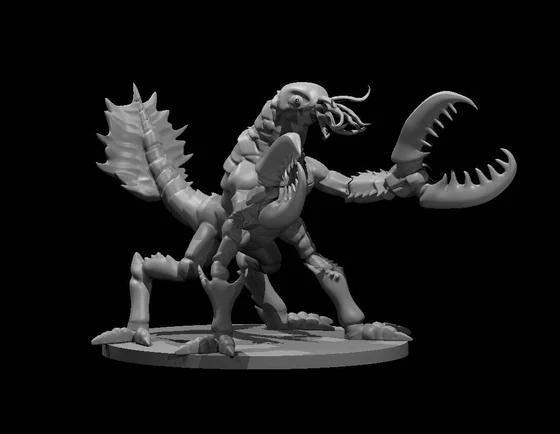
An aboleth combines an aquatic body with mental domination. The third-edition revised SRD describes a fish-like amphibian that swims with its tail and pulls itself over land with tentacles. It inhabits underground lakes and rivers, secretes slime and can use illusions to fight at a distance. That version distinguishes a tentacle-induced skin transformation from mucus that temporarily prevents air breathing. Their effects and remedies differ, so the two exposures are not one interchangeable infection.
In the 2014 fifth-edition profile, submerged lairs may occupy the ruins of earlier aboleth cities. Nearby surfaces become slippery, water is fouled and a projected image lets the creature speak and perceive remotely. Mucus causes temporary water-only breathing; tentacle disease instead develops after a delay into slimy skin that must remain moist and prevents recovery outside water. Telepathic contact can expose a creature's desires, while Enslave places a victim under control and enables distant communication. Injury gives the captive another chance to resist.
The revised 2025 block replaces these disease procedures with an underwater Mucus Cloud curse: affected skin becomes slimy, healing requires submersion and drying causes acid damage, but breathing remains possible in both air and water. Tentacles now grapple, while Consume Memories can obtain a humanoid victim's memories when that action reduces it to zero hit points. Dominate Mind provides direct control within sixty feet despite communication at any distance. Eldritch Restoration supplies a new body after destruction, in the Far Realm or a location chosen by the Dungeon Master. These mechanics describe a particular revision, rather than proving a shared anatomy or control range across every edition.
First appearances & development
The selected bibliography follows the 2000 Monster Manual into the third-edition revision and compares the 2014 and 2025 fifth-edition treatments. The revised SRD is a rules witness for its own edition, not a fresh reading of the complete 2000 book. No exhaustive original-debut history is established.
Canon & continuity
Official legacy and revised creature blocks were inspected alongside the older SRD's reproduced creature text. The profile compares specified abilities and habitat without borrowing reader comments, homebrew statistics or hypothetical physiology. A book's publication year identifies the edition; older material is not silently presented as the latest rules.
Selected bibliography
Documented works and useful reading. This is not a list of every appearance.
- 01
Monster Manual (2014)
Legacy fifth-edition creature procedures represented by the official online block.
- 02
Monster Manual (2000)
Initial third-edition bibliography; the inspected revised SRD is a later rules witness.
- 03
Monster Manual (2003)
Third-edition revised comparison, represented here by the creature's reproduced SRD account.
- 04
Monster Manual (2025)
Revised fifth-edition creature procedures, represented by the official online block.
Family & connections
A source-supported family tree or inspiration record has not yet been compiled for this profile. Related reading below indicates a connection in subject matter, not a proven lineage or creative influence.
References
Sources supporting this profile. Linked pages have their own scope and editorial standards.
- OfficialAboleth (Dungeons & Dragons) — official franchise guideResearch access: 2026-10-05
- OfficialAboleth — revised creature blockResearch access: 2026-10-05
- ReferenceAboleth — third-edition revised SRD reproductionResearch access: 2026-10-05
Image credits
A sourced illustration has not yet been added. This gap is included in the coverage record.