
NATURAL HISTORY · CATALOGUE RECORD
Rook
Corvus frugilegus Linnaeus, 1758
Source-backed taxonomic record
Accepted species in Catalogue of Life’s 11 September 2026 base release. This preserves the source classification and available supporting data; it is not a completed species monograph.
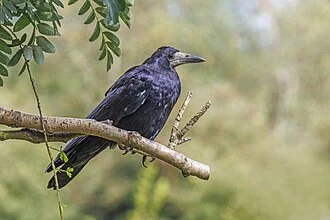
Rook (Corvus frugilegus), Lost Gardens of Heligan, Cornwall
Charles J. Sharp · CC BY-SA 4.0 · Image sourceProvider-generated thumbnail requested at 320 pixels; no local editing Local WebP display rendition; resized without cropping.
Open encyclopedia reference
The rook (Corvus frugilegus) is a member of the family Corvidae in the passerine order of birds. It is found in the Palearctic, its range extending from Scandinavia and western Europe to eastern Siberia. It is a large, gregarious, black-feathered bird, distinguished from similar species by the whitish featherless area on the face. Rooks nest collectively in the tops of tall trees, often close to farms or villages; the groups of nests are known as rookeries. Rooks are mainly resident birds, but the northernmost populations may migrate southwards to avoid the harshest winter conditions. The birds form flocks in winter, often in the company of other Corvus species or jackdaws. They return to their rookeries, and breeding takes place in spring. They forage on arable land and pasture, probing the ground with their strong bills and feeding largely on grubs and soil-based invertebrates, but they also consume cereals and other plant material. Historically, farmers have accused the birds of damaging their crops and have made efforts to drive them away or kill them.
Wikipedia contributors, Rook (bird); see linked history · CC BY-SA 4.0 . Plain-text lead excerpt, at most 180 words; no infobox or later sections Retrieved 2026-10-05T01:19:51.290660+00:00. This reference remains separate from the taxonomic record.
Identity & source status
- Scientific name
- Corvus frugilegus Linnaeus, 1758
- Name authority
- Linnaeus, 1758
- Common name
- Rook
- Rank
- species
- Accepted status
- accepted
- Kingdom
- Animalia
- Phylum
- Chordata
- Class
- Aves
- Order
- Passeriformes
- Family
- Corvidae
- Genus
- Corvus
- Extinction status
- Recorded extant
Classification family tree
Nested taxonomic groups from the source. This is not a direct-ancestor chain, a dated evolutionary tree or a phylogenetic reconstruction.
- domainEukaryota (Chatton, 1925) Whittaker & Margulis, 1978
- kingdomAnimalia
- phylumChordata
- subphylumVertebrata
- infraphylumGnathostomata
- parvphylumOsteichthyes
- megaclassTetrapoda
- classAves
- orderPasseriformes
- familyCorvidae Leach, 1820
- genusCorvus Linnaeus, 1758
- speciesCorvus frugilegus Linnaeus, 1758
Close classified relatives
These entries share the source’s genus, Corvus. They are not necessarily the closest relatives established by molecular evidence.
| Species | Classification | Source status |
|---|---|---|
| Brown-headed CrowCorvus fuscicapillus G. R. Gray, 1859 | CorvidaeChordata | Accepted speciesRecorded extant |
| Samar CrowCorvus samarensis Steere, 1890 | CorvidaeChordata | Accepted speciesRecorded extant |
| Philippine Jungle CrowCorvus philippinus (Bonaparte, 1853) | CorvidaeChordata | Accepted speciesRecorded extant |
| Little CrowCorvus bennetti North, 1901 | CorvidaeChordata | Accepted speciesRecorded extant |
| Northern RavenCorvus corax Linnaeus, 1758 | CorvidaeChordata | Accepted speciesRecorded extant |
| Hooded CrowCorvus cornix Linnaeus, 1758 | CorvidaeChordata | Accepted speciesRecorded extant |
| Carrion CrowCorvus corone Linnaeus, 1758 | CorvidaeChordata | Accepted speciesRecorded extant |
| Thick-billed RavenCorvus crassirostris Rüppell, 1836 | CorvidaeChordata | Accepted speciesRecorded extant |
| Chihuahuan RavenCorvus cryptoleucus Couch, 1854 | CorvidaeChordata | Accepted speciesRecorded extant |
| Indian Jungle CrowCorvus culminatus Sykes, 1832 | CorvidaeChordata | Accepted speciesRecorded extant |
| Somali CrowCorvus edithae Lort Phillips, 1895 | CorvidaeChordata | Accepted speciesRecorded extant |
| Flores CrowCorvus florensis Büttikofer, 1894 | CorvidaeChordata | Accepted speciesRecorded extant |
Documented distribution
Source distribution statements, not a complete range map. A listed locality is not necessarily a place of origin.
Southern Asia
Source literature & publication evidence
References attached to this source record, including nomenclatural citations where supplied. This is a selected bibliography; abbreviated citations remain in the source’s form.
- Linnaeus, & Carolus. (1758). Systema Naturae per Regna Tria Naturae, Secundum Classes, Ordines, Genera, Species, Cum Characteribus, Differentiis, Synonymis, Locis, 10th Edition, Vol. 1. Source fields: Taxon.tsv dwc:namePublishedIn, Taxon.tsv dcterms:references
Origins, evidence & remaining research
Name authority and publication references document nomenclature where the source supplies it. They do not establish evolutionary origins or the earliest fossil occurrence.
Specimen-level evidence, morphology, ecological research, phylogenetic studies, a comprehensive bibliography and a located literary passage have not yet been compiled for this record.
Dataset citation & attribution
This exact taxon in ChecklistBank · Catalogue of Life 2026-09-11
Catalogue of Life 2026-09-11; dataset 316321; doi:10.48580/dgz5n. https://creativecommons.org/licenses/by/4.0/ . Retrieved 5 October 2026.
Stable key: col:YNHT. Classification follows source parent identifiers. English common names may vary by region.