
NATURAL HISTORY · CATALOGUE RECORD
Egyptian Nightjar
Caprimulgus aegyptius M. H. K. Lichtenstein, 1823
Source-backed taxonomic record
Accepted species in Catalogue of Life’s 11 September 2026 base release. This preserves the source classification and available supporting data; it is not a completed species monograph.
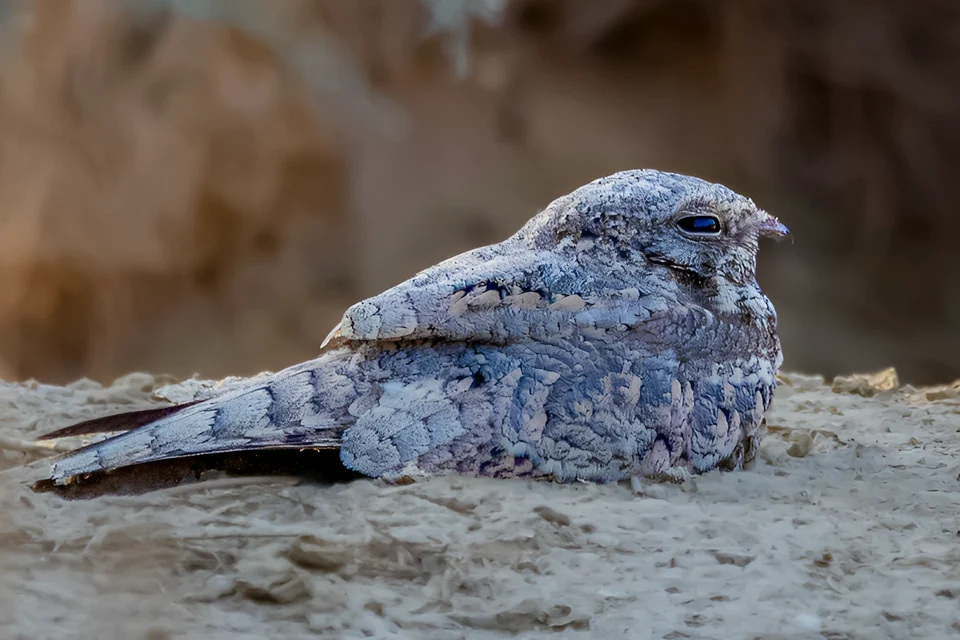
The Egyptian nightjar, known by its local name in Egypt (Abu al-Num) or (The Shepherd's Nightclub), is a medium-sized bird about (20-28 cm) long. It feeds on insects and has a distinct ability to change its flight path to be able to catch insects. It is difficult to watch because it is skilled at catching insects. Camouflage and chooses an environment suitable for camouflage away from human activity.
Morhaf kamal aljanee · CC BY-SA 4.0 · Image sourceProvider-generated thumbnail requested at 800 pixels; no local editing Local WebP display rendition; resized without cropping.
Open encyclopedia reference
The Egyptian nightjar (Caprimulgus aegyptius) is a medium-small nightjar which occurs in south west Asia and north Africa and winters in tropical Africa. This is a fairly common species with a wide distribution which faces no obvious threats apart from habitat destruction, so the International Union for Conservation of Nature has rated its conservation status as being of "least concern".
Wikipedia contributors, Egyptian nightjar; see linked history · CC BY-SA 4.0 . Plain-text lead excerpt, at most 180 words; no infobox or later sections Retrieved 2026-10-05T06:23:21.500948+00:00. This reference remains separate from the taxonomic record.
Identity & source status
- Scientific name
- Caprimulgus aegyptius M. H. K. Lichtenstein, 1823
- Name authority
- M. H. K. Lichtenstein, 1823
- Common name
- Egyptian Nightjar
- Rank
- species
- Accepted status
- accepted
- Kingdom
- Animalia
- Phylum
- Chordata
- Class
- Aves
- Order
- Caprimulgiformes
- Family
- Caprimulgidae
- Genus
- Caprimulgus
- Extinction status
- Recorded extant
Classification family tree
Nested taxonomic groups from the source. This is not a direct-ancestor chain, a dated evolutionary tree or a phylogenetic reconstruction.
- domainEukaryota (Chatton, 1925) Whittaker & Margulis, 1978
- kingdomAnimalia
- phylumChordata
- subphylumVertebrata
- infraphylumGnathostomata
- parvphylumOsteichthyes
- megaclassTetrapoda
- classAves
- orderCaprimulgiformes
- familyCaprimulgidae
- genusCaprimulgus Linnaeus, 1758
- speciesCaprimulgus aegyptius M. H. K. Lichtenstein, 1823
Close classified relatives
These entries share the source’s genus, Caprimulgus. They are not necessarily the closest relatives established by molecular evidence.
| Species | Classification | Source status |
|---|---|---|
| Jerdon's NightjarCaprimulgus atripennis Jerdon, 1845 | CaprimulgidaeChordata | Accepted speciesRecorded extant |
| Slender-tailed NightjarCaprimulgus clarus Reichenow, 1892 | CaprimulgidaeChordata | Accepted speciesRecorded extant |
| Long-tailed NightjarCaprimulgus climacurus Vieillot, 1824 | CaprimulgidaeChordata | Accepted speciesRecorded extant |
| Bonaparte's NightjarCaprimulgus concretus Bonaparte, 1850 | CaprimulgidaeChordata | Accepted speciesRecorded extant |
| Grey NightjarCaprimulgus indicus Latham, 1790 | CaprimulgidaeChordata | Accepted speciesRecorded extant |
| Grey NightjarCaprimulgus jotaka Temminck & Schlegel, 1845 | CaprimulgidaeChordata | Accepted speciesRecorded extant |
| Large-tailed NightjarCaprimulgus macrurus Horsfield, 1821 | CaprimulgidaeChordata | Accepted speciesRecorded extant |
| Sykes's NightjarCaprimulgus mahrattensis Sykes, 1832 | CaprimulgidaeChordata | Accepted speciesRecorded extant |
| Swamp NightjarCaprimulgus natalensis A. Smith, 1845 | CaprimulgidaeChordata | Accepted speciesRecorded extant |
| Palau NightjarCaprimulgus phalaena Hartlaub & Finsch, 1872 | CaprimulgidaeChordata | Accepted speciesRecorded extant |
| Montane NightjarCaprimulgus poliocephalus Rüppell, 1840 | CaprimulgidaeChordata | Accepted speciesRecorded extant |
| Nechisar NightjarCaprimulgus solala Ash Safford, Telfer Duckworth & Zewdie, 1995 | CaprimulgidaeChordata | Accepted speciesRecorded extant |
Documented distribution
Source distribution statements, not a complete range map. A listed locality is not necessarily a place of origin.
Europe & Northern Asia (excluding China)
Southern Asia
Source literature & publication evidence
References attached to this source record, including nomenclatural citations where supplied. This is a selected bibliography; abbreviated citations remain in the source’s form.
- https://www.itis.gov/servlet/SingleRpt/SingleRpt?search_topic=TSN&search_value=555572 Source fields: Taxon.tsv dwc:namePublishedIn, Taxon.tsv dcterms:references
Origins, evidence & remaining research
Name authority and publication references document nomenclature where the source supplies it. They do not establish evolutionary origins or the earliest fossil occurrence.
Specimen-level evidence, morphology, ecological research, phylogenetic studies, a comprehensive bibliography and a located literary passage have not yet been compiled for this record.
Dataset citation & attribution
This exact taxon in ChecklistBank · Catalogue of Life 2026-09-11
Catalogue of Life 2026-09-11; dataset 316321; doi:10.48580/dgz5n. https://creativecommons.org/licenses/by/4.0/ . Retrieved 5 October 2026.
Stable key: col:QSMD. Classification follows source parent identifiers. English common names may vary by region.