
NATURAL HISTORY · CATALOGUE RECORD
Japanese Serow
Capricornis crispus (Temminck, 1836)
Source-backed taxonomic record
Accepted species in Catalogue of Life’s 11 September 2026 base release. This preserves the source classification and available supporting data; it is not a completed species monograph.
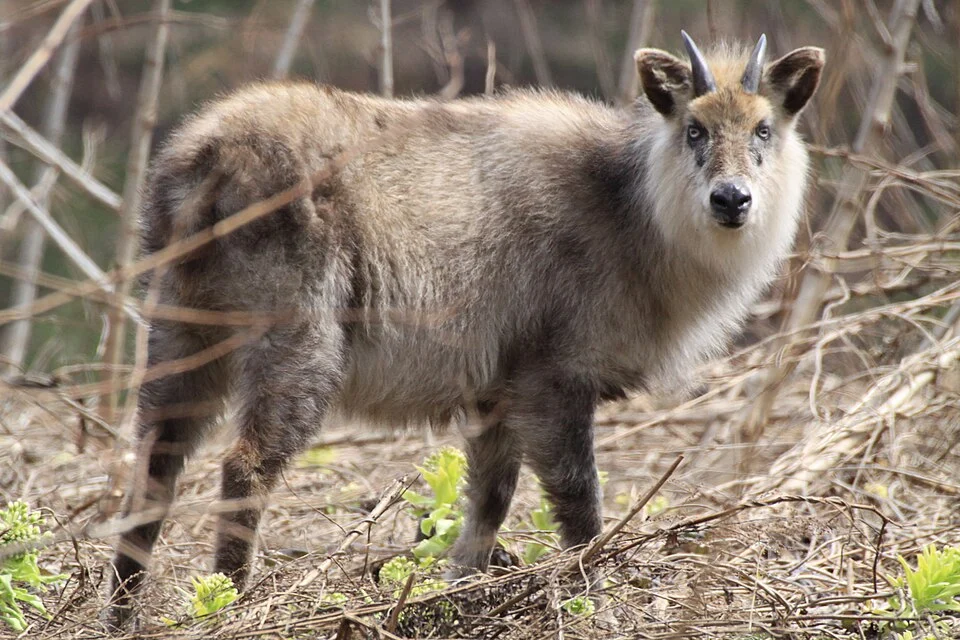
秋田県鹿角市尾去沢におけるニホンカモシカ
Kei hashi · CC BY-SA 3.0 · Image sourceProvider-generated thumbnail requested at 800 pixels; no local editing Local WebP display rendition; resized without cropping.
Open encyclopedia reference
The Japanese serow (氈鹿, kamoshika; lit. "coarse pelt deer") (Capricornis crispus) (羚羊) is a Japanese goat-antelope, an even-toed ungulate. It is found in dense woodland in Japan, primarily in northern and central Honshu. The serow is seen as a national symbol of Japan, and is subject to protection in conservation areas. Adult Japanese serow stand about 81 centimetres (32 in) tall and weigh 30–45 kg (66–99 lb). They are black to whitish, and colouring lightens in summer. The fur is very bushy, especially the tail. Both sexes have short, backwards-curving horns, and are difficult to distinguish by sight. Japanese serow are found in dense mountain forests where they eat leaves, shoots, and acorns. They are diurnal and feed in early mornings and late afternoons. Serows are solitary, or gather in couples or small family groups. The animal marks its territory with sweet-and-sour-smelling preorbital gland secretions, and males and females have separate territories that may overlap. In the mid-20th century, the Japanese serow was hunted to near-extinction.
Wikipedia contributors, Japanese serow; see linked history · CC BY-SA 4.0 . Plain-text lead excerpt, at most 180 words; no infobox or later sections Retrieved 2026-10-05T03:42:17.857803+00:00. This reference remains separate from the taxonomic record.
Identity & source status
- Scientific name
- Capricornis crispus (Temminck, 1836)
- Name authority
- (Temminck, 1836)
- Common name
- Japanese Serow
- Rank
- species
- Accepted status
- accepted
- Kingdom
- Animalia
- Phylum
- Chordata
- Class
- Mammalia
- Order
- Artiodactyla
- Family
- Bovidae
- Genus
- Capricornis
- Extinction status
- Recorded extant
Classification family tree
Nested taxonomic groups from the source. This is not a direct-ancestor chain, a dated evolutionary tree or a phylogenetic reconstruction.
- domainEukaryota (Chatton, 1925) Whittaker & Margulis, 1978
- kingdomAnimalia
- phylumChordata
- subphylumVertebrata
- infraphylumGnathostomata
- parvphylumOsteichthyes
- megaclassTetrapoda
- classMammalia Linnaeus, 1758
- subclassTheria Parker & Haswell, 1897
- infraclassEutheria Gill, 1872
- orderArtiodactyla Owen, 1848
- familyBovidae Gray, 1821
- subfamilyAntilopinae Gray, 1821
- tribeCaprini Gray, 1821
- genusCapricornis Ogilby, 1837
- speciesCapricornis crispus (Temminck, 1836)
Close classified relatives
These entries share the source’s genus, Capricornis. They are not necessarily the closest relatives established by molecular evidence.
| Species | Classification | Source status |
|---|---|---|
| Burmese Red SerowCapricornis rubidus Blyth, 1863 | BovidaeChordata | Accepted speciesRecorded extant |
| Indochinese SerowCapricornis maritimus Heude, 1888 | BovidaeChordata | Accepted speciesRecorded extant |
| Sumatran SerowCapricornis sumatraensis (Bechstein, 1799) | BovidaeChordata | Accepted speciesRecorded extant |
| Formosan SerowCapricornis swinhoei Gray, 1862 | BovidaeChordata | Accepted speciesRecorded extant |
| Himalayan SerowCapricornis thar (Hodgson, 1831) | BovidaeChordata | Accepted speciesRecorded extant |
Names & synonyms
Names explicitly linked to this accepted taxon in the source. Synonymy can change with revision.
| Recorded name | Source status |
|---|---|
| Antilope crispa Temminck, 1836 Temminck, 1836 | synonym |
| Naemorhedus crispus (Temminck, 1845) (Temminck, 1845) | synonym |
Documented distribution
Source distribution statements, not a complete range map. A listed locality is not necessarily a place of origin.
Source literature & publication evidence
References attached to this source record, including nomenclatural citations where supplied. This is a selected bibliography; abbreviated citations remain in the source’s form.
- https://www.itis.gov/servlet/SingleRpt/SingleRpt?search_topic=TSN&search_value=898230 Source fields: Taxon.tsv dwc:namePublishedIn, Taxon.tsv dcterms:references
Origins, evidence & remaining research
Name authority and publication references document nomenclature where the source supplies it. They do not establish evolutionary origins or the earliest fossil occurrence.
Specimen-level evidence, morphology, ecological research, phylogenetic studies, a comprehensive bibliography and a located literary passage have not yet been compiled for this record.
Dataset citation & attribution
This exact taxon in ChecklistBank · Catalogue of Life 2026-09-11
Catalogue of Life 2026-09-11; dataset 316321; doi:10.48580/dgz5n. https://creativecommons.org/licenses/by/4.0/ . Retrieved 5 October 2026.
Stable key: col:QSFS. Classification follows source parent identifiers. English common names may vary by region.