
NATURAL HISTORY · CATALOGUE RECORD
Domestic Goat
Capra hircus Linnaeus, 1758
Source-backed taxonomic record
Accepted species in Catalogue of Life’s 11 September 2026 base release. This preserves the source classification and available supporting data; it is not a completed species monograph.
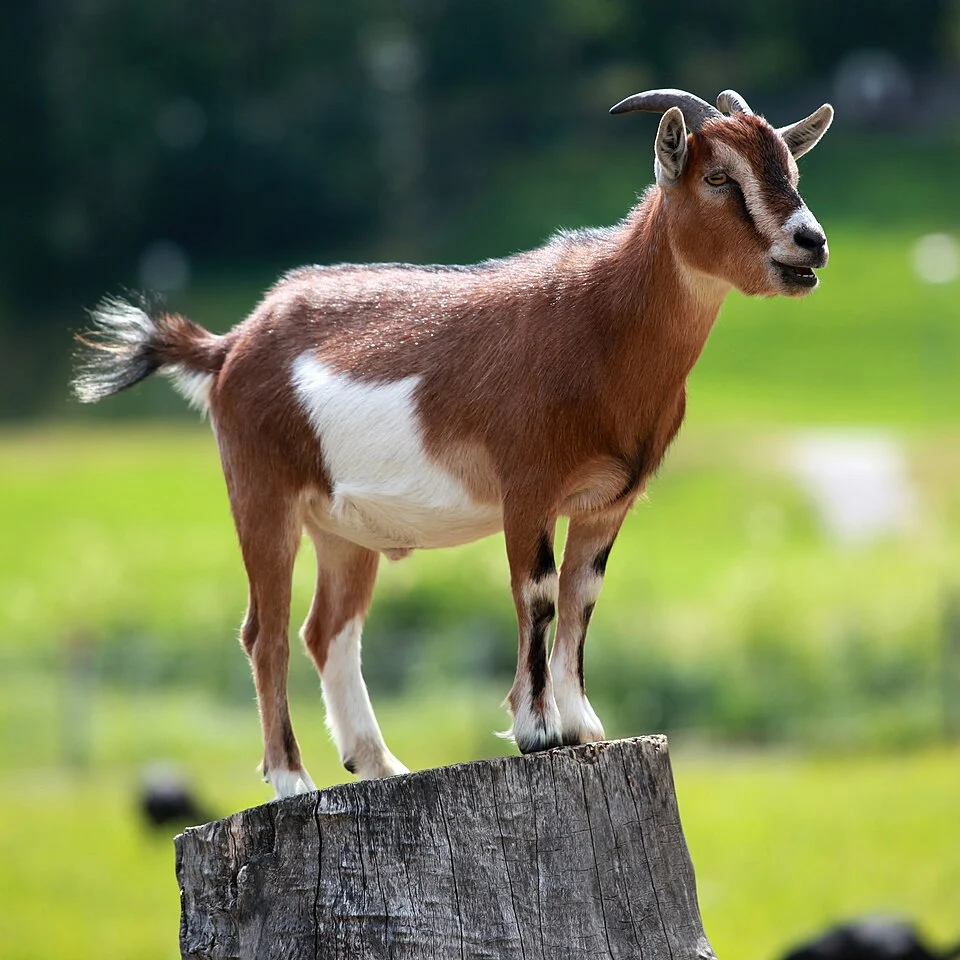
Goat, located in Fiesch, Valais (Switzerland).
Kuebi = Armin Kübelbeck · CC BY-SA 3.0 · Image sourceProvider-generated thumbnail requested at 800 pixels; no local editing Local WebP display rendition; resized without cropping.
Open encyclopedia reference
The goat or domestic goat (Capra hircus) is a species of goat-antelope that is mostly kept as livestock. It was domesticated from the wild goat (C. aegagrus) of Southwest Asia and Eastern Europe. The goat is a member of the family Bovidae and is closely related to the sheep. It was one of the first animals to be domesticated, in Iran around 10,000 years ago.
Goats have been used for milk, meat, wool, and skins across much of the world. Milk from goats is often turned into cheese. In 2022, there were more than 1.1 billion goats living in the world, of which 150 million were in India.
Goats feature in mythology, folklore, and religion in many parts of the world, including in the Greek myth of Amalthea, in the goats that pulled the chariot of the Norse god Thor, in the Scandinavian Yule goat, in Hinduism's goat-headed Daksha, in the Israelite ritual of the scapegoat, and in Christianity as a common depiction of Satan, among others.
Wikipedia contributors, Goat; see linked history · CC BY-SA 4.0 . Plain-text lead excerpt, at most 180 words; no infobox or later sections Retrieved 2026-10-05T03:03:43.497517+00:00. This reference remains separate from the taxonomic record.
Identity & source status
- Scientific name
- Capra hircus Linnaeus, 1758
- Name authority
- Linnaeus, 1758
- Common name
- Domestic Goat
- Rank
- species
- Accepted status
- accepted
- Kingdom
- Animalia
- Phylum
- Chordata
- Class
- Mammalia
- Order
- Artiodactyla
- Family
- Bovidae
- Genus
- Capra
- Extinction status
- Recorded extant
Classification family tree
Nested taxonomic groups from the source. This is not a direct-ancestor chain, a dated evolutionary tree or a phylogenetic reconstruction.
- domainEukaryota (Chatton, 1925) Whittaker & Margulis, 1978
- kingdomAnimalia
- phylumChordata
- subphylumVertebrata
- infraphylumGnathostomata
- parvphylumOsteichthyes
- megaclassTetrapoda
- classMammalia Linnaeus, 1758
- subclassTheria Parker & Haswell, 1897
- infraclassEutheria Gill, 1872
- orderArtiodactyla Owen, 1848
- familyBovidae Gray, 1821
- subfamilyAntilopinae Gray, 1821
- tribeCaprini Gray, 1821
- genusCapra Linnaeus, 1758
- speciesCapra hircus Linnaeus, 1758
Close classified relatives
These entries share the source’s genus, Capra. They are not necessarily the closest relatives established by molecular evidence.
| Species | Classification | Source status |
|---|---|---|
| WaliaCapra walie Rüppell, 1835 | BovidaeChordata | Accepted speciesRecorded extant |
| MarkhorCapra falconeri (Wagner, 1839) | BovidaeChordata | Accepted speciesRecorded extant |
| Iberian IbexCapra pyrenaica Schinz, 1838 | BovidaeChordata | Accepted speciesRecorded extant |
Names & synonyms
Names explicitly linked to this accepted taxon in the source. Synonymy can change with revision.
| Recorded name | Source status |
|---|---|
| Capra hircus chialtanensis Lydekker, 1913 Lydekker, 1913 | synonym |
| Capra hircus cretica Schinz, 1838 Schinz, 1838 | synonym |
| Capra hircus hircus Linnaeus, 1758 Linnaeus, 1758 | synonym |
| Capra hircus picta (Erhard, 1858) (Erhard, 1858) | synonym |
| Capra falconeri chiltanensis Lydekker, 1913 Lydekker, 1913 | synonym |
| Capra falconeri chialtanensis Lydekker, 1913 Lydekker, 1913 | synonym |
| Capra hircus jourensis Ivrea, 1899 Ivrea, 1899 | synonym |
Documented distribution
Source distribution statements, not a complete range map. A listed locality is not necessarily a place of origin.
Europe & Northern Asia (excluding China)
North America
Oceania
South America
Southern Asia
Source literature & publication evidence
References attached to this source record, including nomenclatural citations where supplied. This is a selected bibliography; abbreviated citations remain in the source’s form.
- https://www.itis.gov/servlet/SingleRpt/SingleRpt?search_topic=TSN&search_value=180715 Source fields: Taxon.tsv dwc:namePublishedIn, Taxon.tsv dcterms:references
Origins, evidence & remaining research
Name authority and publication references document nomenclature where the source supplies it. They do not establish evolutionary origins or the earliest fossil occurrence.
Specimen-level evidence, morphology, ecological research, phylogenetic studies, a comprehensive bibliography and a located literary passage have not yet been compiled for this record.
Dataset citation & attribution
This exact taxon in ChecklistBank · Catalogue of Life 2026-09-11
Catalogue of Life 2026-09-11; dataset 316321; doi:10.48580/dgz5n. https://creativecommons.org/licenses/by/4.0/ . Retrieved 5 October 2026.
Stable key: col:QS68. Classification follows source parent identifiers. English common names may vary by region.