
NATURAL HISTORY · CATALOGUE RECORD
Marsh Deer
Blastocerus dichotomus (Illiger, 1815)
Source-backed taxonomic record
Accepted species in Catalogue of Life’s 11 September 2026 base release. This preserves the source classification and available supporting data; it is not a completed species monograph.
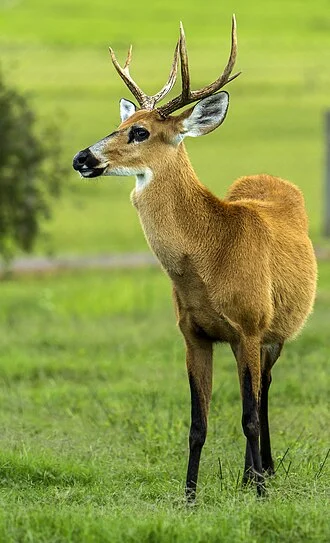
This surprisingly shy and secretive deer is actually the largest native deer species in South America. Marsh deer have large, primarily ornamental antlers, which are usually impressively forked, growing to about 60 centimetres in length and weighing, on average, about two kilograms. They are shed irregularly and may be retained for up to two years. Marsh deer also have well-developed hindquarters, making them good at jumping, which is the fastest way to move in water.The marsh deer has a shaggy, reddish chestnut coloured coat, with paler undersides of the neck and belly. The muzzle and lips are black, as are the lower legs. The eye is surrounded by a faint white ring and the large ears are lined with white hair. Marsh deer have long, broad hooves that are particularly adapted to the marshy environment, as they are joined by a special membrane and can spread out, giving the hooves a greater surface area, to prevent the deer from sinking into swampy ground.
Jonathan Wilkins · CC BY-SA 3.0 · Image sourceProvider-generated thumbnail requested at 320 pixels; no local editing Local WebP display rendition; resized without cropping.
Open encyclopedia reference
The marsh deer (Blastocerus dichotomus) is a species of deer native to South America. It is the largest living species of South American deer. It is the only species in the genus Blastocerus.
Wikipedia contributors, Marsh deer; see linked history · CC BY-SA 4.0 . Plain-text lead excerpt, at most 180 words; no infobox or later sections Retrieved 2026-10-05T01:52:06.614378+00:00. This reference remains separate from the taxonomic record.
Identity & source status
- Scientific name
- Blastocerus dichotomus (Illiger, 1815)
- Name authority
- (Illiger, 1815)
- Common name
- Marsh Deer
- Rank
- species
- Accepted status
- accepted
- Kingdom
- Animalia
- Phylum
- Chordata
- Class
- Mammalia
- Order
- Artiodactyla
- Family
- Cervidae
- Genus
- Blastocerus
- Extinction status
- Recorded extant
Classification family tree
Nested taxonomic groups from the source. This is not a direct-ancestor chain, a dated evolutionary tree or a phylogenetic reconstruction.
- domainEukaryota (Chatton, 1925) Whittaker & Margulis, 1978
- kingdomAnimalia
- phylumChordata
- subphylumVertebrata
- infraphylumGnathostomata
- parvphylumOsteichthyes
- megaclassTetrapoda
- classMammalia Linnaeus, 1758
- subclassTheria Parker & Haswell, 1897
- infraclassEutheria Gill, 1872
- orderArtiodactyla Owen, 1848
- familyCervidae Goldfuss, 1820
- subfamilyCapreolinae Brookes, 1828
- tribeOdocoileini Pocock, 1923
- genusBlastocerus Wagner, 1844
- speciesBlastocerus dichotomus (Illiger, 1815)
Close classified relatives
No other member of this genus is present in the selected snapshot.
Names & synonyms
Names explicitly linked to this accepted taxon in the source. Synonymy can change with revision.
| Recorded name | Source status |
|---|---|
| Cervus dichotomus Illiger, 1815 Illiger, 1815 | synonym |
Documented distribution
Source distribution statements, not a complete range map. A listed locality is not necessarily a place of origin.
Source literature & publication evidence
References attached to this source record, including nomenclatural citations where supplied. This is a selected bibliography; abbreviated citations remain in the source’s form.
- https://www.itis.gov/servlet/SingleRpt/SingleRpt?search_topic=TSN&search_value=625062 Source fields: Taxon.tsv dwc:namePublishedIn, Taxon.tsv dcterms:references
Origins, evidence & remaining research
Name authority and publication references document nomenclature where the source supplies it. They do not establish evolutionary origins or the earliest fossil occurrence.
Specimen-level evidence, morphology, ecological research, phylogenetic studies, a comprehensive bibliography and a located literary passage have not yet been compiled for this record.
Dataset citation & attribution
This exact taxon in ChecklistBank · Catalogue of Life 2026-09-11
Catalogue of Life 2026-09-11; dataset 316321; doi:10.48580/dgz5n. https://creativecommons.org/licenses/by/4.0/ . Retrieved 5 October 2026.
Stable key: col:M2J6. Classification follows source parent identifiers. English common names may vary by region.