
tusky eel
Aplatophis chauliodus Böhlke, 1956
Accepted species in Catalogue of Life’s 11 September 2026 base release. This preserves the source classification and available supporting data; it is not a completed species monograph.
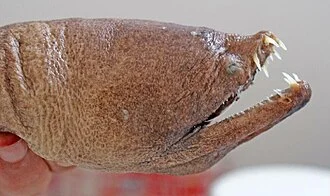
Image of Aplatophis chauliodus for the northeastern coast of Brazil
Cláudio Luis Santos Sampaio, Paulo Roberto Duarte Lopes, & Jailza Tavares de Oliveira-Silva · CC BY 4.0 · Image sourceProvider-generated thumbnail requested at 320 pixels; no local editing Local WebP display rendition; resized without cropping.
Open encyclopedia reference
Aplatophis chauliodus, the fangtooth snake-eel, also known as the tusky eel in Cuba and the United States, is an eel in the family Ophichthidae. It was described by James Erwin Böhlke in 1956. It is a marine, tropical eel known from the western Atlantic Ocean, including the Gulf of Mexico and French Guiana. It is also known to occur on the northeastern coast of Brasil. It dwells at a depth range of 33–91 m (100–300 ft), and dwells in both marine waters and brackish estuaries. It inhabits burrows on a permanent or semipermanent basis, and leaves its eyes and snout exposed. Males can reach a maximum total length of 84 cm (33 in). The fangtooth snake-eel's diet consists of bony fish and crustaceans.
Wikipedia contributors, Aplatophis chauliodus; see linked history · CC BY-SA 4.0 . Plain-text lead excerpt, at most 180 words; no infobox or later sections Retrieved 2026-10-05T02:49:10.444701+00:00. This reference remains separate from the taxonomic record.
Identity & source status
- Scientific name
- Aplatophis chauliodus Böhlke, 1956
- Name authority
- Böhlke, 1956
- Common name
- tusky eel
- Rank
- species
- Accepted status
- accepted
- Kingdom
- Animalia
- Phylum
- Chordata
- Class
- Teleostei
- Order
- Anguilliformes
- Family
- Ophichthidae
- Genus
- Aplatophis
- Extinction status
- Not supplied by this source
Source habitat flags: Marine: yes · Freshwater: no · Terrestrial: no. These do not form a complete habitat description.
Classification family tree
Nested taxonomic groups from the source. This is not a direct-ancestor chain, a dated evolutionary tree or a phylogenetic reconstruction.
- domainEukaryota (Chatton, 1925) Whittaker & Margulis, 1978
- kingdomAnimalia
- phylumChordata
- subphylumVertebrata
- infraphylumGnathostomata
- parvphylumOsteichthyes
- gigaclassActinopterygii
- superclassActinopteri
- classTeleostei
- orderAnguilliformes
- familyOphichthidae Günther, 1870
- subfamilyOphichthinae Günther, 1870
- genusAplatophis Böhlke, 1956
- speciesAplatophis chauliodus Böhlke, 1956
Close classified relatives
No other member of this genus is present in the selected snapshot.
Source literature & publication evidence
References attached to this source record, including nomenclatural citations where supplied. This is a selected bibliography; abbreviated citations remain in the source’s form.
- Böhlke, J. E. (1956). A small collection of new eels from western Puerto Rico. Notulae Naturae (Philadelphia), No. 289: 1–13. Source fields: Taxon.tsv dwc:namePublishedIn, Taxon.tsv dcterms:references
Origins, evidence & remaining research
Name authority and publication references document nomenclature where the source supplies it. They do not establish evolutionary origins or the earliest fossil occurrence.
Specimen-level evidence, morphology, ecological research, phylogenetic studies, a comprehensive bibliography and a located literary passage have not yet been compiled for this record.
Dataset citation & attribution
This exact taxon in ChecklistBank · Catalogue of Life 2026-09-11
Catalogue of Life 2026-09-11; dataset 316321; doi:10.48580/dgz5n. https://creativecommons.org/licenses/by/4.0/ . Retrieved 5 October 2026.
Stable key: col:FNNM. Classification follows source parent identifiers. English common names may vary by region.