
NATURAL HISTORY · CATALOGUE RECORD
Chinese Giant Salamander
Andrias davidianus (Blanchard, 1871)
Source-backed taxonomic record
Accepted species in Catalogue of Life’s 11 September 2026 base release. This preserves the source classification and available supporting data; it is not a completed species monograph.
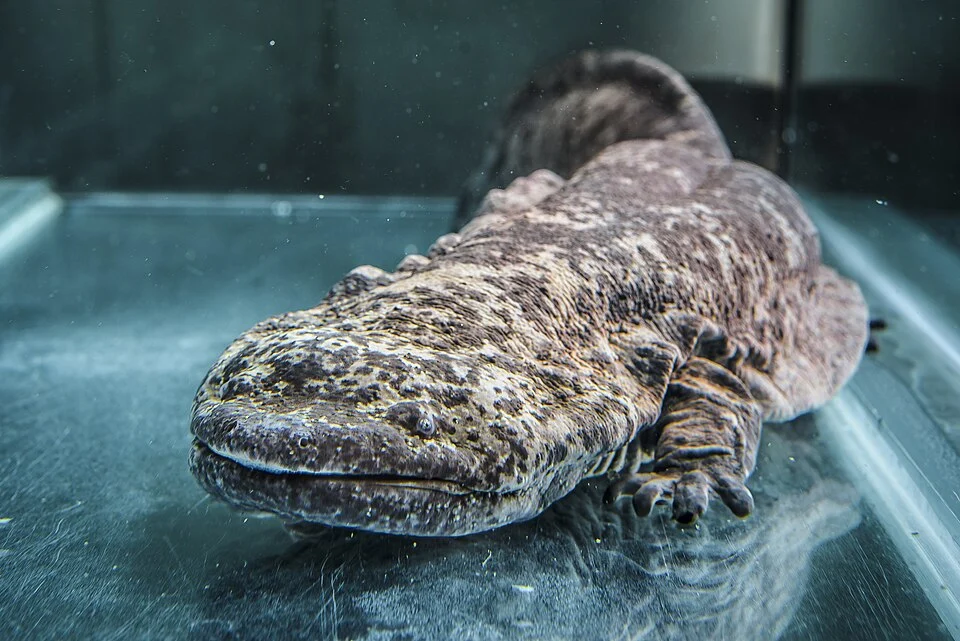
Chinese giant salamander in Prague Zoo
Petr Hamerník · CC BY-SA 4.0 · Image sourceProvider-generated thumbnail requested at 800 pixels; no local editing Local WebP display rendition; resized without cropping.
Open encyclopedia reference
The Chinese giant salamander (Andrias davidianus) is the largest salamander and the largest amphibian in the world. It is fully aquatic, and is endemic to rocky mountain streams and lakes in the Yangtze river basin of central China. It has also been introduced to Kyoto Prefecture in Japan, and possibly to Taiwan. It is considered critically endangered in the wild due to habitat loss, pollution, and overcollection, as it is considered a delicacy and used in traditional Chinese medicine. On farms in central China, it is extensively farmed and sometimes bred, although many of the salamanders on the farms are caught in the wild. It has been listed as one of the top-10 "focal species" in 2008 by the Evolutionarily Distinct and Globally Endangered project. The Chinese giant salamander is considered to be a "living fossil". Although protected under Chinese law and CITES Appendix I, the wild population has declined by more than an estimated 80% since the 1950s.
Wikipedia contributors, Chinese giant salamander; see linked history · CC BY-SA 4.0 . Plain-text lead excerpt, at most 180 words; no infobox or later sections Retrieved 2026-10-05T10:58:12.748840+00:00. This reference remains separate from the taxonomic record.
Identity & source status
- Scientific name
- Andrias davidianus (Blanchard, 1871)
- Name authority
- (Blanchard, 1871)
- Common name
- Chinese Giant Salamander
- Rank
- species
- Accepted status
- accepted
- Kingdom
- Animalia
- Phylum
- Chordata
- Class
- Amphibia
- Order
- Caudata
- Family
- Cryptobranchidae
- Genus
- Andrias
- Extinction status
- Recorded extant
Classification family tree
Nested taxonomic groups from the source. This is not a direct-ancestor chain, a dated evolutionary tree or a phylogenetic reconstruction.
- domainEukaryota (Chatton, 1925) Whittaker & Margulis, 1978
- kingdomAnimalia
- phylumChordata
- subphylumVertebrata
- infraphylumGnathostomata
- parvphylumOsteichthyes
- megaclassTetrapoda
- classAmphibia
- orderCaudata
- familyCryptobranchidae Fitzinger, 1826
- genusAndrias Tschudi, 1837
- speciesAndrias davidianus (Blanchard, 1871)
Close classified relatives
These entries share the source’s genus, Andrias. They are not necessarily the closest relatives established by molecular evidence.
| Species | Classification | Source status |
|---|---|---|
| Andrias jiangxiensis Lu, Wang, Chai, Yi, Peng, Murphy, Zhang & Che, 2022 | CryptobranchidaeChordata | Accepted speciesRecorded extant |
| Andrias sligoi (Boulenger, 1924) | CryptobranchidaeChordata | Accepted speciesRecorded extant |
| Andrias cheni Xu, Gong, Li, Jiang, Huang & Huang, 2023 | CryptobranchidaeChordata | Accepted speciesRecorded extant |
Names & synonyms
Names explicitly linked to this accepted taxon in the source. Synonymy can change with revision.
| Recorded name | Source status |
|---|---|
| Sieboldia davidi Blanchard, 1871 Blanchard, 1871 | synonym |
| Sieboldia davidiana Blanchard, 1871 Blanchard, 1871 | synonym |
| Megalobatrachus japonicus davidi (Blanchard, 1871) (Blanchard, 1871) | synonym |
| Andrias scheuchzeri davidiana (Blanchard, 1871) (Blanchard, 1871) | synonym |
| Andrias davidianus davidianus (Blanchard, 1871) (Blanchard, 1871) | synonym |
| Megalobatrachus japonicus davidianus (Blanchard, 1871) (Blanchard, 1871) | synonym |
| Megalobatrachus davidianus (Blanchard, 1871) (Blanchard, 1871) | synonym |
| Cryptobranchus davidianus (Blanchard, 1871) (Blanchard, 1871) | synonym |
Documented distribution
Source distribution statements, not a complete range map. A listed locality is not necessarily a place of origin.
Source literature & publication evidence
References attached to this source record, including nomenclatural citations where supplied. This is a selected bibliography; abbreviated citations remain in the source’s form.
- https://www.itis.gov/servlet/SingleRpt/SingleRpt?search_topic=TSN&search_value=202085 Source fields: Taxon.tsv dwc:namePublishedIn, Taxon.tsv dcterms:references
Origins, evidence & remaining research
Name authority and publication references document nomenclature where the source supplies it. They do not establish evolutionary origins or the earliest fossil occurrence.
Specimen-level evidence, morphology, ecological research, phylogenetic studies, a comprehensive bibliography and a located literary passage have not yet been compiled for this record.
Dataset citation & attribution
This exact taxon in ChecklistBank · Catalogue of Life 2026-09-11
Catalogue of Life 2026-09-11; dataset 316321; doi:10.48580/dgz5n. https://creativecommons.org/licenses/by/4.0/ . Retrieved 5 October 2026.
Stable key: col:DTJQ. Classification follows source parent identifiers. English common names may vary by region.