
Alytes obstetricans (Laurenti, 1768)
Accepted species in Catalogue of Life’s 11 September 2026 base release. This preserves the source classification and available supporting data; it is not a completed species monograph.
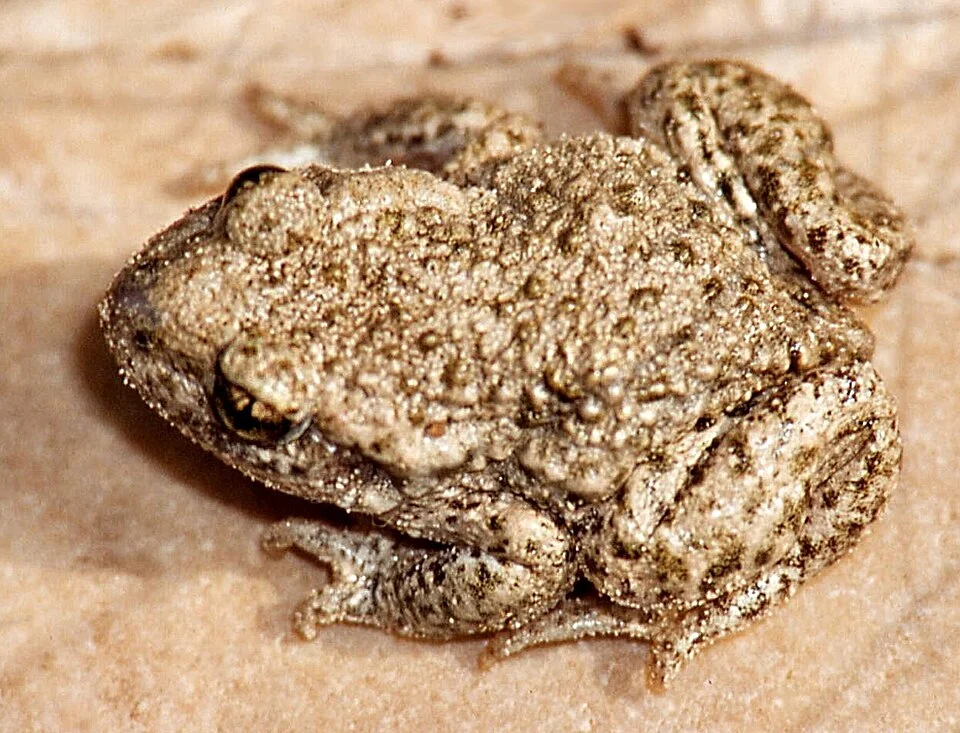
Dorsal side of a male Common Midwife Toad (Alytes obstetricans).
Christian Fischer · CC BY-SA 3.0 · Image sourceProvider-generated thumbnail requested at 800 pixels; no local editing Local WebP display rendition; resized without cropping.
Open encyclopedia reference
The common midwife toad (Alytes obstetricans) is a species of midwife frog in the family Alytidae (formerly Discoglossidae). It is found in Belgium, France, Germany, Luxembourg, the Netherlands, Portugal, Spain, Switzerland, and the United Kingdom (although, in the latter, only as an introduction). Like other members of its genus (Alytes), the male toad carries the eggs around entwined on his back and thighs until they are ready to hatch.
Its natural habitats are temperate forests, dry forests, shrubland, rivers, freshwater lakes, freshwater marshes, temperate desert, arable land, pastureland and urban areas. It is threatened by habitat loss.
Wikipedia contributors, Common midwife toad; see linked history · CC BY-SA 4.0 . Plain-text lead excerpt, at most 180 words; no infobox or later sections Retrieved 2026-10-05T15:04:45.264543+00:00. This reference remains separate from the taxonomic record.
Identity & source status
- Scientific name
- Alytes obstetricans (Laurenti, 1768)
- Name authority
- (Laurenti, 1768)
- Rank
- species
- Accepted status
- accepted
- Kingdom
- Animalia
- Phylum
- Chordata
- Class
- Amphibia
- Order
- Anura
- Family
- Alytidae
- Genus
- Alytes
- Extinction status
- Recorded extant
Classification family tree
Nested taxonomic groups from the source. This is not a direct-ancestor chain, a dated evolutionary tree or a phylogenetic reconstruction.
- domainEukaryota (Chatton, 1925) Whittaker & Margulis, 1978
- kingdomAnimalia
- phylumChordata
- subphylumVertebrata
- infraphylumGnathostomata
- parvphylumOsteichthyes
- megaclassTetrapoda
- classAmphibia
- orderAnura
- familyAlytidae Fitzinger, 1843
- genusAlytes Wagler, 1830
- speciesAlytes obstetricans (Laurenti, 1768)
Close classified relatives
These entries share the source’s genus, Alytes. They are not necessarily the closest relatives established by molecular evidence.
| Species | Classification | Source status |
|---|---|---|
| Alytes cisternasii Boscá, 1879 | AlytidaeChordata | Accepted speciesRecorded extant |
| Alytes dickhilleni Arntzen & García-París, 1995 | AlytidaeChordata | Accepted speciesRecorded extant |
| Alytes almogavarii Arntzen & García-París, 1995 | AlytidaeChordata | Accepted speciesRecorded extant |
Names & synonyms
Names explicitly linked to this accepted taxon in the source. Synonymy can change with revision.
| Recorded name | Source status |
|---|---|
| Alytes campanisonus boscai Lataste, 1879 Lataste, 1879 | synonym |
| Obstetricans vulgaris Dugès, 1834 Dugès, 1834 | synonym |
| Bombinator obstetricans (Laurenti, 1768) (Laurenti, 1768) | synonym |
| Alytes obstetricans lusitanicus Ambu, Martínez-Solano & Dufresnes, 2024 Ambu, Martínez-Solano & Dufresnes, 2024 | synonym |
| Alytes obstetricans boscai Lataste, 1879 Lataste, 1879 | synonym |
| Alytes obstetricans pertinax García-París & Martínez-Solano, 2001 García-París & Martínez-Solano, 2001 | synonym |
| Rana obstetricans (Laurenti, 1768) (Laurenti, 1768) | synonym |
| Bufo obstetricans Laurenti, 1768 Laurenti, 1768 | synonym |
Source literature & publication evidence
References attached to this source record, including nomenclatural citations where supplied. This is a selected bibliography; abbreviated citations remain in the source’s form.
- https://www.itis.gov/servlet/SingleRpt/SingleRpt?search_topic=TSN&search_value=662327 Source fields: Taxon.tsv dwc:namePublishedIn, Taxon.tsv dcterms:references
Origins, evidence & remaining research
Name authority and publication references document nomenclature where the source supplies it. They do not establish evolutionary origins or the earliest fossil occurrence.
Specimen-level evidence, morphology, ecological research, phylogenetic studies, a comprehensive bibliography and a located literary passage have not yet been compiled for this record.
Dataset citation & attribution
This exact taxon in ChecklistBank · Catalogue of Life 2026-09-11
Catalogue of Life 2026-09-11; dataset 316321; doi:10.48580/dgz5n. https://creativecommons.org/licenses/by/4.0/ . Retrieved 5 October 2026.
Stable key: col:CCWK. Classification follows source parent identifiers. English common names may vary by region.