
NATURAL HISTORY · CATALOGUE RECORD
Great Myna
Acridotheres grandis F. Moore, 1858
Source-backed taxonomic record
Accepted species in Catalogue of Life’s 11 September 2026 base release. This preserves the source classification and available supporting data; it is not a completed species monograph.
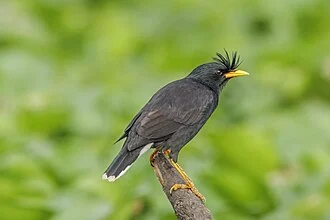
Great myna (Acridotheres grandis), Prek Toal Biosphere Reserve, Cambodia
Charles J. Sharp · CC BY-SA 4.0 · Image sourceProvider-generated thumbnail requested at 320 pixels; no local editing Local WebP display rendition; resized without cropping.
Open encyclopedia reference
The great myna (Acridotheres grandis), also known as the white-vented myna, is a species of starling in the family Sturnidae. Its range extends from Sikkim across Northeast India and Indochina.
Wikipedia contributors, Great myna; see linked history · CC BY-SA 4.0 . Plain-text lead excerpt, at most 180 words; no infobox or later sections Retrieved 2026-10-05T01:57:58.604811+00:00. This reference remains separate from the taxonomic record.
Identity & source status
- Scientific name
- Acridotheres grandis F. Moore, 1858
- Name authority
- F. Moore, 1858
- Common name
- Great Myna
- Rank
- species
- Accepted status
- accepted
- Kingdom
- Animalia
- Phylum
- Chordata
- Class
- Aves
- Order
- Passeriformes
- Family
- Sturnidae
- Genus
- Acridotheres
- Extinction status
- Recorded extant
Classification family tree
Nested taxonomic groups from the source. This is not a direct-ancestor chain, a dated evolutionary tree or a phylogenetic reconstruction.
- domainEukaryota (Chatton, 1925) Whittaker & Margulis, 1978
- kingdomAnimalia
- phylumChordata
- subphylumVertebrata
- infraphylumGnathostomata
- parvphylumOsteichthyes
- megaclassTetrapoda
- classAves
- orderPasseriformes
- familySturnidae Rafinesque, 1815
- genusAcridotheres Vieillot, 1816
- speciesAcridotheres grandis F. Moore, 1858
Close classified relatives
These entries share the source’s genus, Acridotheres. They are not necessarily the closest relatives established by molecular evidence.
| Species | Classification | Source status |
|---|---|---|
| Collared MynaAcridotheres albocinctus Godwin-Austen & Walden, 1875 | SturnidaeChordata | Accepted speciesRecorded extant |
| Burmese MynaAcridotheres burmannicus (Jerdon, 1862) | SturnidaeChordata | Accepted speciesRecorded extant |
| Pale-bellied MynaAcridotheres cinereus Bonaparte, 1850 | SturnidaeChordata | Accepted speciesRecorded extant |
| Crested MynaAcridotheres cristatellus (Linnaeus, 1758) | SturnidaeChordata | Accepted speciesRecorded extant |
| Bank MynaAcridotheres ginginianus (Latham, 1790) | SturnidaeChordata | Accepted speciesRecorded extant |
| Javan MynaAcridotheres javanicus Cabanis, 1851 | SturnidaeChordata | Accepted speciesRecorded extant |
Documented distribution
Source distribution statements, not a complete range map. A listed locality is not necessarily a place of origin.
Source literature & publication evidence
References attached to this source record, including nomenclatural citations where supplied. This is a selected bibliography; abbreviated citations remain in the source’s form.
- Moore, & Frederic. (1858). A Catalogue of the Birds in the Museum of the Hononrable East-India Company, Vol. 2. Source fields: Taxon.tsv dwc:namePublishedIn, Taxon.tsv dcterms:references
Origins, evidence & remaining research
Name authority and publication references document nomenclature where the source supplies it. They do not establish evolutionary origins or the earliest fossil occurrence.
Specimen-level evidence, morphology, ecological research, phylogenetic studies, a comprehensive bibliography and a located literary passage have not yet been compiled for this record.
Dataset citation & attribution
This exact taxon in ChecklistBank · Catalogue of Life 2026-09-11
Catalogue of Life 2026-09-11; dataset 316321; doi:10.48580/dgz5n. https://creativecommons.org/licenses/by/4.0/ . Retrieved 5 October 2026.
Stable key: col:9KHQ. Classification follows source parent identifiers. English common names may vary by region.