
NATURAL HISTORY · CATALOGUE RECORD
Polar Bear
Ursus maritimus Phipps, 1774
Source-backed taxonomic record
Accepted species in Catalogue of Life’s 11 September 2026 base release. This preserves the source classification and available supporting data; it is not a completed species monograph.
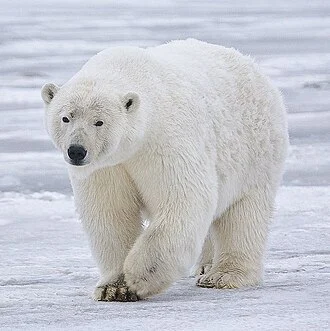
Female polar bear (Ursus maritimus) near Kaktovik, Barter Island, Alaska.
Alan Wilson · CC BY-SA 3.0 · Image sourceProvider-generated thumbnail requested at 320 pixels; no local editing Local WebP display rendition; resized without cropping.
Open encyclopedia reference
The polar bear (Ursus maritimus) is a large bear native to the Arctic and nearby areas. It is closely related to the brown bear, and the two species can interbreed. The polar bear is the largest extant species of bear and land carnivore by body mass, with adult males weighing 300–800 kg (660–1,760 lb). The species is sexually dimorphic, as adult females are much smaller. The polar bear is white or yellowish-furred with black skin and a thick layer of fat. It is more slender than the brown bear, with a narrower skull, longer neck and lower shoulder hump. Its teeth are sharper and more adapted to cutting meat. The paws are large and allow the bear to walk on ice and paddle in the water. Polar bears are both terrestrial and pagophilic (ice-living) and are considered marine mammals because of their dependence on marine ecosystems. They prefer the annual sea ice but live on land when the ice melts in the summer. They are mostly carnivorous and specialized for preying on seals, particularly ringed seals.
Wikipedia contributors, Polar bear; see linked history · CC BY-SA 4.0 . Plain-text lead excerpt, at most 180 words; no infobox or later sections Retrieved 2026-10-05T01:19:40.020239+00:00. This reference remains separate from the taxonomic record.
Identity & source status
- Scientific name
- Ursus maritimus Phipps, 1774
- Name authority
- Phipps, 1774
- Common name
- Polar Bear
- Rank
- species
- Accepted status
- accepted
- Kingdom
- Animalia
- Phylum
- Chordata
- Class
- Mammalia
- Order
- Carnivora
- Family
- Ursidae
- Genus
- Ursus
- Extinction status
- Recorded extant
Classification family tree
Nested taxonomic groups from the source. This is not a direct-ancestor chain, a dated evolutionary tree or a phylogenetic reconstruction.
- domainEukaryota (Chatton, 1925) Whittaker & Margulis, 1978
- kingdomAnimalia
- phylumChordata
- subphylumVertebrata
- infraphylumGnathostomata
- parvphylumOsteichthyes
- megaclassTetrapoda
- classMammalia Linnaeus, 1758
- subclassTheria Parker & Haswell, 1897
- infraclassEutheria Gill, 1872
- orderCarnivora Bowdich, 1821
- suborderCaniformia Kretzoi, 1938
- familyUrsidae G. Fischer von Waldheim, 1817
- genusUrsus Linnaeus, 1758
- speciesUrsus maritimus Phipps, 1774
Close classified relatives
These entries share the source’s genus, Ursus. They are not necessarily the closest relatives established by molecular evidence.
| Species | Classification | Source status |
|---|---|---|
| Asian Black BearUrsus thibetanus G. [Baron] Cuvier, 1823 | UrsidaeChordata | Accepted speciesRecorded extant |
| Brown BearUrsus arctos Linnaeus, 1758 | UrsidaeChordata | Accepted speciesRecorded extant |
| American Black BearUrsus americanus Pallas, 1780 | UrsidaeChordata | Accepted speciesRecorded extant |
Names & synonyms
Names explicitly linked to this accepted taxon in the source. Synonymy can change with revision.
| Recorded name | Source status |
|---|---|
| Ursus maritimus marinus Pallas, 1776 Pallas, 1776 | synonym |
| Ursus maritimus maritimus Phipps, 1774 Phipps, 1774 | synonym |
| Ursus polaris Shaw, 1792 Shaw, 1792 | synonym |
| Thalassarctos eogroenlandicus Knottnerus-Meyer, 1908 Knottnerus-Meyer, 1908 | synonym |
| Thalassarctos jenaensis Knottnerus-Meyer, 1908 Knottnerus-Meyer, 1908 | synonym |
| Thalassarctos labradorensis Knottnerus-Meyer, 1908 Knottnerus-Meyer, 1908 | synonym |
| Ursus marinus Pallas, 1776 Pallas, 1776 | synonym |
| Thalassarctos maritimus groenlandicus Birula, 1932 Birula, 1932 | synonym |
Documented distribution
Source distribution statements, not a complete range map. A listed locality is not necessarily a place of origin.
North America
Source literature & publication evidence
References attached to this source record, including nomenclatural citations where supplied. This is a selected bibliography; abbreviated citations remain in the source’s form.
- https://www.itis.gov/servlet/SingleRpt/SingleRpt?search_topic=TSN&search_value=180542 Source fields: Taxon.tsv dwc:namePublishedIn, Taxon.tsv dcterms:references
Origins, evidence & remaining research
Name authority and publication references document nomenclature where the source supplies it. They do not establish evolutionary origins or the earliest fossil occurrence.
Specimen-level evidence, morphology, ecological research, phylogenetic studies, a comprehensive bibliography and a located literary passage have not yet been compiled for this record.
Dataset citation & attribution
This exact taxon in ChecklistBank · Catalogue of Life 2026-09-11
Catalogue of Life 2026-09-11; dataset 316321; doi:10.48580/dgz5n. https://creativecommons.org/licenses/by/4.0/ . Retrieved 5 October 2026.
Stable key: col:7F2J9. Classification follows source parent identifiers. English common names may vary by region.