
NATURAL HISTORY · CATALOGUE RECORD
Diademed Sifaka
Propithecus diadema Bennett, 1832
Source-backed taxonomic record
Accepted species in Catalogue of Life’s 11 September 2026 base release. This preserves the source classification and available supporting data; it is not a completed species monograph.
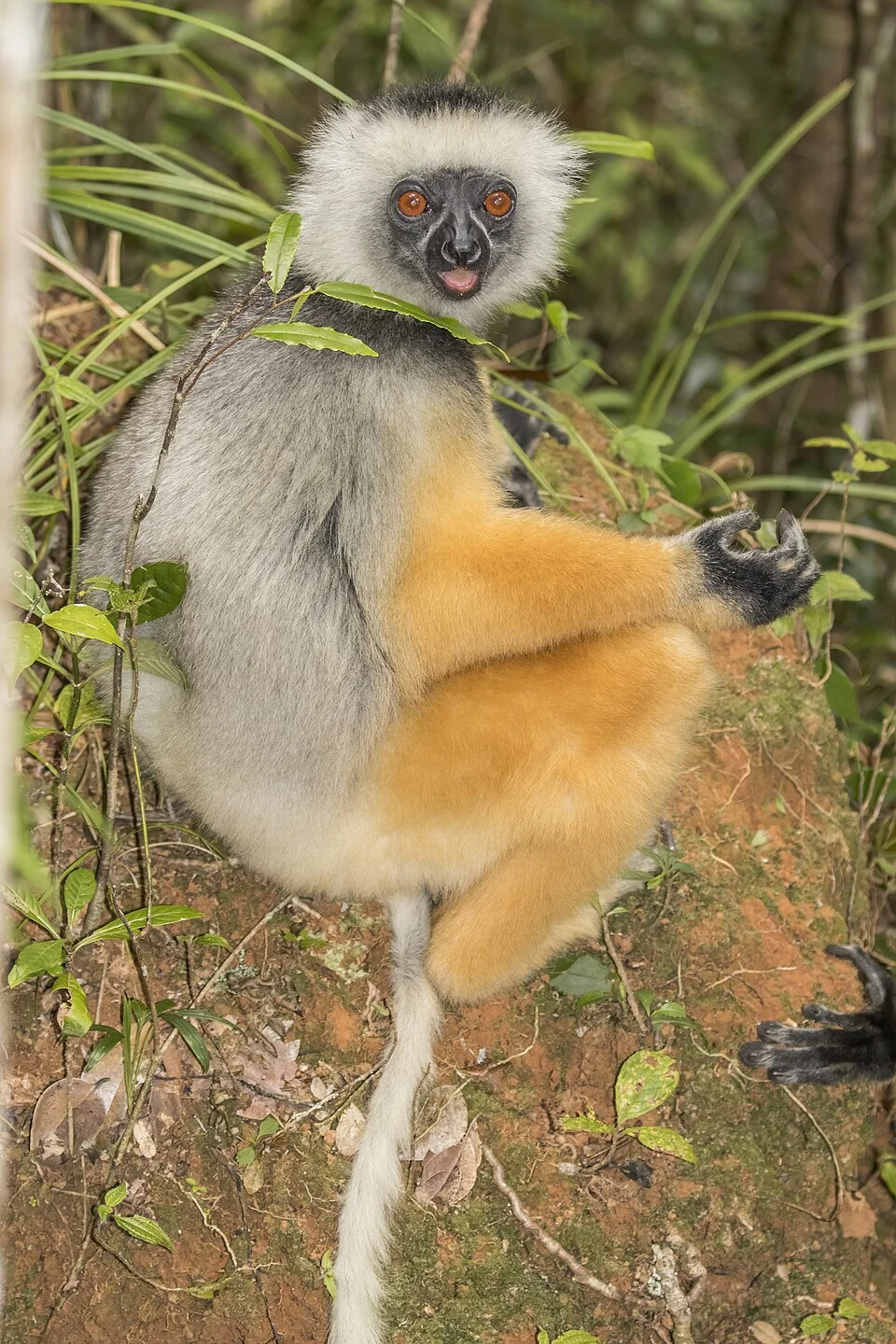
Diademed sifaka (Propithecus diadema), Analamazaotra Special Reserve, Madagascar
Charles J. Sharp · CC BY-SA 4.0 · Image sourceProvider-generated thumbnail requested at 800 pixels; no local editing Local WebP display rendition; resized without cropping.
Open encyclopedia reference
The diademed sifaka (Propithecus diadema), or diademed simpona, is a critically endangered sifaka endemic to rainforests in eastern Madagascar. Along with the indri, it is one of the two largest living lemurs, with an average weight of 6.5 kg (14 lb) and an average length of 105 cm (41 in), half of which is its tail. It has a striking appearance that features a silky coat of brightly colored limbs that contrast with black, white, and gray shades on its torso, head, and tail. Russell Mittermeier, one of the contemporary authorities on lemurs, describes the diademed sifaka as "one of the most colorful and attractive of all the lemurs." The diademed sifaka is a diurnal, arboreal folivore that seasonally augments its diet with a variety of foods, including seeds, fruit, and flowers. It lives in small, territorial, female-dominated troops of two to nine individuals, which consist of infants, juveniles, and adults of both sexes. Every day, a diademed sifaka patrols the boundaries of its home range with its fellows, depositing scent markings at contested trees along the way.
Wikipedia contributors, Diademed sifaka; see linked history · CC BY-SA 4.0 . Plain-text lead excerpt, at most 180 words; no infobox or later sections Retrieved 2026-10-05T04:26:20.460861+00:00. This reference remains separate from the taxonomic record.
Identity & source status
- Scientific name
- Propithecus diadema Bennett, 1832
- Name authority
- Bennett, 1832
- Common name
- Diademed Sifaka
- Rank
- species
- Accepted status
- accepted
- Kingdom
- Animalia
- Phylum
- Chordata
- Class
- Mammalia
- Order
- Primates
- Family
- Indriidae
- Genus
- Propithecus
- Extinction status
- Recorded extant
Classification family tree
Nested taxonomic groups from the source. This is not a direct-ancestor chain, a dated evolutionary tree or a phylogenetic reconstruction.
- domainEukaryota (Chatton, 1925) Whittaker & Margulis, 1978
- kingdomAnimalia
- phylumChordata
- subphylumVertebrata
- infraphylumGnathostomata
- parvphylumOsteichthyes
- megaclassTetrapoda
- classMammalia Linnaeus, 1758
- subclassTheria Parker & Haswell, 1897
- infraclassEutheria Gill, 1872
- orderPrimates Linnaeus, 1758
- suborderStrepsirrhini É. Geoffroy Saint-Hilaire, 1812
- infraorderLemuriformes Gray, 1821
- superfamilyLemuroidea Gray, 1821
- familyIndriidae Burnett, 1828
- genusPropithecus Bennett, 1832
- speciesPropithecus diadema Bennett, 1832
Close classified relatives
These entries share the source’s genus, Propithecus. They are not necessarily the closest relatives established by molecular evidence.
| Species | Classification | Source status |
|---|---|---|
| Perrier's SifakaPropithecus perrieri Lavauden, 1931 | IndriidaeChordata | Accepted speciesRecorded extant |
| Coquerel's SifakaPropithecus coquereli (Grandidier, 1867) | IndriidaeChordata | Accepted speciesRecorded extant |
| Crowned SifakaPropithecus coronatus A. Milne-Edwards, 1871 | IndriidaeChordata | Accepted speciesRecorded extant |
Names & synonyms
Names explicitly linked to this accepted taxon in the source. Synonymy can change with revision.
| Recorded name | Source status |
|---|---|
| Indris albus Vinson, 1862 Vinson, 1862 | synonym |
| Macromerus typicus A. Smith, 1833 A. Smith, 1833 | synonym |
Documented distribution
Source distribution statements, not a complete range map. A listed locality is not necessarily a place of origin.
Source literature & publication evidence
References attached to this source record, including nomenclatural citations where supplied. This is a selected bibliography; abbreviated citations remain in the source’s form.
- https://www.itis.gov/servlet/SingleRpt/SingleRpt?search_topic=TSN&search_value=572883 Source fields: Taxon.tsv dwc:namePublishedIn, Taxon.tsv dcterms:references
Origins, evidence & remaining research
Name authority and publication references document nomenclature where the source supplies it. They do not establish evolutionary origins or the earliest fossil occurrence.
Specimen-level evidence, morphology, ecological research, phylogenetic studies, a comprehensive bibliography and a located literary passage have not yet been compiled for this record.
Dataset citation & attribution
This exact taxon in ChecklistBank · Catalogue of Life 2026-09-11
Catalogue of Life 2026-09-11; dataset 316321; doi:10.48580/dgz5n. https://creativecommons.org/licenses/by/4.0/ . Retrieved 5 October 2026.
Stable key: col:77XPY. Classification follows source parent identifiers. English common names may vary by region.