
NATURAL HISTORY · CATALOGUE RECORD
South Georgia Diving Petrel
Pelecanoides georgicus Murphy & Harper, 1916
Source-backed taxonomic record
Accepted species in Catalogue of Life’s 11 September 2026 base release. This preserves the source classification and available supporting data; it is not a completed species monograph.
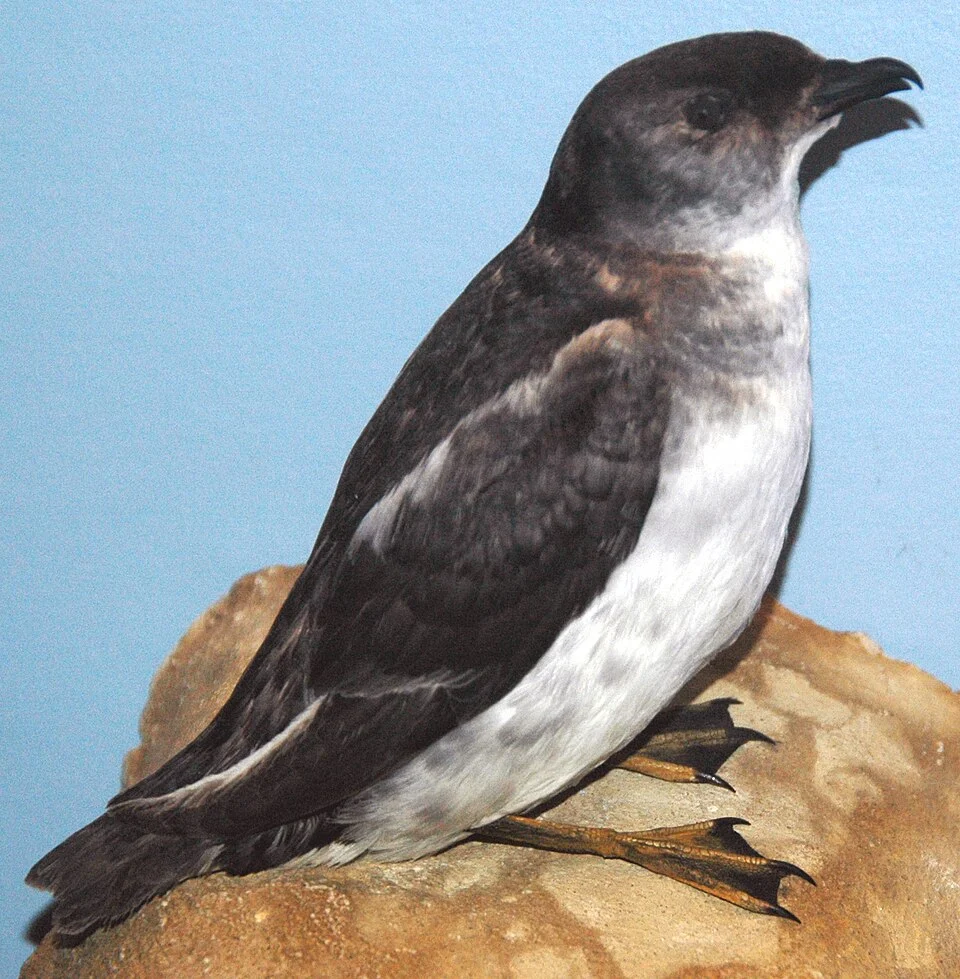
Pelecanoides georgicus Murphy & Harper, 1916 - South Georgian diving-petrel (mount, Field Museum of Natural History, Chicago, Illinois, USA). Classification: Animalia, Chordata, Vertebrata, Aves, Procellariiformes, Pelecanoididae Birds are small to large, warm-blooded, egg-laying, feathered, bipedal vertebrates capable of powered flight (although some are secondarily flightless). Many scientists characterize birds as dinosaurs, but this is consequence of the physical structure of evolutionary diagrams. Birds aren’t dinosaurs. They’re birds. The logic & rationale that some use to justify statements such as “birds are dinosaurs” is the same logic & rationale that results in saying “vertebrates are echinoderms”. Well, no one says the latter. No one should say the former, either. However, birds are evolutionarily derived from theropod dinosaurs. Birds first appeared in the Triassic or Jurassic, depending on which avian paleontologist you ask. They inhabit a wide variety of terrestrial and surface marine environments, and exhibit considerable variation in behaviors and diets.
James St. John · CC BY 2.0 · Image sourceProvider-generated thumbnail requested at 800 pixels; no local editing Local WebP display rendition; resized without cropping.
Open encyclopedia reference
The South Georgia diving petrel or Georgian diving-petrel (Pelecanoides georgicus) is one of five very similar small auk-like diving petrels of the southern oceans. It is native to the South Atlantic and islands of the southern Indian Ocean and south-eastern Australia.
Wikipedia contributors, South Georgia diving petrel; see linked history · CC BY-SA 4.0 . Plain-text lead excerpt, at most 180 words; no infobox or later sections Retrieved 2026-10-05T12:44:04.000034+00:00. This reference remains separate from the taxonomic record.
Identity & source status
- Scientific name
- Pelecanoides georgicus Murphy & Harper, 1916
- Name authority
- Murphy & Harper, 1916
- Common name
- South Georgia Diving Petrel
- Rank
- species
- Accepted status
- accepted
- Kingdom
- Animalia
- Phylum
- Chordata
- Class
- Aves
- Order
- Procellariiformes
- Family
- Procellariidae
- Genus
- Pelecanoides
- Extinction status
- Recorded extant
Classification family tree
Nested taxonomic groups from the source. This is not a direct-ancestor chain, a dated evolutionary tree or a phylogenetic reconstruction.
- domainEukaryota (Chatton, 1925) Whittaker & Margulis, 1978
- kingdomAnimalia
- phylumChordata
- subphylumVertebrata
- infraphylumGnathostomata
- parvphylumOsteichthyes
- megaclassTetrapoda
- classAves
- orderProcellariiformes
- familyProcellariidae Leach, 1820
- genusPelecanoides Lacépède, 1799
- speciesPelecanoides georgicus Murphy & Harper, 1916
Close classified relatives
These entries share the source’s genus, Pelecanoides. They are not necessarily the closest relatives established by molecular evidence.
| Species | Classification | Source status |
|---|---|---|
| Peruvian Diving PetrelPelecanoides garnotii (R. P. Lesson & Garnot, 1828) | ProcellariidaeChordata | Accepted speciesRecorded extant |
Documented distribution
Source distribution statements, not a complete range map. A listed locality is not necessarily a place of origin.
Source literature & publication evidence
References attached to this source record, including nomenclatural citations where supplied. This is a selected bibliography; abbreviated citations remain in the source’s form.
- Murphy, Robert Cushman, & and Francis Harper. (1916). Two new diving petrels. Bulletin of the American Museum of Natural History, Vol. 35, No. 7. Source fields: Taxon.tsv dwc:namePublishedIn, Taxon.tsv dcterms:references
Origins, evidence & remaining research
Name authority and publication references document nomenclature where the source supplies it. They do not establish evolutionary origins or the earliest fossil occurrence.
Specimen-level evidence, morphology, ecological research, phylogenetic studies, a comprehensive bibliography and a located literary passage have not yet been compiled for this record.
Dataset citation & attribution
This exact taxon in ChecklistBank · Catalogue of Life 2026-09-11
Catalogue of Life 2026-09-11; dataset 316321; doi:10.48580/dgz5n. https://creativecommons.org/licenses/by/4.0/ . Retrieved 5 October 2026.
Stable key: col:6TZ8D. Classification follows source parent identifiers. English common names may vary by region.