
NATURAL HISTORY · CATALOGUE RECORD
Common Peafowl
Pavo cristatus Linnaeus, 1758
Source-backed taxonomic record
Accepted species in Catalogue of Life’s 11 September 2026 base release. This preserves the source classification and available supporting data; it is not a completed species monograph.
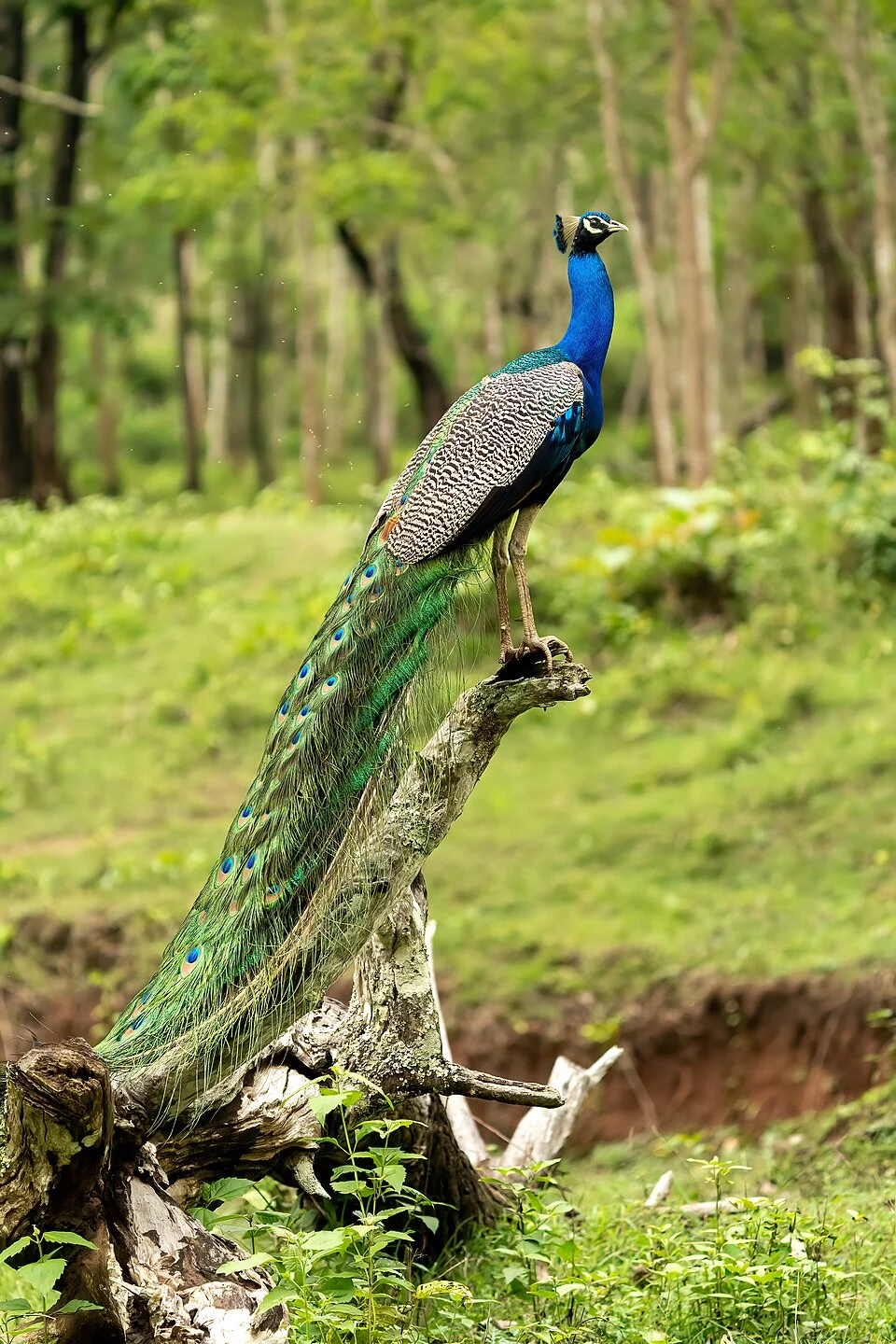
Jungle book at Kabini, May '22. A summer of rain, thanks to Cyclone Asani.
Kandukuru Nagarjun from Bangalore, India · CC BY 2.0 · Image sourceProvider-generated thumbnail requested at 800 pixels; no local editing Local WebP display rendition; resized without cropping.
Open encyclopedia reference
The Indian peafowl (Pavo cristatus), also known as the common peafowl, or blue peafowl, is a species of peafowl native to the Indian subcontinent. While it originated in the Indian subcontinent, it has since been introduced to many other parts of the world. Male peafowl are referred to as peacocks, and female peafowl are referred to as peahens, although both sexes are often referred to colloquially as a "peacock". The Indian peafowl displays a marked form of sexual dimorphism. The brightly coloured male has a blue coloured head with a fan-shaped crest and is best known for his long train. The train is made up of elongated upper-tail covert feathers with colourful eyespots. These stiff feathers are raised into a fan and quivered in a display during courtship. The peahen is predominantly brown in colour, with a white face and iridescent green lower neck, and lacks the elaborate train. There are several colour mutations of the Indian peafowl including the leucistic white peafowl. Despite the length and size of the covert feathers, the peacock is still capable of flight.
Wikipedia contributors, Indian peafowl; see linked history · CC BY-SA 4.0 . Plain-text lead excerpt, at most 180 words; no infobox or later sections Retrieved 2026-10-05T03:57:06.652178+00:00. This reference remains separate from the taxonomic record.
Identity & source status
- Scientific name
- Pavo cristatus Linnaeus, 1758
- Name authority
- Linnaeus, 1758
- Common name
- Common Peafowl
- Rank
- species
- Accepted status
- accepted
- Kingdom
- Animalia
- Phylum
- Chordata
- Class
- Aves
- Order
- Galliformes
- Family
- Phasianidae
- Genus
- Pavo
- Extinction status
- Recorded extant
Classification family tree
Nested taxonomic groups from the source. This is not a direct-ancestor chain, a dated evolutionary tree or a phylogenetic reconstruction.
- domainEukaryota (Chatton, 1925) Whittaker & Margulis, 1978
- kingdomAnimalia
- phylumChordata
- subphylumVertebrata
- infraphylumGnathostomata
- parvphylumOsteichthyes
- megaclassTetrapoda
- classAves
- orderGalliformes
- familyPhasianidae
- genusPavo Linnaeus, 1758
- speciesPavo cristatus Linnaeus, 1758
Close classified relatives
These entries share the source’s genus, Pavo. They are not necessarily the closest relatives established by molecular evidence.
| Species | Classification | Source status |
|---|---|---|
| Green PeafowlPavo muticus Linnaeus, 1766 | PhasianidaeChordata | Accepted speciesRecorded extant |
Documented distribution
Source distribution statements, not a complete range map. A listed locality is not necessarily a place of origin.
Southern Asia
Source literature & publication evidence
References attached to this source record, including nomenclatural citations where supplied. This is a selected bibliography; abbreviated citations remain in the source’s form.
- https://www.itis.gov/servlet/SingleRpt/SingleRpt?search_topic=TSN&search_value=176113 Source fields: Taxon.tsv dwc:namePublishedIn, Taxon.tsv dcterms:references
Origins, evidence & remaining research
Name authority and publication references document nomenclature where the source supplies it. They do not establish evolutionary origins or the earliest fossil occurrence.
Specimen-level evidence, morphology, ecological research, phylogenetic studies, a comprehensive bibliography and a located literary passage have not yet been compiled for this record.
Dataset citation & attribution
This exact taxon in ChecklistBank · Catalogue of Life 2026-09-11
Catalogue of Life 2026-09-11; dataset 316321; doi:10.48580/dgz5n. https://creativecommons.org/licenses/by/4.0/ . Retrieved 5 October 2026.
Stable key: col:6TWGZ. Classification follows source parent identifiers. English common names may vary by region.