
Gastrotheca ovifera (Lichtenstein & Weinland, 1854)
Accepted species in Catalogue of Life’s 11 September 2026 base release. This preserves the source classification and available supporting data; it is not a completed species monograph.
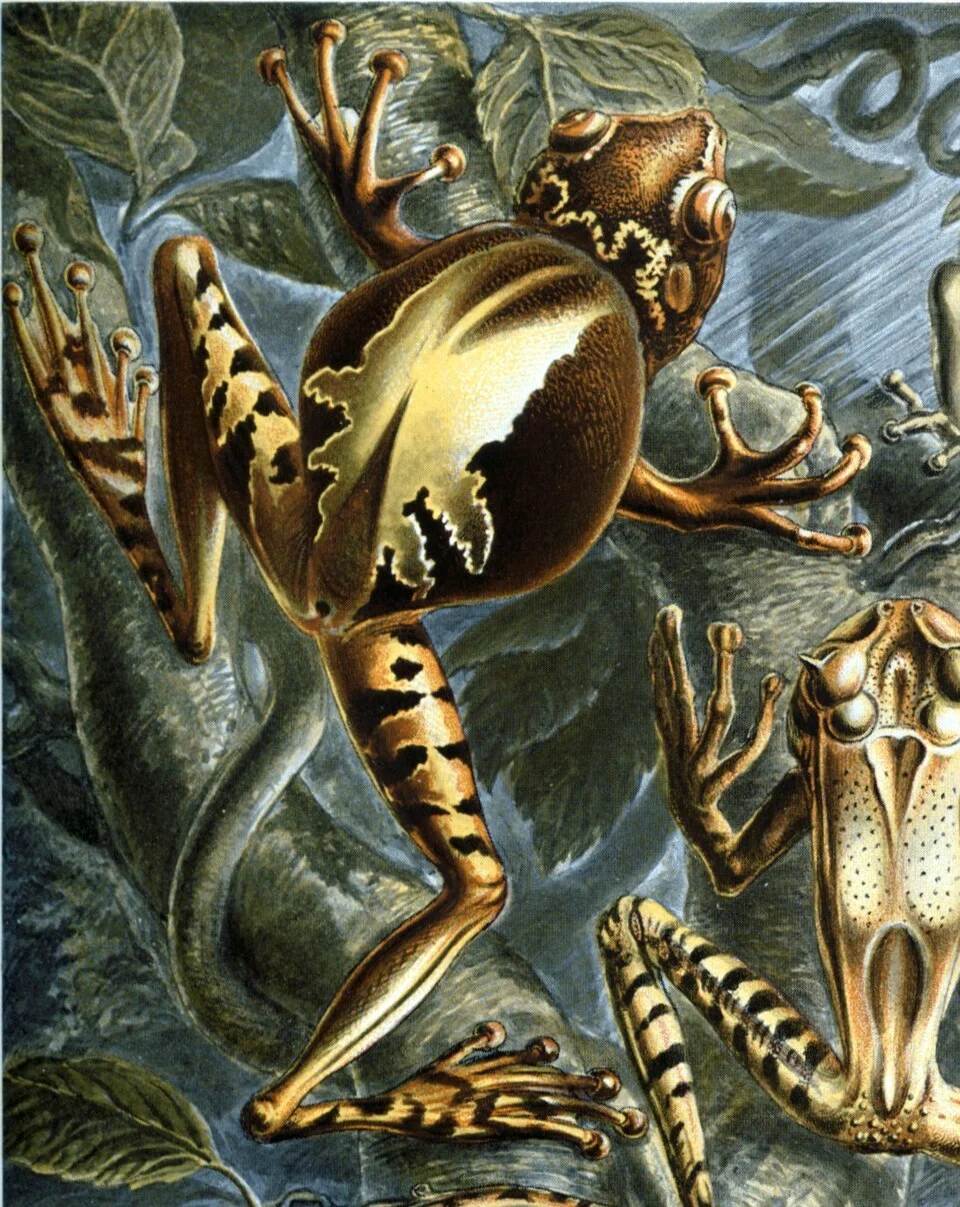
Notodelphys ovifera (Weinland) = Gastrotheca ovifera (Lichtenstein & Weinland, 1854) Hyla meridionalis (Boulenger) = Hyla meridionalis Boettger, 1874 Hyla tuberculosa (Boulenger) = Ecnomiohyla tuberculosa (Boulenger, 1882) Amphignathodon Güntheri (Boulenger) = Gastrotheca guentheri (Boulenger, 1882) Rhacophorus pardalis (Wallace) = Rhacophorus pardalis Günther, 1858 Hylodes lineatus (Schneider) = Lithodytes lineatus / Leptodactylus lineatus (Schneider, 1799) Limnodytes erythraeus (Duméril) = Hylarana erythraea (Schlegel, 1837) Ceratobatrachus Güntheri (Boulenger) = Ceratobatrachus guentheri Boulenger, 1884 Breviceps mossambicus (Peters) = Breviceps mossambicus Peters, 1854 Lithobates pipiens (Linné) = Rana pipiens (Schreber, 1782) Full text description (in German): English translation: [Remarks made by the translator are in italics or square brackets] Fig. 1. The pouch frog of Venezuela is remarkable for its female's possession of a paired dorsal [back] pouch, in which the eggs remain until the hatching of the tadpoles. A narrow triangular gap at the rear of the back (in the centre of the lightly coloured saddle patch) leads to the pouch. Fig. 2.Mediterranean Tree Frog, Stripeless Tree Frog The treefrog of North Africa and Southern Europe is little different from our native common green treefrog (Hyla arborea) and like the latter lives on trees and shrubs. When crying [calling], the male pushes forward the vocal sac like a bubble. Fig. 3. The treefrog of Ecuador is characterised by the crude build of its thick fingers (with very wide contact plates) and the knobbly skin, that like in toads is covered in glandular warts. Fig. 4. The climbing frog of Ecuador is among the slimmest and most supple forms of treefrogs; his extraordinarily thin and long limbs (with zebralike dark stripes across) enable it of the most dexterous climbing arts. Fig. 5. The flying frog of Borneo is remarkable above all other Batrachids for its extraordinarily widened foot webbings between the elongated toes. If the flying frog spreads these webs while jumping from tree to tree, he can use them as a parachute, similar to the flying dragon (Draconellus) among the reptiles (Plate 79) and the flying squirrels (Pteromys) among the rodents. Fig. 6. The military frog of Surinam is very peculiar in that the female carries its young on its back in military rank. The little tadpoles, numbering 12 to 20, attach to two diverging back ridges of the mother (that run symmetrically either side of the dorsal central line) by their oral suction plates. The mobile rudder tails are turned outward, on the left side as on the right. Fig. 7. The banded frog of Java has two parallel white bands on its back, running lengthwise, that contrast strongly against the dark red brown base colour. The jumping treefrog is about to capture an insect with its protruded bicornuated tongue. Fig. 8. The tip frog from the Solomon Islands is assigned to the group of "horn frogs" that are distinguished by a pair of sharp horns on top of the triangular head; these are elongated coverings of the upper eye lids. The bright colouration and patterning of this horn frog is most variable and often adapted to its environment. Fig. 9. The thickhead frog from East Africa (Mozambique, Sambesi) deviates from all other frogs in the appearance of its very short and thick head. Furthermore, it cannot jump with its short and weak legs, and moves its fat, crude body only with difficulty. The hind feet have large, spade-like digging swellings that help it to rapidly dig itself into the soil. It feeds on termites and in its subterranean habits is equal to the moles. Fig. 10. Northern Leopard Frog The piping frog of North America. Right behind the eye, one can see the large white, entirely superficially positioned eardrum.
Ernst Haeckel · Public domain · Image sourceProvider-generated thumbnail requested at 800 pixels; no local editing Local WebP display rendition; resized without cropping.
Open encyclopedia reference
Gastrotheca ovifera (vernacular names: pouched frog and giant marsupial frog; Spanish: rana marsupial comun or rana marsupial) is a species of frog in the family Hemiphractidae. It is endemic to northern Venezuela and is known from the Venezuelan Coastal Range, including Sierra de Aroa.
Gastrotheca ovifera occurs in cloud forests at elevations of 800–1,800 m (2,600–5,900 ft) above sea level. It is associated with bromeliads where it hides, especially during dry periods. The eggs are carried on the female's back and have direct development (i.e., there is no free-living larval stage).
Wikipedia contributors, Gastrotheca ovifera; see linked history · CC BY-SA 4.0 . Plain-text lead excerpt, at most 180 words; no infobox or later sections Retrieved 2026-10-05T16:12:13.106332+00:00. This reference remains separate from the taxonomic record.
Identity & source status
- Scientific name
- Gastrotheca ovifera (Lichtenstein & Weinland, 1854)
- Name authority
- (Lichtenstein & Weinland, 1854)
- Rank
- species
- Accepted status
- accepted
- Kingdom
- Animalia
- Phylum
- Chordata
- Class
- Amphibia
- Order
- Anura
- Family
- Hemiphractidae
- Genus
- Gastrotheca
- Extinction status
- Recorded extant
Classification family tree
Nested taxonomic groups from the source. This is not a direct-ancestor chain, a dated evolutionary tree or a phylogenetic reconstruction.
- domainEukaryota (Chatton, 1925) Whittaker & Margulis, 1978
- kingdomAnimalia
- phylumChordata
- subphylumVertebrata
- infraphylumGnathostomata
- parvphylumOsteichthyes
- megaclassTetrapoda
- classAmphibia
- orderAnura
- familyHemiphractidae Peters, 1862
- genusGastrotheca Fitzinger, 1843
- speciesGastrotheca ovifera (Lichtenstein & Weinland, 1854)
Close classified relatives
These entries share the source’s genus, Gastrotheca. They are not necessarily the closest relatives established by molecular evidence.
| Species | Classification | Source status |
|---|---|---|
| Gastrotheca williamsoni Gaige, 1922 | HemiphractidaeChordata | Accepted speciesRecorded extant |
| Gastrotheca ruizi Duellman & Burrowes, 1986 | HemiphractidaeChordata | Accepted speciesRecorded extant |
| Gastrotheca psychrophila Duellman, 1974 | HemiphractidaeChordata | Accepted speciesRecorded extant |
| Gastrotheca megacephala Izecksohn, Carvalho-e-Silva & Peixoto, 2009 | HemiphractidaeChordata | Accepted speciesRecorded extant |
| Gastrotheca longipes (Boulenger, 1882) | HemiphractidaeChordata | Accepted speciesRecorded extant |
| Gastrotheca orophylax Duellman & Pyles, 1980 | HemiphractidaeChordata | Accepted speciesRecorded extant |
| Gastrotheca nicefori Gaige, 1933 | HemiphractidaeChordata | Accepted speciesRecorded extant |
| Gastrotheca microdiscus (Andersson in Lönnberg & Andersson, 1910) | HemiphractidaeChordata | Accepted speciesRecorded extant |
| Gastrotheca flamma Juncá & Nunes, 2008 | HemiphractidaeChordata | Accepted speciesRecorded extant |
| Gastrotheca ernestoi Miranda-Ribeiro, 1920 | HemiphractidaeChordata | Accepted speciesRecorded extant |
| Gastrotheca angustifrons (Boulenger, 1898) | HemiphractidaeChordata | Accepted speciesRecorded extant |
| Gastrotheca aguaruna Duellman, Barley & Venegas, 2014 | HemiphractidaeChordata | Accepted speciesRecorded extant |
Names & synonyms
Names explicitly linked to this accepted taxon in the source. Synonymy can change with revision.
| Recorded name | Source status |
|---|---|
| Hyla vogli Müller, 1938 Müller, 1938 | synonym |
| Notodelphis dorsigera Schlegel, 1858 Schlegel, 1858 | synonym |
| Notodelphys ovifera Lichtenstein & Weinland, 1854 Lichtenstein & Weinland, 1854 | synonym |
| Nototrema oviferum (Lichtenstein & Weinland, 1854) (Lichtenstein & Weinland, 1854) | synonym |
| Opisthodelphys ovifera (Lichtenstein & Weinland, 1854) (Lichtenstein & Weinland, 1854) | synonym |
Source literature & publication evidence
References attached to this source record, including nomenclatural citations where supplied. This is a selected bibliography; abbreviated citations remain in the source’s form.
- https://www.itis.gov/servlet/SingleRpt/SingleRpt?search_topic=TSN&search_value=207370 Source fields: Taxon.tsv dwc:namePublishedIn, Taxon.tsv dcterms:references
Origins, evidence & remaining research
Name authority and publication references document nomenclature where the source supplies it. They do not establish evolutionary origins or the earliest fossil occurrence.
Specimen-level evidence, morphology, ecological research, phylogenetic studies, a comprehensive bibliography and a located literary passage have not yet been compiled for this record.
Dataset citation & attribution
This exact taxon in ChecklistBank · Catalogue of Life 2026-09-11
Catalogue of Life 2026-09-11; dataset 316321; doi:10.48580/dgz5n. https://creativecommons.org/licenses/by/4.0/ . Retrieved 5 October 2026.
Stable key: col:6K9WG. Classification follows source parent identifiers. English common names may vary by region.