
NATURAL HISTORY · CATALOGUE RECORD
Labord’s chameleon
Furcifer labordi (Grandidier, 1872)
Source-backed taxonomic record
Accepted species in Catalogue of Life’s 11 September 2026 base release. This preserves the source classification and available supporting data; it is not a completed species monograph.
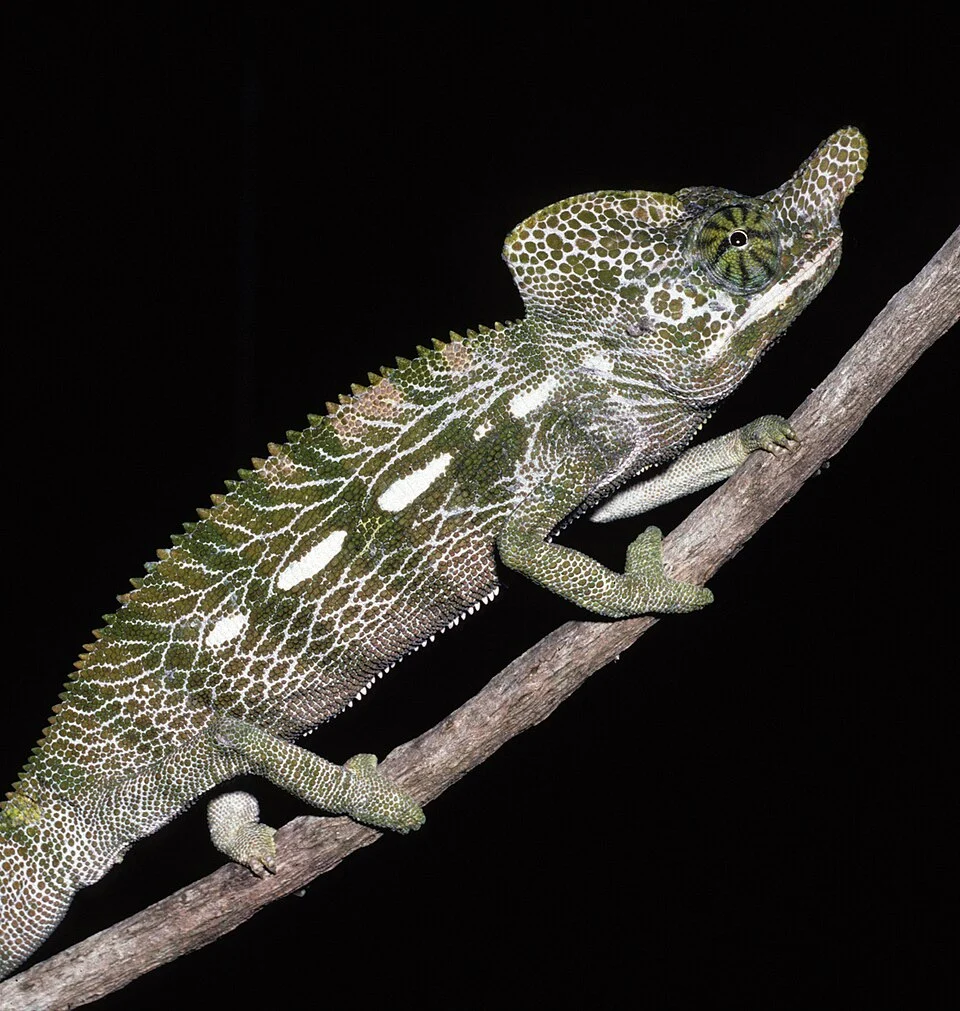
A photograph of Furcifer labordi.Labord's Chameleon from Madagascar Adult male Labord's chameleon (Furcifer labordi) from southwestern Madagascar. They are a species of tetrapod (four-limbed vertebrates). F. labordi have the shortest lifespan ever recorded for a four-legged vertebrate animal--just 4-5 months, post-hatch--and spend more of their short life inside the egg than outside. No other tetrapods are known to have this short a life span. These findings suggest that the rapid death of chameleons in captivity may, for some species, actually represent the natural adult life span. Labord's chameleons hatch from eggs in November, then grow at an astonishing rate, reaching sexual maturity by January. They battle fiercely over mates, then breed and lay their eggs by February, after which they will promptly drop dead. For the next nine months, the entire species is represented only by eggs. More about this Image Christopher John Raxworthy received a CAREER (Faculty Early Career Advancement) award from the National Science Foundation to complete a survey of amphibians, reptiles and small mammals and their co-evolved parasites at 15 sites in the Tsaratanana Massif Complex of Madagascar; describe new species, revise taxonomic groups and produce species lists, monographs, keys and field guides; and establish a Web site-accessible database for use with future research work and conservation planning. When he began his research, only about 400 species of Malagasy reptiles and amphibians had been identified, and the information available about these species was often inaccurate or incomplete. Through his research, Raxworthy has found (and is now describing) more than 150 new species and has added a wealth of information to the database on known species. Currently, he is focusing his research on chameleon systematics, a project that includes field surveys in remote, mountainous areas of northern Madagascar. Many of these areas have never been previously explored or surveyed. [Research supported by NSF grant DEB 99-84496.]
Christopher Raxworthy · Public domain · Image sourceProvider-generated thumbnail requested at 800 pixels; no local editing Local WebP display rendition; resized without cropping.
Open encyclopedia reference
Labord's chameleon (Furcifer labordi) is a species of chameleon, a lizard in the family Chamaeleonidae. The species is endemic to dry and deciduous forests, including spiny forests, in lowlands of western Madagascar, at altitudes of 20–100 m (66–328 ft). It is considered vulnerable because of ongoing habitat loss.
Wikipedia contributors, Labord's chameleon; see linked history · CC BY-SA 4.0 . Plain-text lead excerpt, at most 180 words; no infobox or later sections Retrieved 2026-10-05T07:16:38.396011+00:00. This reference remains separate from the taxonomic record.
Identity & source status
- Scientific name
- Furcifer labordi (Grandidier, 1872)
- Name authority
- (Grandidier, 1872)
- Common name
- Labord’s chameleon
- Rank
- species
- Accepted status
- accepted
- Kingdom
- Animalia
- Phylum
- Chordata
- Class
- Reptilia
- Order
- Squamata
- Family
- Chamaeleonidae
- Genus
- Furcifer
- Extinction status
- Not supplied by this source
Classification family tree
Nested taxonomic groups from the source. This is not a direct-ancestor chain, a dated evolutionary tree or a phylogenetic reconstruction.
- domainEukaryota (Chatton, 1925) Whittaker & Margulis, 1978
- kingdomAnimalia
- phylumChordata
- subphylumVertebrata
- infraphylumGnathostomata
- parvphylumOsteichthyes
- megaclassTetrapoda
- classReptilia Laurenti, 1768
- orderSquamata Oppel, 1811
- suborderIguania
- familyChamaeleonidae
- genusFurcifer
- speciesFurcifer labordi (Grandidier, 1872)
Close classified relatives
These entries share the source’s genus, Furcifer. They are not necessarily the closest relatives established by molecular evidence.
| Species | Classification | Source status |
|---|---|---|
| Furcifer polleni (Peters, 1874) | ChamaeleonidaeChordata | Accepted speciesExtinction status not supplied |
| Lesser ChameleonFurcifer minor (Günther, 1879) | ChamaeleonidaeChordata | Accepted speciesExtinction status not supplied |
| Furcifer bifidus (Brongniart, 1800) | ChamaeleonidaeChordata | Accepted speciesExtinction status not supplied |
| Green chameleonFurcifer viridis Florio, Ingram, Rakotondravony, Louis Jr & Raxworthy, 2012 | ChamaeleonidaeChordata | Accepted speciesExtinction status not supplied |
| Rhinoceros chameleonFurcifer rhinoceratus (Gray, 1845) | ChamaeleonidaeChordata | Accepted speciesExtinction status not supplied |
| Campan’s chameleonFurcifer campani (Grandidier, 1872) | ChamaeleonidaeChordata | Accepted speciesExtinction status not supplied |
| Timon’s chameleonFurcifer timoni Glaw, Köhler & Vences, 2009 | ChamaeleonidaeChordata | Accepted speciesExtinction status not supplied |
| Furcifer cephalolepis (Günther, 1880) | ChamaeleonidaeChordata | Accepted speciesExtinction status not supplied |
| Furcifer balteatus (Duméril & Bibron, 1851) | ChamaeleonidaeChordata | Accepted speciesExtinction status not supplied |
| Wills’ chameleonFurcifer willsii (Günther, 1890) | ChamaeleonidaeChordata | Accepted speciesExtinction status not supplied |
| Furcifer verrucosus (Cuvier, 1829) | ChamaeleonidaeChordata | Accepted speciesExtinction status not supplied |
| Ambilobe panther chameleonFurcifer pardalis (Cuvier, 1829) | ChamaeleonidaeChordata | Accepted speciesExtinction status not supplied |
Names & synonyms
Names explicitly linked to this accepted taxon in the source. Synonymy can change with revision.
| Recorded name | Source status |
|---|---|
| Chamaeleo barbouri Hechenbleikner, 1942 Hechenbleikner, 1942 | synonym |
| Chamaeleo labordi Grandidier, 1872 Grandidier, 1872 | synonym |
Documented distribution
Source distribution statements, not a complete range map. A listed locality is not necessarily a place of origin.
Source literature & publication evidence
References attached to this source record, including nomenclatural citations where supplied. This is a selected bibliography; abbreviated citations remain in the source’s form.
- https://reptile-database.reptarium.cz/species?genus=Furcifer&species=labordi Source fields: Taxon.tsv dwc:namePublishedIn, Taxon.tsv dcterms:references
Origins, evidence & remaining research
Name authority and publication references document nomenclature where the source supplies it. They do not establish evolutionary origins or the earliest fossil occurrence.
Specimen-level evidence, morphology, ecological research, phylogenetic studies, a comprehensive bibliography and a located literary passage have not yet been compiled for this record.
Dataset citation & attribution
This exact taxon in ChecklistBank · Catalogue of Life 2026-09-11
Catalogue of Life 2026-09-11; dataset 316321; doi:10.48580/dgz5n. https://creativecommons.org/licenses/by/4.0/ . Retrieved 5 October 2026.
Stable key: col:6K4XX. Classification follows source parent identifiers. English common names may vary by region.