
NATURAL HISTORY · CATALOGUE RECORD
Pink Fairy Armadillo
Chlamyphorus truncatus Harlan, 1825
Source-backed taxonomic record
Accepted species in Catalogue of Life’s 11 September 2026 base release. This preserves the source classification and available supporting data; it is not a completed species monograph.
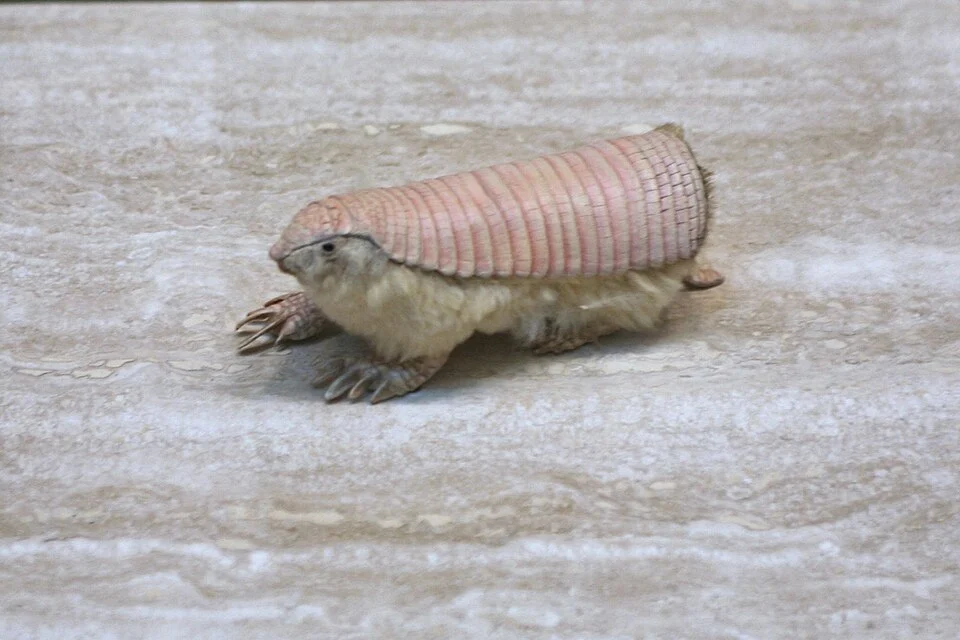
Pink fairy armadillos (or pichiciegos) are found in the warm sandy plains of Argentina. These armadillos prefer to burrow in very dry soil. They will leave a burrow if it is moistened by rainfall. These animals often burrow near anthills, so that they can be close to their food source. The pink fairy armadillo generally lives by itself. The animals stay in their burrrows during the day and feed at night. They are remarkable diggers. The pink fairy armadillo is the smallest member of the armadillo family, measuring only about five to six inches in length. It is also the only armadillo in which the dorsal shell is almost separate from the body. Baby armadillos resemble their parents, but their shells do not completely harden until they are full grown. <a href="http://animaldiversity.ummz.umich.edu/site/accounts/information/Chlamyphorus_truncatus.html">animaldiversity.ummz.umich.edu/site/accounts/information/...</a>
Cliff · CC BY 2.0 · Image sourceProvider-generated thumbnail requested at 800 pixels; no local editing Local WebP display rendition; resized without cropping.
Open encyclopedia reference
The pink fairy armadillo (Chlamyphorus truncatus) is the smallest species of armadillo, first described by Richard Harlan in 1825. The pink fairy armadillo is 90–115 mm (3.5–4.5 in) long, and typically weighs about 120 g (4.2 oz). This solitary, desert-adapted animal is endemic to the deserts and scrub lands of central Argentina. The pink fairy armadillo is closely related to the only other fairy armadillo (Chlamyphorinae), the greater fairy armadillo. Pink fairy armadillos have small eyes, silky yellowish white fur, and flexible dorsal shells that are attached to their bodies solely by thin dorsal membranes. Their spatula-shaped tails protrude from vertical plates at the blunt rear of their shells. They exhibit nocturnal and solitary habits and feed themselves largely on insects, worms, snails, and various plant parts. The pink fairy armadillo has a unique ability to bury itself in a matter of seconds, using its specialised claws to dig into sandy or loamy soils. This behaviour helps protect the armadillo from predators and extreme temperatures, as well as conserve moisture in its arid habitat.
Wikipedia contributors, Pink fairy armadillo; see linked history · CC BY-SA 4.0 . Plain-text lead excerpt, at most 180 words; no infobox or later sections Retrieved 2026-10-05T08:42:17.788312+00:00. This reference remains separate from the taxonomic record.
Identity & source status
- Scientific name
- Chlamyphorus truncatus Harlan, 1825
- Name authority
- Harlan, 1825
- Common name
- Pink Fairy Armadillo
- Rank
- species
- Accepted status
- accepted
- Kingdom
- Animalia
- Phylum
- Chordata
- Class
- Mammalia
- Order
- Cingulata
- Family
- Chlamyphoridae
- Genus
- Chlamyphorus
- Extinction status
- Recorded extant
Classification family tree
Nested taxonomic groups from the source. This is not a direct-ancestor chain, a dated evolutionary tree or a phylogenetic reconstruction.
- domainEukaryota (Chatton, 1925) Whittaker & Margulis, 1978
- kingdomAnimalia
- phylumChordata
- subphylumVertebrata
- infraphylumGnathostomata
- parvphylumOsteichthyes
- megaclassTetrapoda
- classMammalia Linnaeus, 1758
- subclassTheria Parker & Haswell, 1897
- infraclassEutheria Gill, 1872
- orderCingulata Illiger, 1811
- familyChlamyphoridae Bonaparte, 1850
- subfamilyChlamyphorinae Bonaparte, 1850
- genusChlamyphorus Harlan, 1825
- speciesChlamyphorus truncatus Harlan, 1825
Close classified relatives
No other member of this genus is present in the selected snapshot.
Documented distribution
Source distribution statements, not a complete range map. A listed locality is not necessarily a place of origin.
Source literature & publication evidence
References attached to this source record, including nomenclatural citations where supplied. This is a selected bibliography; abbreviated citations remain in the source’s form.
- https://www.itis.gov/servlet/SingleRpt/SingleRpt?search_topic=TSN&search_value=624890 Source fields: Taxon.tsv dwc:namePublishedIn, Taxon.tsv dcterms:references
Origins, evidence & remaining research
Name authority and publication references document nomenclature where the source supplies it. They do not establish evolutionary origins or the earliest fossil occurrence.
Specimen-level evidence, morphology, ecological research, phylogenetic studies, a comprehensive bibliography and a located literary passage have not yet been compiled for this record.
Dataset citation & attribution
This exact taxon in ChecklistBank · Catalogue of Life 2026-09-11
Catalogue of Life 2026-09-11; dataset 316321; doi:10.48580/dgz5n. https://creativecommons.org/licenses/by/4.0/ . Retrieved 5 October 2026.
Stable key: col:69WT2. Classification follows source parent identifiers. English common names may vary by region.