
NATURAL HISTORY · CATALOGUE RECORD
Vervet Monkey
Chlorocebus pygerythrus (F. Cuvier, 1821)
Source-backed taxonomic record
Accepted species in Catalogue of Life’s 11 September 2026 base release. This preserves the source classification and available supporting data; it is not a completed species monograph.
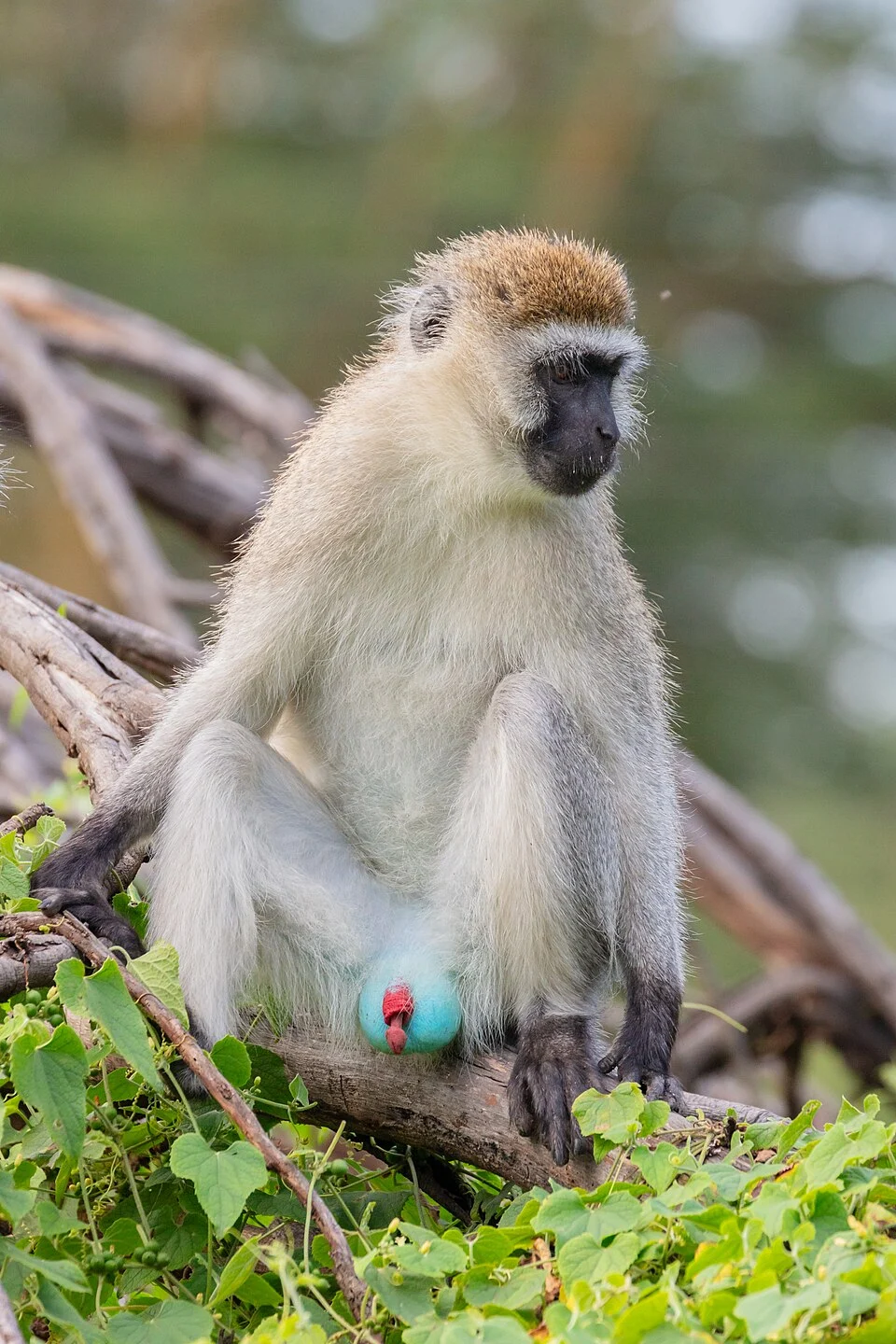
Vervet monkey (Chlorocebus pygerythrus), Lake Nakuru National Park, Kenya
Diego Delso · CC BY-SA 4.0 · Image sourceProvider-generated thumbnail requested at 800 pixels; no local editing Local WebP display rendition; resized without cropping.
Open encyclopedia reference
The vervet monkey (Chlorocebus pygerythrus), or simply vervet, is an Old World monkey of the family Cercopithecidae native to Africa. The term "vervet" is also used to refer to all the members of the genus Chlorocebus. The five distinct subspecies can be found mostly throughout Southern Africa, as well as some of the eastern countries. These mostly herbivorous monkeys have black faces and grey body hair color, ranging in body length from about 40 cm (16 in) for females, to about 50 cm (20 in) for males.
In addition to behavioral research on natural populations, vervet monkeys serve as a nonhuman primate model for understanding genetic and social behaviors of humans. They have been noted for having human-like characteristics, such as hypertension, anxiety, and social and dependent alcohol use. Vervets live in social groups ranging from 10 to 70 individuals, with males moving to other groups at the time of sexual maturity. Studies done on vervet monkeys involve their communication and alarm calls, specifically in regard to kin and group recognition, and particular predator sightings.
Wikipedia contributors, Vervet monkey; see linked history · CC BY-SA 4.0 . Plain-text lead excerpt, at most 180 words; no infobox or later sections Retrieved 2026-10-05T03:10:23.729659+00:00. This reference remains separate from the taxonomic record.
Identity & source status
- Scientific name
- Chlorocebus pygerythrus (F. Cuvier, 1821)
- Name authority
- (F. Cuvier, 1821)
- Common name
- Vervet Monkey
- Rank
- species
- Accepted status
- accepted
- Kingdom
- Animalia
- Phylum
- Chordata
- Class
- Mammalia
- Order
- Primates
- Family
- Cercopithecidae
- Genus
- Chlorocebus
- Extinction status
- Recorded extant
Classification family tree
Nested taxonomic groups from the source. This is not a direct-ancestor chain, a dated evolutionary tree or a phylogenetic reconstruction.
- domainEukaryota (Chatton, 1925) Whittaker & Margulis, 1978
- kingdomAnimalia
- phylumChordata
- subphylumVertebrata
- infraphylumGnathostomata
- parvphylumOsteichthyes
- megaclassTetrapoda
- classMammalia Linnaeus, 1758
- subclassTheria Parker & Haswell, 1897
- infraclassEutheria Gill, 1872
- orderPrimates Linnaeus, 1758
- suborderHaplorrhini Pocock, 1918
- infraorderSimiiformes Haeckel, 1866
- superfamilyCercopithecoidea Gray, 1821
- familyCercopithecidae Gray, 1821
- subfamilyCercopithecinae Gray, 1821
- tribeCercopithecini
- genusChlorocebus Gray, 1870
- speciesChlorocebus pygerythrus (F. Cuvier, 1821)
Close classified relatives
These entries share the source’s genus, Chlorocebus. They are not necessarily the closest relatives established by molecular evidence.
| Species | Classification | Source status |
|---|---|---|
| Bale MonkeyChlorocebus djamdjamensis (Neumann, 1902) | CercopithecidaeChordata | Accepted speciesRecorded extant |
| GrivetChlorocebus aethiops (Linnaeus, 1758) | CercopithecidaeChordata | Accepted speciesRecorded extant |
| Green MonkeyChlorocebus sabaeus (Linnaeus, 1766) | CercopithecidaeChordata | Accepted speciesRecorded extant |
| MalbrouckChlorocebus cynosuros (Scopoli, 1786) | CercopithecidaeChordata | Accepted speciesRecorded extant |
| Tantalus MonkeyChlorocebus tantalus (Ogilby, 1841) | CercopithecidaeChordata | Accepted speciesRecorded extant |
Documented distribution
Source distribution statements, not a complete range map. A listed locality is not necessarily a place of origin.
Source literature & publication evidence
References attached to this source record, including nomenclatural citations where supplied. This is a selected bibliography; abbreviated citations remain in the source’s form.
- https://www.itis.gov/servlet/SingleRpt/SingleRpt?search_topic=TSN&search_value=944217 Source fields: Taxon.tsv dwc:namePublishedIn, Taxon.tsv dcterms:references
Origins, evidence & remaining research
Name authority and publication references document nomenclature where the source supplies it. They do not establish evolutionary origins or the earliest fossil occurrence.
Specimen-level evidence, morphology, ecological research, phylogenetic studies, a comprehensive bibliography and a located literary passage have not yet been compiled for this record.
Dataset citation & attribution
This exact taxon in ChecklistBank · Catalogue of Life 2026-09-11
Catalogue of Life 2026-09-11; dataset 316321; doi:10.48580/dgz5n. https://creativecommons.org/licenses/by/4.0/ . Retrieved 5 October 2026.
Stable key: col:69VWT. Classification follows source parent identifiers. English common names may vary by region.