
NATURAL HISTORY · CATALOGUE RECORD
Maned Wolf
Chrysocyon brachyurus (Illiger, 1815)
Source-backed taxonomic record
Accepted species in Catalogue of Life’s 11 September 2026 base release. This preserves the source classification and available supporting data; it is not a completed species monograph.
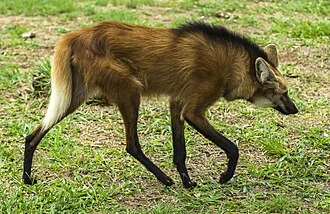
The Maned Wolf (Chrysocyon brachyurus) endangered species
Jonathan Wilkins · CC BY-SA 3.0 · Image sourceProvider-generated thumbnail requested at 320 pixels; no local editing Local WebP display rendition; resized without cropping.
Open encyclopedia reference
The maned wolf (Chrysocyon brachyurus) is a large canine of South America. It is found in Argentina, Brazil, Bolivia, Peru, and Paraguay, and is almost locally extinct in Uruguay. Its markings resemble those of a red fox but it is neither a fox nor a wolf. It is the only species in the genus Chrysocyon (from Greek χρῡσο-κύων [chrúso-kúōn], "golden dog"). The maned wolf's young pups appear to have darker fur than the bronze, grown ones. It is the largest canine in South America, weighing 20–30 kg (44–66 lb) and up to 110 cm (43 in) at the withers. Its slender legs and dense reddish coat give it a distinctive appearance. The maned wolf is a crepuscular and omnivorous animal adapted to the open environments of the South American savanna, with an important role in the seed dispersal of fruits, especially the wolf apple (Solanum lycocarpum). The maned wolf is a solitary animal. It communicates primarily by scent marking, but also gives a loud call known as "roar-barking".
Wikipedia contributors, Maned wolf; see linked history · CC BY-SA 4.0 . Plain-text lead excerpt, at most 180 words; no infobox or later sections Retrieved 2026-10-05T01:52:06.614378+00:00. This reference remains separate from the taxonomic record.
Identity & source status
- Scientific name
- Chrysocyon brachyurus (Illiger, 1815)
- Name authority
- (Illiger, 1815)
- Common name
- Maned Wolf
- Rank
- species
- Accepted status
- accepted
- Kingdom
- Animalia
- Phylum
- Chordata
- Class
- Mammalia
- Order
- Carnivora
- Family
- Canidae
- Genus
- Chrysocyon
- Extinction status
- Recorded extant
Classification family tree
Nested taxonomic groups from the source. This is not a direct-ancestor chain, a dated evolutionary tree or a phylogenetic reconstruction.
- domainEukaryota (Chatton, 1925) Whittaker & Margulis, 1978
- kingdomAnimalia
- phylumChordata
- subphylumVertebrata
- infraphylumGnathostomata
- parvphylumOsteichthyes
- megaclassTetrapoda
- classMammalia Linnaeus, 1758
- subclassTheria Parker & Haswell, 1897
- infraclassEutheria Gill, 1872
- orderCarnivora Bowdich, 1821
- suborderCaniformia Kretzoi, 1938
- familyCanidae G. Fischer von Waldheim, 1817
- genusChrysocyon C. E. H. Smith, 1839
- speciesChrysocyon brachyurus (Illiger, 1815)
Close classified relatives
No other member of this genus is present in the selected snapshot.
Names & synonyms
Names explicitly linked to this accepted taxon in the source. Synonymy can change with revision.
| Recorded name | Source status |
|---|---|
| Canis brachyurus Illiger, 1815 Illiger, 1815 | synonym |
Documented distribution
Source distribution statements, not a complete range map. A listed locality is not necessarily a place of origin.
Source literature & publication evidence
References attached to this source record, including nomenclatural citations where supplied. This is a selected bibliography; abbreviated citations remain in the source’s form.
- https://www.itis.gov/servlet/SingleRpt/SingleRpt?search_topic=TSN&search_value=183827 Source fields: Taxon.tsv dwc:namePublishedIn, Taxon.tsv dcterms:references
Origins, evidence & remaining research
Name authority and publication references document nomenclature where the source supplies it. They do not establish evolutionary origins or the earliest fossil occurrence.
Specimen-level evidence, morphology, ecological research, phylogenetic studies, a comprehensive bibliography and a located literary passage have not yet been compiled for this record.
Dataset citation & attribution
This exact taxon in ChecklistBank · Catalogue of Life 2026-09-11
Catalogue of Life 2026-09-11; dataset 316321; doi:10.48580/dgz5n. https://creativecommons.org/licenses/by/4.0/ . Retrieved 5 October 2026.
Stable key: col:5YNGG. Classification follows source parent identifiers. English common names may vary by region.