
Blotchy swell shark
Cephaloscyllium umbratile Jordan & Fowler, 1903
Accepted species in Catalogue of Life’s 11 September 2026 base release. This preserves the source classification and available supporting data; it is not a completed species monograph.
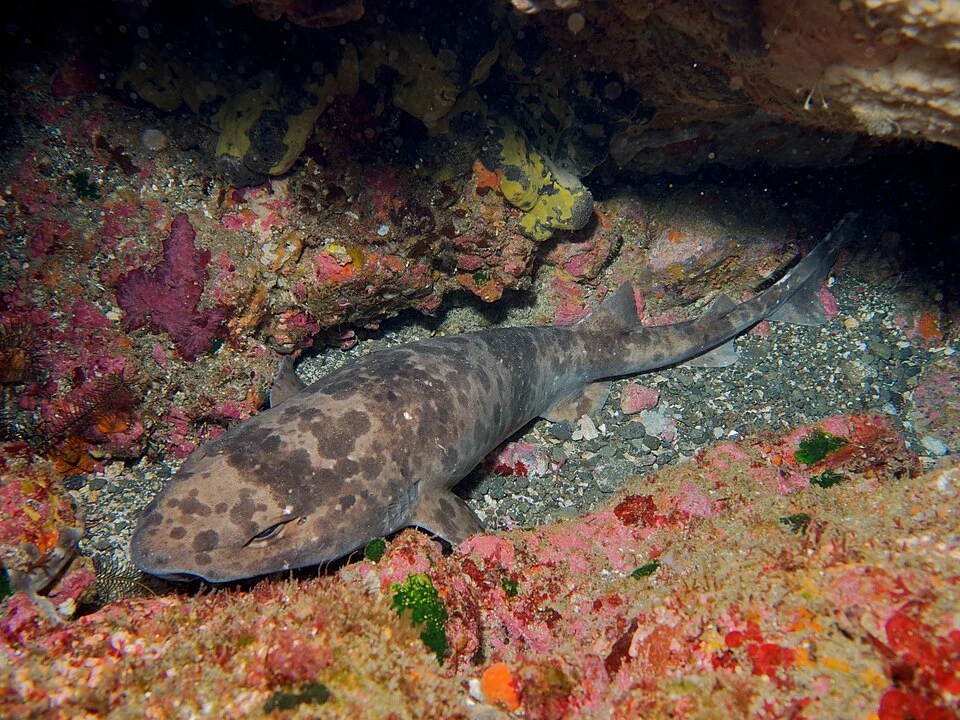
Blotchy swell shark (Cephaloscyllium umbratile)
RYO SATO from Hamamatsu, Shizuoka, Japan · CC BY-SA 2.0 · Image sourceProvider-generated thumbnail requested at 800 pixels; no local editing Local WebP display rendition; resized without cropping.
Open encyclopedia reference
The blotchy swellshark or Japanese swellshark (Cephaloscyllium umbratile) is a common species of catshark, belonging to the family Scyliorhinidae. The Blotchy swellshark is found at depths of 90–200 m (300–660 ft) in the northwestern Pacific Ocean, from Japan to Taiwan. It is benthic in nature and favors rocky reefs. Reaching 1.4 m (4.6 ft) in length, this thick-bodied shark has a broad head, large mouth, and two unequally-sized dorsal fins positioned far back past the pelvic fins. It can be identified by its dorsal coloration, consisting of seven brown "saddles" and extensive darker mottling on a light tan background. This species has often been confounded with the draughtsboard shark (C. isabellum) and the Sarawak pygmy swellshark (C. sarawakensis) in scientific literature. Voracious and opportunistic in feeding habits, the blotchy swellshark is known to consume numerous types of fishes and invertebrates, including an unusually high diversity of cartilaginous fishes. Like other Cephaloscyllium species, it is capable of rapidly inflating its body as a defense against predators. This species is oviparous, with females laying encapsulated eggs two at a time.
Wikipedia contributors, Blotchy swellshark; see linked history · CC BY-SA 4.0 . Plain-text lead excerpt, at most 180 words; no infobox or later sections Retrieved 2026-10-05T08:30:33.260279+00:00. This reference remains separate from the taxonomic record.
Identity & source status
- Scientific name
- Cephaloscyllium umbratile Jordan & Fowler, 1903
- Name authority
- Jordan & Fowler, 1903
- Common name
- Blotchy swell shark
- Rank
- species
- Accepted status
- accepted
- Kingdom
- Animalia
- Phylum
- Chordata
- Class
- Elasmobranchii
- Order
- Carcharhiniformes
- Family
- Scyliorhinidae
- Genus
- Cephaloscyllium
- Extinction status
- Not supplied by this source
Source habitat flags: Marine: yes · Freshwater: no · Terrestrial: no. These do not form a complete habitat description.
Classification family tree
Nested taxonomic groups from the source. This is not a direct-ancestor chain, a dated evolutionary tree or a phylogenetic reconstruction.
- domainEukaryota (Chatton, 1925) Whittaker & Margulis, 1978
- kingdomAnimalia
- phylumChordata
- subphylumVertebrata
- infraphylumGnathostomata
- parvphylumChondrichthyes
- classElasmobranchii
- subclassNeoselachii
- infraclassSelachii
- superorderGaleomorphi
- orderCarcharhiniformes
- familyScyliorhinidae Gill, 1862
- genusCephaloscyllium Gill, 1862
- speciesCephaloscyllium umbratile Jordan & Fowler, 1903
Close classified relatives
These entries share the source’s genus, Cephaloscyllium. They are not necessarily the closest relatives established by molecular evidence.
| Species | Classification | Source status |
|---|---|---|
| Cephaloscyllium albipinnum Last, Motomura & White, 2008 | ScyliorhinidaeChordata | Accepted speciesExtinction status not supplied |
| Cephaloscyllium laticeps (Duméril, 1853) | ScyliorhinidaeChordata | Accepted speciesExtinction status not supplied |
| Cephaloscyllium hiscosellum White & Ebert, 2008 | ScyliorhinidaeChordata | Accepted speciesExtinction status not supplied |
| Cephaloscyllium sarawakense Yano, Ahmad & Gambang, 2005 | ScyliorhinidaeChordata | Accepted speciesExtinction status not supplied |
| Cephaloscyllium signourum Last, Séret & White, 2008 | ScyliorhinidaeChordata | Accepted speciesExtinction status not supplied |
| Cephaloscyllium pictum Last, Séret & White, 2008 | ScyliorhinidaeChordata | Accepted speciesExtinction status not supplied |
| Cephaloscyllium silasi (Talwar, 1974) | ScyliorhinidaeChordata | Accepted speciesExtinction status not supplied |
| swell sharkCephaloscyllium ventriosum (Garman, 1880) | ScyliorhinidaeChordata | Accepted speciesExtinction status not supplied |
| Cephaloscyllium zebrum Last & White, 2008 | ScyliorhinidaeChordata | Accepted speciesExtinction status not supplied |
| Cephaloscyllium stevensi Clark & Randall, 2011 | ScyliorhinidaeChordata | Accepted speciesExtinction status not supplied |
| Cephaloscyllium fasciatum Chan, 1966 | ScyliorhinidaeChordata | Accepted speciesExtinction status not supplied |
Names & synonyms
Names explicitly linked to this accepted taxon in the source. Synonymy can change with revision.
| Recorded name | Source status |
|---|---|
| Cephaloscyllium formosanum Teng, 1962 Teng, 1962 | synonym |
Source literature & publication evidence
References attached to this source record, including nomenclatural citations where supplied. This is a selected bibliography; abbreviated citations remain in the source’s form.
- Jordan, D. S.; H. W. Fowler, H. W. (1903). A review of the elasmobranchiate fishes of Japan. Proceedings of the United States National Museum, v. 26 (no. 1324): 593–674, Pls. 26–27. https://doi.org/10.5479/si.00963801.26-1324.593 Source fields: Taxon.tsv dwc:namePublishedIn, Taxon.tsv dcterms:references
Origins, evidence & remaining research
Name authority and publication references document nomenclature where the source supplies it. They do not establish evolutionary origins or the earliest fossil occurrence.
Specimen-level evidence, morphology, ecological research, phylogenetic studies, a comprehensive bibliography and a located literary passage have not yet been compiled for this record.
Dataset citation & attribution
This exact taxon in ChecklistBank · Catalogue of Life 2026-09-11
Catalogue of Life 2026-09-11; dataset 316321; doi:10.48580/dgz5n. https://creativecommons.org/licenses/by/4.0/ . Retrieved 5 October 2026.
Stable key: col:5XJXM. Classification follows source parent identifiers. English common names may vary by region.