
NATURAL HISTORY · CATALOGUE RECORD
Guadeloupe Anole
Anolis marmoratus Duméril & Bibron, 1837
Source-backed taxonomic record
Accepted species in Catalogue of Life’s 11 September 2026 base release. This preserves the source classification and available supporting data; it is not a completed species monograph.
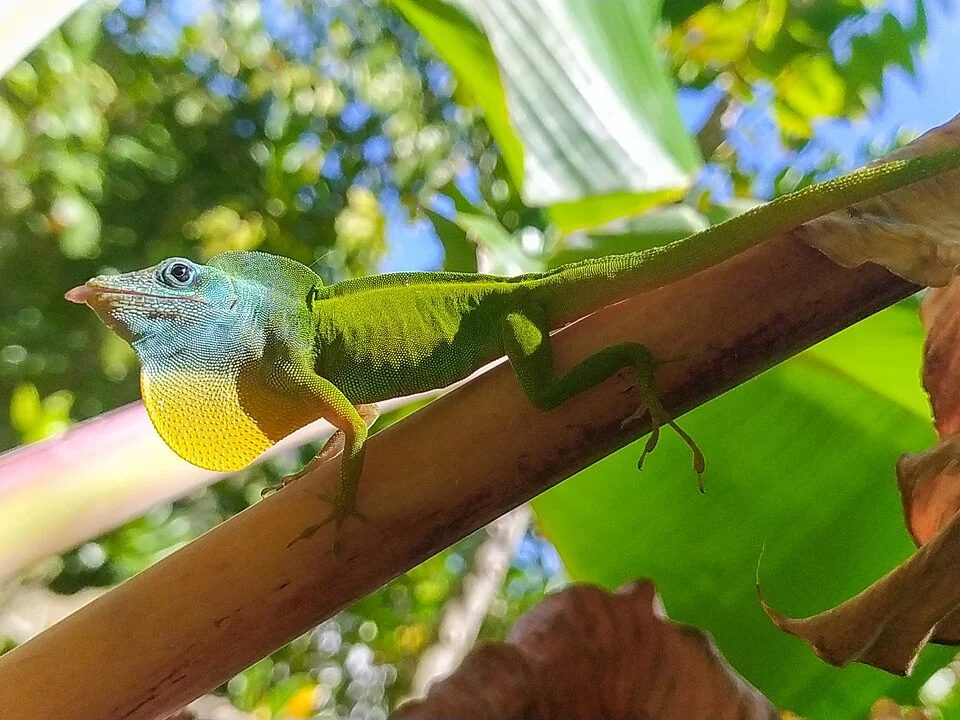
Anolis marmoratusDuméril&Bibron, 1837
Filo gèn' · CC BY-SA 4.0 · Image sourceProvider-generated thumbnail requested at 800 pixels; no local editing Local WebP display rendition; resized without cropping.
Open encyclopedia reference
Anolis marmoratus, commonly known as the leopard anole, Guadeloupe anole, or Guadeloupean anole, is a species of anole that is endemic to the islands of Guadeloupe, in the Caribbean Lesser Antilles.
Five former subspecies have been elevated to species status: A. ferreus, A. terraealtae, A.kahouannensis, A.chrysops, and A.desiradei.
Of the currently accepted leopard anole subspecies, five live on the island of Basse-Terre and two on the island of Grande-Terre. The validity of these subspecies has been questioned as there is extensive intergradation between them and the species shows extreme variability in its appearance; both between regions and individually in the same region. This has possibly been enhanced by habitats changes by humans (allowing populations to easier come into contact with each other) and translocations of individuals. Most leopard anoles do not clearly match the typically recognized subspecies. Genetic studies confirm that strong assortative mating between the different populations does not exist, despite their distinct differences in appearance and them having separated about 650,000 years ago (confidence interval starting at 351,000 years).
Wikipedia contributors, Anolis marmoratus; see linked history · CC BY-SA 4.0 . Plain-text lead excerpt, at most 180 words; no infobox or later sections Retrieved 2026-10-05T05:54:47.453877+00:00. This reference remains separate from the taxonomic record.
Identity & source status
- Scientific name
- Anolis marmoratus Duméril & Bibron, 1837
- Name authority
- Duméril & Bibron, 1837
- Common name
- Guadeloupe Anole
- Rank
- species
- Accepted status
- accepted
- Kingdom
- Animalia
- Phylum
- Chordata
- Class
- Reptilia
- Order
- Squamata
- Family
- Anolidae
- Genus
- Anolis
- Extinction status
- Not supplied by this source
Classification family tree
Nested taxonomic groups from the source. This is not a direct-ancestor chain, a dated evolutionary tree or a phylogenetic reconstruction.
- domainEukaryota (Chatton, 1925) Whittaker & Margulis, 1978
- kingdomAnimalia
- phylumChordata
- subphylumVertebrata
- infraphylumGnathostomata
- parvphylumOsteichthyes
- megaclassTetrapoda
- classReptilia Laurenti, 1768
- orderSquamata Oppel, 1811
- suborderIguania
- familyAnolidae
- genusAnolis
- speciesAnolis marmoratus Duméril & Bibron, 1837
Close classified relatives
These entries share the source’s genus, Anolis. They are not necessarily the closest relatives established by molecular evidence.
| Species | Classification | Source status |
|---|---|---|
| Blue-lipped forest anoleAnolis bombiceps Cope, 1875 | AnolidaeChordata | Accepted speciesExtinction status not supplied |
| Branch AnoleAnolis birama Garrido, 1990 | AnolidaeChordata | Accepted speciesExtinction status not supplied |
| Hummelinck's AnoleAnolis blanquillanus Hummelinck, 1940 | AnolidaeChordata | Accepted speciesExtinction status not supplied |
| Cuban Variegated AnoleAnolis bremeri Barbour, 1914 | AnolidaeChordata | Accepted speciesExtinction status not supplied |
| Ayala's AnoleAnolis calimae Ayala, Harris & Williams, 1983 | AnolidaeChordata | Accepted speciesExtinction status not supplied |
| Anolis anatoloros Ugueto, Rivas, Barros, Sánchez-Pacheco & García-Pérez, 2007 | AnolidaeChordata | Accepted speciesExtinction status not supplied |
| Chiapas Ornate AnoleAnolis anisolepis Smith, Burley & Fritts, 1968 | AnolidaeChordata | Accepted speciesExtinction status not supplied |
| Bay Islands AnoleAnolis bicaorum (Köhler, 1996) | AnolidaeChordata | Accepted speciesExtinction status not supplied |
| Boulenger's AnoleAnolis apollinaris Boulenger, 1919 | AnolidaeChordata | Accepted speciesExtinction status not supplied |
| Panther AnoleAnolis bimaculatus (Sparrman, 1784) | AnolidaeChordata | Accepted speciesExtinction status not supplied |
| Giant Green AnoleAnolis biporcatus (Wiegmann, 1834) | AnolidaeChordata | Accepted speciesExtinction status not supplied |
| Odd AnoleAnolis dissimilis Williams, 1965 | AnolidaeChordata | Accepted speciesExtinction status not supplied |
Names & synonyms
Names explicitly linked to this accepted taxon in the source. Synonymy can change with revision.
| Recorded name | Source status |
|---|---|
| Anolis speciosus Garman, 1888 Garman, 1888 | synonym |
| Anolis alliaceus Cope, 1864 Cope, 1864 | synonym |
| Anolis speciosus Garman, 1887 Garman, 1887 | synonym |
Documented distribution
Source distribution statements, not a complete range map. A listed locality is not necessarily a place of origin.
Source literature & publication evidence
References attached to this source record, including nomenclatural citations where supplied. This is a selected bibliography; abbreviated citations remain in the source’s form.
- https://reptile-database.reptarium.cz/species?genus=Anolis&species=marmoratus Source fields: Taxon.tsv dwc:namePublishedIn, Taxon.tsv dcterms:references
Origins, evidence & remaining research
Name authority and publication references document nomenclature where the source supplies it. They do not establish evolutionary origins or the earliest fossil occurrence.
Specimen-level evidence, morphology, ecological research, phylogenetic studies, a comprehensive bibliography and a located literary passage have not yet been compiled for this record.
Dataset citation & attribution
This exact taxon in ChecklistBank · Catalogue of Life 2026-09-11
Catalogue of Life 2026-09-11; dataset 316321; doi:10.48580/dgz5n. https://creativecommons.org/licenses/by/4.0/ . Retrieved 5 October 2026.
Stable key: col:5V5PY. Classification follows source parent identifiers. English common names may vary by region.