
NATURAL HISTORY · CATALOGUE RECORD
Mistle Thrush
Turdus viscivorus Linnaeus, 1758
Source-backed taxonomic record
Accepted species in Catalogue of Life’s 11 September 2026 base release. This preserves the source classification and available supporting data; it is not a completed species monograph.
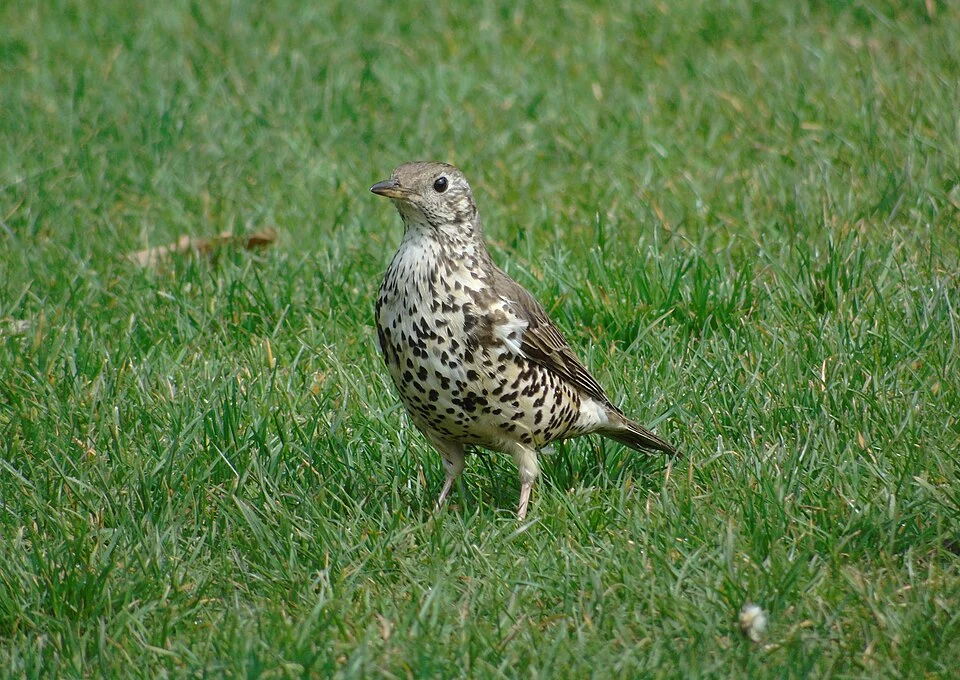
Turdus viscivorus (Mistle thrush), in Cardiff (Wales, United Kingdom).
Fernando Losada Rodríguez · CC BY-SA 4.0 · Image sourceProvider-generated thumbnail requested at 800 pixels; no local editing Local WebP display rendition; resized without cropping.
Open encyclopedia reference
The mistle thrush (Turdus viscivorus) is a bird common to much of Europe, temperate Asia and North Africa. It is a year-round resident in a large part of its range, but northern and eastern populations migrate south for the winter, often in small flocks. It is a large thrush with pale grey-brown upper parts, a greyish-white chin and throat, and black spots on its pale yellow and off-white under parts. The sexes are similar in plumage, and its three subspecies show only minimal differences. The male has a loud, far-carrying song which is delivered even in wet and windy weather, earning the bird the old name of stormcock. Historically, the name was also sometimes spelled "missel thrush". Found in open woods, parks, hedges and cultivated land, the mistle thrush feeds on a wide variety of invertebrates, seeds and berries. Its preferred fruit include those of mistletoe, holly, rowan, and yew.
Wikipedia contributors, Mistle thrush; see linked history · CC BY-SA 4.0 . Plain-text lead excerpt, at most 180 words; no infobox or later sections Retrieved 2026-10-05T03:29:51.924130+00:00. This reference remains separate from the taxonomic record.
Identity & source status
- Scientific name
- Turdus viscivorus Linnaeus, 1758
- Name authority
- Linnaeus, 1758
- Common name
- Mistle Thrush
- Rank
- species
- Accepted status
- accepted
- Kingdom
- Animalia
- Phylum
- Chordata
- Class
- Aves
- Order
- Passeriformes
- Family
- Turdidae
- Genus
- Turdus
- Extinction status
- Recorded extant
Classification family tree
Nested taxonomic groups from the source. This is not a direct-ancestor chain, a dated evolutionary tree or a phylogenetic reconstruction.
- domainEukaryota (Chatton, 1925) Whittaker & Margulis, 1978
- kingdomAnimalia
- phylumChordata
- subphylumVertebrata
- infraphylumGnathostomata
- parvphylumOsteichthyes
- megaclassTetrapoda
- classAves
- orderPasseriformes
- familyTurdidae Rafinesque, 1815
- genusTurdus Linnaeus, 1758
- speciesTurdus viscivorus Linnaeus, 1758
Close classified relatives
These entries share the source’s genus, Turdus. They are not necessarily the closest relatives established by molecular evidence.
| Species | Classification | Source status |
|---|---|---|
| White-necked ThrushTurdus albicollis Vieillot, 1818 | TurdidaeChordata | Accepted speciesRecorded extant |
| Creamy-bellied ThrushTurdus amaurochalinus Cabanis, 1851 | TurdidaeChordata | Accepted speciesRecorded extant |
| White-throated RobinTurdus assimilis Cabanis, 1851 | TurdidaeChordata | Accepted speciesRecorded extant |
| Black-throated ThrushTurdus atrogularis Jarocki, 1819 | TurdidaeChordata | Accepted speciesRecorded extant |
| Comoro ThrushTurdus bewsheri E. Newton, 1877 | TurdidaeChordata | Accepted speciesRecorded extant |
| Dusky ThrushTurdus eunomus Temminck, 1831 | TurdidaeChordata | Accepted speciesRecorded extant |
| Grey-sided ThrushTurdus feae (Salvadori, 1887) | TurdidaeChordata | Accepted speciesRecorded extant |
| Yellow-legged ThrushTurdus flavipes Vieillot, 1818 | TurdidaeChordata | Accepted speciesRecorded extant |
| Cocoa ThrushTurdus fumigatus M. H. C. Lichtenstein, 1823 | TurdidaeChordata | Accepted speciesRecorded extant |
| Clay-colored RobinTurdus grayi Bonaparte, 1838 | TurdidaeChordata | Accepted speciesRecorded extant |
| Grey-backed ThrushTurdus hortulorum P. L. Sclater, 1863 | TurdidaeChordata | Accepted speciesRecorded extant |
| White-eyed ThrushTurdus jamaicensis J. F. Gmelin, 1789 | TurdidaeChordata | Accepted speciesRecorded extant |
Documented distribution
Source distribution statements, not a complete range map. A listed locality is not necessarily a place of origin.
Europe & Northern Asia (excluding China)
Southern Asia
Source literature & publication evidence
References attached to this source record, including nomenclatural citations where supplied. This is a selected bibliography; abbreviated citations remain in the source’s form.
- Linnaeus, & Carolus. (1758). Systema Naturae per Regna Tria Naturae, Secundum Classes, Ordines, Genera, Species, Cum Characteribus, Differentiis, Synonymis, Locis, 10th Edition, Vol. 1. Source fields: Taxon.tsv dwc:namePublishedIn, Taxon.tsv dcterms:references
Origins, evidence & remaining research
Name authority and publication references document nomenclature where the source supplies it. They do not establish evolutionary origins or the earliest fossil occurrence.
Specimen-level evidence, morphology, ecological research, phylogenetic studies, a comprehensive bibliography and a located literary passage have not yet been compiled for this record.
Dataset citation & attribution
This exact taxon in ChecklistBank · Catalogue of Life 2026-09-11
Catalogue of Life 2026-09-11; dataset 316321; doi:10.48580/dgz5n. https://creativecommons.org/licenses/by/4.0/ . Retrieved 5 October 2026.
Stable key: col:59PNF. Classification follows source parent identifiers. English common names may vary by region.