
NATURAL HISTORY · CATALOGUE RECORD
Ring Ouzel
Turdus torquatus Linnaeus, 1758
Source-backed taxonomic record
Accepted species in Catalogue of Life’s 11 September 2026 base release. This preserves the source classification and available supporting data; it is not a completed species monograph.
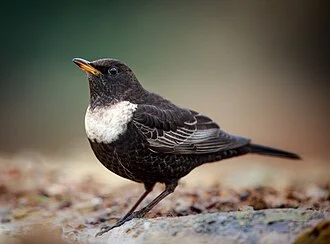
Merle à plastron sous-espèce torquatus, Espagne
Paco Gómez · CC BY-SA 2.0 · Image sourceProvider-generated thumbnail requested at 320 pixels; no local editing Local WebP display rendition; resized without cropping.
Open encyclopedia reference
The ring ouzel (Turdus torquatus) is a mainly European member of the thrush family Turdidae. It is a medium-sized thrush, 23–24 centimetres (9.1–9.4 in) in length and weighing 90–138 grams (3.2–4.9 oz). The male is predominantly black with a conspicuous white crescent across its breast. Females are browner and duller than males, and young birds may lack the pale chest markings altogether. In all but the northernmost part of its range, this is a high-altitude species, with three subspecies breeding in mountains from Ireland east to Iran. It breeds in open mountain areas with some trees or shrubs, the latter often including juniper and other treeline conifers, rowan, bilberry, heather, and hairy alpenrose. It is a migratory bird, leaving the breeding areas to winter in southern Europe, North Africa and Turkey, typically in mountains with junipers. The typical clutch is 3–6 brown-flecked pale blue or greenish-blue eggs. They are incubated almost entirely by the female, with hatching normally occurring after 13 days.
Wikipedia contributors, Ring ouzel; see linked history · CC BY-SA 4.0 . Plain-text lead excerpt, at most 180 words; no infobox or later sections Retrieved 2026-10-05T02:02:54.585550+00:00. This reference remains separate from the taxonomic record.
Identity & source status
- Scientific name
- Turdus torquatus Linnaeus, 1758
- Name authority
- Linnaeus, 1758
- Common name
- Ring Ouzel
- Rank
- species
- Accepted status
- accepted
- Kingdom
- Animalia
- Phylum
- Chordata
- Class
- Aves
- Order
- Passeriformes
- Family
- Turdidae
- Genus
- Turdus
- Extinction status
- Recorded extant
Classification family tree
Nested taxonomic groups from the source. This is not a direct-ancestor chain, a dated evolutionary tree or a phylogenetic reconstruction.
- domainEukaryota (Chatton, 1925) Whittaker & Margulis, 1978
- kingdomAnimalia
- phylumChordata
- subphylumVertebrata
- infraphylumGnathostomata
- parvphylumOsteichthyes
- megaclassTetrapoda
- classAves
- orderPasseriformes
- familyTurdidae Rafinesque, 1815
- genusTurdus Linnaeus, 1758
- speciesTurdus torquatus Linnaeus, 1758
Close classified relatives
These entries share the source’s genus, Turdus. They are not necessarily the closest relatives established by molecular evidence.
| Species | Classification | Source status |
|---|---|---|
| White-necked ThrushTurdus albicollis Vieillot, 1818 | TurdidaeChordata | Accepted speciesRecorded extant |
| Creamy-bellied ThrushTurdus amaurochalinus Cabanis, 1851 | TurdidaeChordata | Accepted speciesRecorded extant |
| White-throated RobinTurdus assimilis Cabanis, 1851 | TurdidaeChordata | Accepted speciesRecorded extant |
| Black-throated ThrushTurdus atrogularis Jarocki, 1819 | TurdidaeChordata | Accepted speciesRecorded extant |
| Comoro ThrushTurdus bewsheri E. Newton, 1877 | TurdidaeChordata | Accepted speciesRecorded extant |
| Dusky ThrushTurdus eunomus Temminck, 1831 | TurdidaeChordata | Accepted speciesRecorded extant |
| Grey-sided ThrushTurdus feae (Salvadori, 1887) | TurdidaeChordata | Accepted speciesRecorded extant |
| Yellow-legged ThrushTurdus flavipes Vieillot, 1818 | TurdidaeChordata | Accepted speciesRecorded extant |
| Cocoa ThrushTurdus fumigatus M. H. C. Lichtenstein, 1823 | TurdidaeChordata | Accepted speciesRecorded extant |
| Clay-colored RobinTurdus grayi Bonaparte, 1838 | TurdidaeChordata | Accepted speciesRecorded extant |
| Grey-backed ThrushTurdus hortulorum P. L. Sclater, 1863 | TurdidaeChordata | Accepted speciesRecorded extant |
| White-eyed ThrushTurdus jamaicensis J. F. Gmelin, 1789 | TurdidaeChordata | Accepted speciesRecorded extant |
Documented distribution
Source distribution statements, not a complete range map. A listed locality is not necessarily a place of origin.
Source literature & publication evidence
References attached to this source record, including nomenclatural citations where supplied. This is a selected bibliography; abbreviated citations remain in the source’s form.
- Linnaeus, & Carolus. (1758). Systema Naturae per Regna Tria Naturae, Secundum Classes, Ordines, Genera, Species, Cum Characteribus, Differentiis, Synonymis, Locis, 10th Edition, Vol. 1. Source fields: Taxon.tsv dwc:namePublishedIn, Taxon.tsv dcterms:references
Origins, evidence & remaining research
Name authority and publication references document nomenclature where the source supplies it. They do not establish evolutionary origins or the earliest fossil occurrence.
Specimen-level evidence, morphology, ecological research, phylogenetic studies, a comprehensive bibliography and a located literary passage have not yet been compiled for this record.
Dataset citation & attribution
This exact taxon in ChecklistBank · Catalogue of Life 2026-09-11
Catalogue of Life 2026-09-11; dataset 316321; doi:10.48580/dgz5n. https://creativecommons.org/licenses/by/4.0/ . Retrieved 5 October 2026.
Stable key: col:59PND. Classification follows source parent identifiers. English common names may vary by region.