
NATURAL HISTORY · CATALOGUE RECORD
Bongo
Tragelaphus eurycerus (Ogilby, 1837)
Source-backed taxonomic record
Accepted species in Catalogue of Life’s 11 September 2026 base release. This preserves the source classification and available supporting data; it is not a completed species monograph.
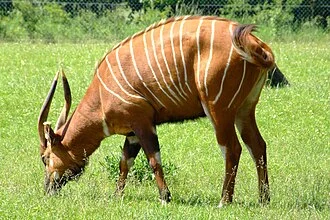
A Bongo at Marwell Wildlife, Hampshire, England.
Charles Miller from Basingstoke, United Kingdom · CC BY 2.0 · Image sourceProvider-generated thumbnail requested at 320 pixels; no local editing Local WebP display rendition; resized without cropping.
Open encyclopedia reference
The bongo (Tragelaphus eurycerus) is a large, mostly nocturnal, forest-dwelling antelope, native to sub-Saharan Africa. Bongos are characterised by a striking reddish-brown coat, black-and-white markings, white-yellow stripes, and long, slightly spiraled horns. Bongos have complex social interactions and are found in African dense forest mosaics. They are the third-largest antelope in the world.
In 2000, the Association of Zoos and Aquariums in the US upgraded the bongo to a Species Survival Plan participant and in 2006 added the Bongo Restoration to Mount Kenya Project to its list of the Top Ten Wildlife Conservation Success Stories of the year. As of 2013, these successes have been compromised by reports of possibly only 100 mountain bongos left in the wild due to logging and poaching.
Wikipedia contributors, Bongo (antelope); see linked history · CC BY-SA 4.0 . Plain-text lead excerpt, at most 180 words; no infobox or later sections Retrieved 2026-10-05T01:20:07.147400+00:00. This reference remains separate from the taxonomic record.
Identity & source status
- Scientific name
- Tragelaphus eurycerus (Ogilby, 1837)
- Name authority
- (Ogilby, 1837)
- Common name
- Bongo
- Rank
- species
- Accepted status
- accepted
- Kingdom
- Animalia
- Phylum
- Chordata
- Class
- Mammalia
- Order
- Artiodactyla
- Family
- Bovidae
- Genus
- Tragelaphus
- Extinction status
- Recorded extant
Classification family tree
Nested taxonomic groups from the source. This is not a direct-ancestor chain, a dated evolutionary tree or a phylogenetic reconstruction.
- domainEukaryota (Chatton, 1925) Whittaker & Margulis, 1978
- kingdomAnimalia
- phylumChordata
- subphylumVertebrata
- infraphylumGnathostomata
- parvphylumOsteichthyes
- megaclassTetrapoda
- classMammalia Linnaeus, 1758
- subclassTheria Parker & Haswell, 1897
- infraclassEutheria Gill, 1872
- orderArtiodactyla Owen, 1848
- familyBovidae Gray, 1821
- subfamilyBovinae Gray, 1821
- tribeTragelaphini Blyth, 1863
- genusTragelaphus Blainville, 1816
- speciesTragelaphus eurycerus (Ogilby, 1837)
Close classified relatives
These entries share the source’s genus, Tragelaphus. They are not necessarily the closest relatives established by molecular evidence.
| Species | Classification | Source status |
|---|---|---|
| GedemsaTragelaphus buxtoni (Lydekker, 1910) | BovidaeChordata | Accepted speciesRecorded extant |
| BushbuckTragelaphus scriptus (Pallas, 1766) | BovidaeChordata | Accepted speciesRecorded extant |
| Lake Victoria SitatungaTragelaphus spekii Speke, 1863 | BovidaeChordata | Accepted speciesRecorded extant |
| Nile SitatungaTragelaphus larkenii (St. Leger, 1931) | BovidaeChordata | Accepted speciesRecorded extant |
| Nkosi Island SitatungaTragelaphus sylvestris (Meinertzhagen, 1916) | BovidaeChordata | Accepted speciesRecorded extant |
Names & synonyms
Names explicitly linked to this accepted taxon in the source. Synonymy can change with revision.
| Recorded name | Source status |
|---|---|
| Antilope eurycerus Ogilby, 1837 Ogilby, 1837 | synonym |
Documented distribution
Source distribution statements, not a complete range map. A listed locality is not necessarily a place of origin.
Source literature & publication evidence
References attached to this source record, including nomenclatural citations where supplied. This is a selected bibliography; abbreviated citations remain in the source’s form.
- https://www.itis.gov/servlet/SingleRpt/SingleRpt?search_topic=TSN&search_value=625130 Source fields: Taxon.tsv dwc:namePublishedIn, Taxon.tsv dcterms:references
Origins, evidence & remaining research
Name authority and publication references document nomenclature where the source supplies it. They do not establish evolutionary origins or the earliest fossil occurrence.
Specimen-level evidence, morphology, ecological research, phylogenetic studies, a comprehensive bibliography and a located literary passage have not yet been compiled for this record.
Dataset citation & attribution
This exact taxon in ChecklistBank · Catalogue of Life 2026-09-11
Catalogue of Life 2026-09-11; dataset 316321; doi:10.48580/dgz5n. https://creativecommons.org/licenses/by/4.0/ . Retrieved 5 October 2026.
Stable key: col:57VQQ. Classification follows source parent identifiers. English common names may vary by region.