
NATURAL HISTORY · CATALOGUE RECORD
Black-headed Ibis
Threskiornis melanocephalus (Latham, 1790)
Source-backed taxonomic record
Accepted species in Catalogue of Life’s 11 September 2026 base release. This preserves the source classification and available supporting data; it is not a completed species monograph.
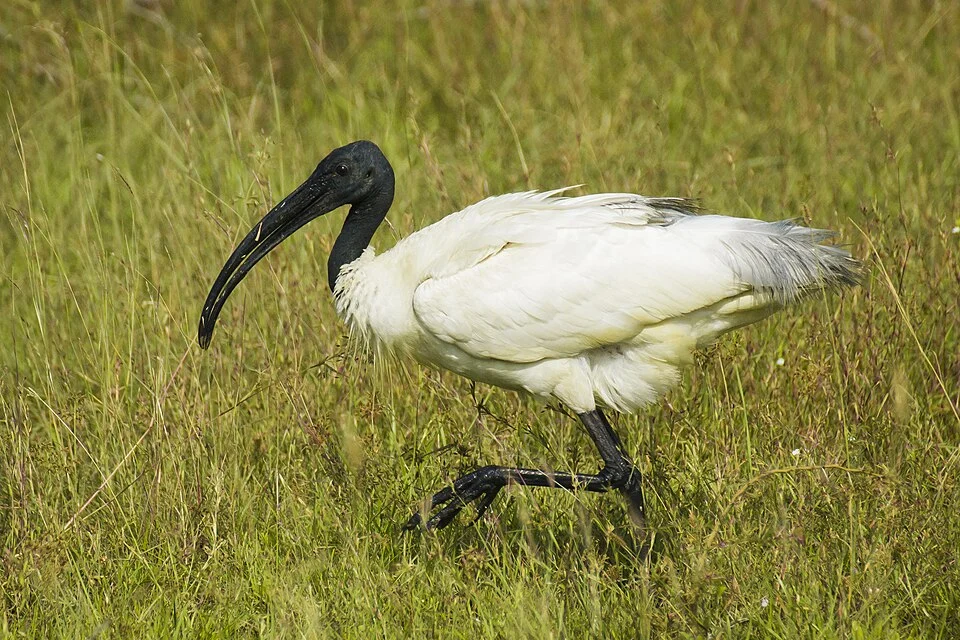
Black-headed Ibis (Threskiornis melanocephalus) photographed in natural habitat, Tirunelveli, India. It is a near-threatened species of wading bird breeding in Asia from India to the west as far as Japan in the east. A large waterbird with adults measuring 65-76 cm in length, it is the only native ibis species in its range that has an overall white plumage starkly contrasted against a conspicuous naked black neck and head and a black, down-curved beak. Tails of adults bear light grey ornamental feathers that turn black during the breeding season, as can be seen here. Like storks and spoonbills, it lacks a true voice-producing mechanism and is silent except for ventriloquistic grunts uttered by pairs at the nest. A versatile species that uses a large variety of natural and man-made habitats including freshwater and saltwater marshes, lakes and ponds, crop fields, irrigation canals, urban lakes and grazing lots, they are now categorized as Near Threatened (NT) by the International Union for Conservation of Nature as their population has declined considerably in southeast Asia.
Hari Krishnan · CC BY-SA 4.0 · Image sourceProvider-generated thumbnail requested at 800 pixels; no local editing Local WebP display rendition; resized without cropping.
Open encyclopedia reference
The black-headed ibis (Threskiornis melanocephalus), also known as the Oriental white ibis, Indian white ibis, and black-necked ibis, is a species of wading bird of the ibis family Threskiornithidae which breeds in the South and Southeast Asia from India to the west and as far east as Japan. It is the only native ibis species in its range that has an overall white plumage with a black neck and head. The down-curved beak and legs are also black. Though often referred to as a wetland species, the black-headed ibis forages in a range of natural and man-made habitats. This species of ibis nests only during the rainy season.
Wikipedia contributors, Black-headed ibis; see linked history · CC BY-SA 4.0 . Plain-text lead excerpt, at most 180 words; no infobox or later sections Retrieved 2026-10-05T06:12:17.495681+00:00. This reference remains separate from the taxonomic record.
Identity & source status
- Scientific name
- Threskiornis melanocephalus (Latham, 1790)
- Name authority
- (Latham, 1790)
- Common name
- Black-headed Ibis
- Rank
- species
- Accepted status
- accepted
- Kingdom
- Animalia
- Phylum
- Chordata
- Class
- Aves
- Order
- Pelecaniformes
- Family
- Threskiornithidae
- Genus
- Threskiornis
- Extinction status
- Recorded extant
Classification family tree
Nested taxonomic groups from the source. This is not a direct-ancestor chain, a dated evolutionary tree or a phylogenetic reconstruction.
- domainEukaryota (Chatton, 1925) Whittaker & Margulis, 1978
- kingdomAnimalia
- phylumChordata
- subphylumVertebrata
- infraphylumGnathostomata
- parvphylumOsteichthyes
- megaclassTetrapoda
- classAves
- orderPelecaniformes
- familyThreskiornithidae Poche, 1904
- genusThreskiornis G. R. Gray, 1842
- speciesThreskiornis melanocephalus (Latham, 1790)
Close classified relatives
These entries share the source’s genus, Threskiornis. They are not necessarily the closest relatives established by molecular evidence.
| Species | Classification | Source status |
|---|---|---|
| Malagasy Sacred IbisThreskiornis bernieri (Bonaparte, 1855) | ThreskiornithidaeChordata | Accepted speciesRecorded extant |
| Reunion IbisThreskiornis solitarius (de Sélys-Longchamps, 1848) | ThreskiornithidaeChordata | Accepted speciesRecorded extinct |
| Straw-necked IbisThreskiornis spinicollis (Jameson, 1835) | ThreskiornithidaeChordata | Accepted speciesRecorded extant |
| African Sacred IbisThreskiornis aethiopicus (Latham, 1790) | ThreskiornithidaeChordata | Accepted speciesRecorded extant |
Names & synonyms
Names explicitly linked to this accepted taxon in the source. Synonymy can change with revision.
| Recorded name | Source status |
|---|---|
| Tantalus melanocephalus Latham, 1790 Latham, 1790 | synonym |
Documented distribution
Source distribution statements, not a complete range map. A listed locality is not necessarily a place of origin.
Source literature & publication evidence
References attached to this source record, including nomenclatural citations where supplied. This is a selected bibliography; abbreviated citations remain in the source’s form.
- https://www.itis.gov/servlet/SingleRpt/SingleRpt?search_topic=TSN&search_value=174944 Source fields: Taxon.tsv dwc:namePublishedIn, Taxon.tsv dcterms:references
Origins, evidence & remaining research
Name authority and publication references document nomenclature where the source supplies it. They do not establish evolutionary origins or the earliest fossil occurrence.
Specimen-level evidence, morphology, ecological research, phylogenetic studies, a comprehensive bibliography and a located literary passage have not yet been compiled for this record.
Dataset citation & attribution
This exact taxon in ChecklistBank · Catalogue of Life 2026-09-11
Catalogue of Life 2026-09-11; dataset 316321; doi:10.48580/dgz5n. https://creativecommons.org/licenses/by/4.0/ . Retrieved 5 October 2026.
Stable key: col:56LQD. Classification follows source parent identifiers. English common names may vary by region.