
NATURAL HISTORY · CATALOGUE RECORD
Etruscan Shrew
Suncus etruscus (Savi, 1822)
Source-backed taxonomic record
Accepted species in Catalogue of Life’s 11 September 2026 base release. This preserves the source classification and available supporting data; it is not a completed species monograph.
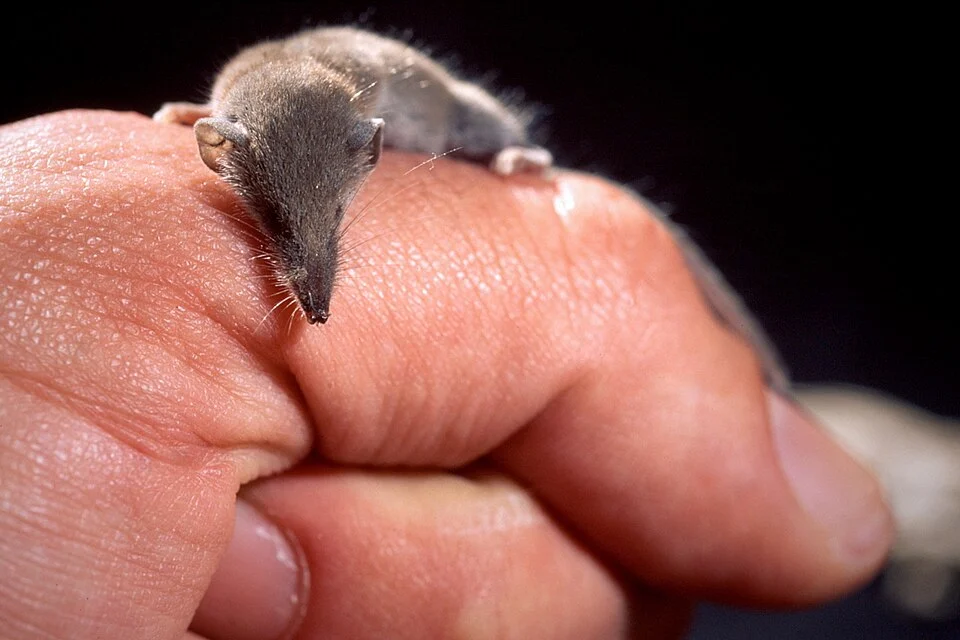
Suncus etruscus, the smallest mammal by weight of the world. Portrait over hand for comparison.
Trebol-a · CC BY-SA 3.0 · Image sourceProvider-generated thumbnail requested at 800 pixels; no local editing Local WebP display rendition; resized without cropping.
Open encyclopedia reference
The Etruscan shrew (Suncus etruscus), also known as the Etruscan pygmy shrew, white-toothed pygmy shrew and Savi's pygmy shrew, is the smallest known extant mammal by mass, weighing only about 1.8 g (0.063 oz) on average - as much as a paperclip. (The bumblebee bat is regarded as the smallest mammal by skull size and body length.)
The Etruscan shrew has a body length of about 4 cm (1.6 in) excluding the tail. It is characterized by very rapid movements and a fast metabolism, eating about 1.5–2 times its own body weight per day. It feeds on various small vertebrates and invertebrates, mostly insects, and can hunt individuals of the same size as itself. These shrews prefer warm and damp climates and are widely distributed in the belt between 10° and 45°N latitude stretching from Europe and North Africa to Malaysia. They are also found in the Maltese islands, situated in the middle of the Mediterranean Sea. Although widespread and not threatened overall, they are generally uncommon and are endangered in some countries.
Wikipedia contributors, Etruscan shrew; see linked history · CC BY-SA 4.0 . Plain-text lead excerpt, at most 180 words; no infobox or later sections Retrieved 2026-10-05T03:40:49.862978+00:00. This reference remains separate from the taxonomic record.
Identity & source status
- Scientific name
- Suncus etruscus (Savi, 1822)
- Name authority
- (Savi, 1822)
- Common name
- Etruscan Shrew
- Rank
- species
- Accepted status
- accepted
- Kingdom
- Animalia
- Phylum
- Chordata
- Class
- Mammalia
- Order
- Eulipotyphla
- Family
- Soricidae
- Genus
- Suncus
- Extinction status
- Recorded extant
Classification family tree
Nested taxonomic groups from the source. This is not a direct-ancestor chain, a dated evolutionary tree or a phylogenetic reconstruction.
- domainEukaryota (Chatton, 1925) Whittaker & Margulis, 1978
- kingdomAnimalia
- phylumChordata
- subphylumVertebrata
- infraphylumGnathostomata
- parvphylumOsteichthyes
- megaclassTetrapoda
- classMammalia Linnaeus, 1758
- subclassTheria Parker & Haswell, 1897
- infraclassEutheria Gill, 1872
- orderEulipotyphla Waddell, Okada & Hasegawa, 1999
- familySoricidae G. Fischer, 1814
- subfamilyCrocidurinae A. Milne-Edwards, 1872
- genusSuncus Ehrenberg, 1832
- speciesSuncus etruscus (Savi, 1822)
Close classified relatives
These entries share the source’s genus, Suncus. They are not necessarily the closest relatives established by molecular evidence.
| Species | Classification | Source status |
|---|---|---|
| Day's ShrewSuncus dayi (Dobson, 1888) | SoricidaeChordata | Accepted speciesRecorded extant |
| Sri Lanka ShrewSuncus fellowesgordoni W. W. A. Phillips, 1932 | SoricidaeChordata | Accepted speciesRecorded extant |
| Least Dwarf ShrewSuncus infinitesimus (Heller, 1912) | SoricidaeChordata | Accepted speciesRecorded extant |
| Malayan Pygmy ShrewSuncus malayanus (Kloss, 1917) | SoricidaeChordata | Accepted speciesRecorded extant |
| Lesser Dwarf ShrewSuncus varilla (Thomas, 1895) | SoricidaeChordata | Accepted speciesRecorded extant |
| Jungle ShrewSuncus zeylanicus Phillips, 1928 | SoricidaeChordata | Accepted speciesRecorded extant |
| Bornean Pgymy ShrewSuncus hosei (Thomas, 1893) | SoricidaeChordata | Accepted speciesRecorded extant |
| Nilgiri Highland ShrewSuncus niger Horsfield, 1851 | SoricidaeChordata | Accepted speciesRecorded extant |
| Taita ShrewSuncus aequatorius (Heller, 1912) | SoricidaeChordata | Accepted speciesRecorded extant |
| Black ShrewSuncus ater Medway, 1965 | SoricidaeChordata | Accepted speciesRecorded extant |
| Greater Dwarf ShrewSuncus lixa (Thomas, 1898) | SoricidaeChordata | Accepted speciesRecorded extant |
| Climbing ShrewSuncus megalurus (Jentink, 1888) | SoricidaeChordata | Accepted speciesRecorded extant |
Names & synonyms
Names explicitly linked to this accepted taxon in the source. Synonymy can change with revision.
| Recorded name | Source status |
|---|---|
| Sorex etruscus Savi, 1822 Savi, 1822 | synonym |
Documented distribution
Source distribution statements, not a complete range map. A listed locality is not necessarily a place of origin.
Europe & Northern Asia (excluding China)
Southern Asia
Source literature & publication evidence
References attached to this source record, including nomenclatural citations where supplied. This is a selected bibliography; abbreviated citations remain in the source’s form.
- https://www.itis.gov/servlet/SingleRpt/SingleRpt?search_topic=TSN&search_value=633726 Source fields: Taxon.tsv dwc:namePublishedIn, Taxon.tsv dcterms:references
Origins, evidence & remaining research
Name authority and publication references document nomenclature where the source supplies it. They do not establish evolutionary origins or the earliest fossil occurrence.
Specimen-level evidence, morphology, ecological research, phylogenetic studies, a comprehensive bibliography and a located literary passage have not yet been compiled for this record.
Dataset citation & attribution
This exact taxon in ChecklistBank · Catalogue of Life 2026-09-11
Catalogue of Life 2026-09-11; dataset 316321; doi:10.48580/dgz5n. https://creativecommons.org/licenses/by/4.0/ . Retrieved 5 October 2026.
Stable key: col:53G5S. Classification follows source parent identifiers. English common names may vary by region.