
NATURAL HISTORY · CATALOGUE RECORD
Black-throated Blue Warbler
Setophaga caerulescens (J. F. Gmelin, 1789)
Source-backed taxonomic record
Accepted species in Catalogue of Life’s 11 September 2026 base release. This preserves the source classification and available supporting data; it is not a completed species monograph.
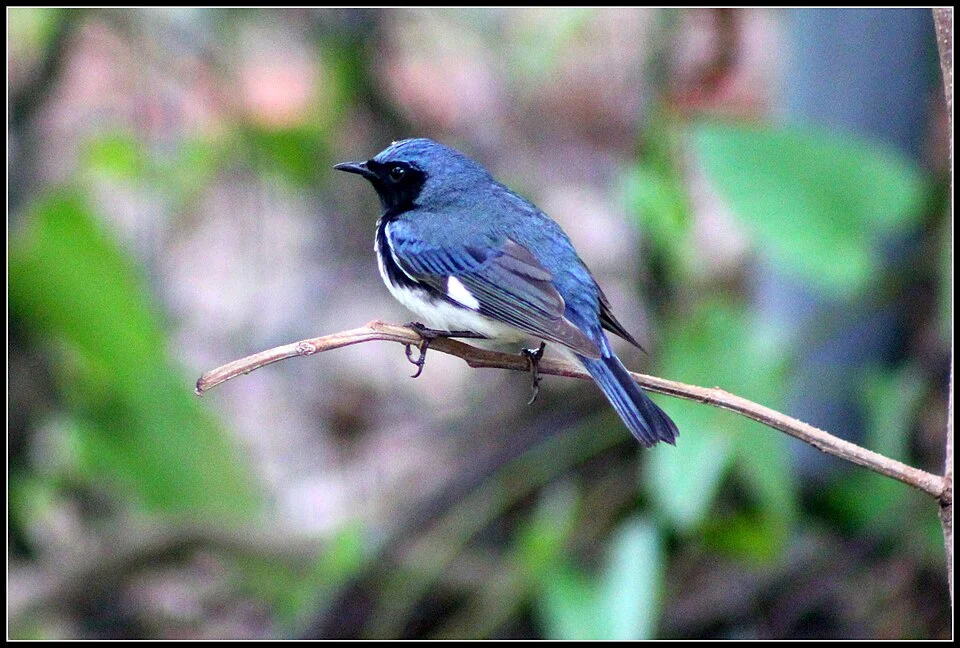
FIELD MARKS-Black-throated Blue Warbler male is dark blue on head and upperparts, with black face, throat, sides of the breast and flanks, contrasting with gleaming white centre of breast and lower underparts and conspicuous white patch at base of primaries. It has conspicuous white patches in outer tail. Legs are black. Eyes are black. Bill is short, thin and black. --Female has a rather dull dark greyish-olive green above and buffy-yellow below with conspicuous whitish surpercilium, a broken whitish eye ring, and a whitish patch at base of primaries. Immature is similar to adult. Back and head feathers of male are edged with green, undersides are tinged yellow, and has some white tips to black feathers on throat. Young female is like adult, more yellowish and sometimes without white spot on wing.
cuatrok77 · CC BY 2.0 · Image sourceProvider-generated thumbnail requested at 800 pixels; no local editing Local WebP display rendition; resized without cropping.
Open encyclopedia reference
The black-throated blue warbler (Setophaga caerulescens) is a small passerine bird of the New World warbler family. Its breeding ranges are located in the interior of deciduous and mixed coniferous forests in eastern North America. Over the cooler months, it migrates to islands in the Caribbean and Central America. It is very rarely found in western Europe, where it is considered to be a non-indigenous species. The black-throated blue warbler is sexually dimorphic; the adult male has a black face and cheeks, deep blue upperparts and white underparts, while the adult female is olive-brown above and light yellow below. Predominantly insectivorous, the black-throated blue warbler supplements its diet with berries and seeds in winter. It builds its nests in thick shrubs and the closeness of its nesting sites to the ground make it a favored species for the study of warbler behavior in the wild. The black-throated blue warbler defends its territory against other birds of the same species for both nesting and winter habitats.
Wikipedia contributors, Black-throated blue warbler; see linked history · CC BY-SA 4.0 . Plain-text lead excerpt, at most 180 words; no infobox or later sections Retrieved 2026-10-05T11:49:25.875505+00:00. This reference remains separate from the taxonomic record.
Identity & source status
- Scientific name
- Setophaga caerulescens (J. F. Gmelin, 1789)
- Name authority
- (J. F. Gmelin, 1789)
- Common name
- Black-throated Blue Warbler
- Rank
- species
- Accepted status
- accepted
- Kingdom
- Animalia
- Phylum
- Chordata
- Class
- Aves
- Order
- Passeriformes
- Family
- Parulidae
- Genus
- Setophaga
- Extinction status
- Recorded extant
Classification family tree
Nested taxonomic groups from the source. This is not a direct-ancestor chain, a dated evolutionary tree or a phylogenetic reconstruction.
- domainEukaryota (Chatton, 1925) Whittaker & Margulis, 1978
- kingdomAnimalia
- phylumChordata
- subphylumVertebrata
- infraphylumGnathostomata
- parvphylumOsteichthyes
- megaclassTetrapoda
- classAves
- orderPasseriformes
- familyParulidae
- genusSetophaga Swainson, 1827
- speciesSetophaga caerulescens (J. F. Gmelin, 1789)
Close classified relatives
These entries share the source’s genus, Setophaga. They are not necessarily the closest relatives established by molecular evidence.
| Species | Classification | Source status |
|---|---|---|
| Cerulean WarblerSetophaga cerulea (A. Wilson, 1810) | ParulidaeChordata | Accepted speciesRecorded extant |
| Golden-cheeked WarblerSetophaga chrysoparia (P. L. Sclater & Salvin, 1860) | ParulidaeChordata | Accepted speciesRecorded extant |
| Hooded WarblerSetophaga citrina (Boddaert, 1783) | ParulidaeChordata | Accepted speciesRecorded extant |
| Myrtle WarblerSetophaga coronata (Linnaeus, 1766) | ParulidaeChordata | Accepted speciesRecorded extant |
| St. Lucia WarblerSetophaga delicata (Ridgway, 1883) | ParulidaeChordata | Accepted speciesRecorded extant |
| Bahama WarblerSetophaga flavescens (Todd, 1909) | ParulidaeChordata | Accepted speciesRecorded extant |
| Blackburnian WarblerSetophaga fusca (P. L. S. Müller, 1776) | ParulidaeChordata | Accepted speciesRecorded extant |
| Kirtland's WarblerSetophaga kirtlandii (S. F. Baird, 1852) | ParulidaeChordata | Accepted speciesRecorded extant |
| Magnolia WarblerSetophaga magnolia (A. Wilson, 1811) | ParulidaeChordata | Accepted speciesRecorded extant |
| Hermit WarblerSetophaga occidentalis (J. K. Townsend, 1837) | ParulidaeChordata | Accepted speciesRecorded extant |
| Palm WarblerSetophaga palmarum (J. F. Gmelin, 1789) | ParulidaeChordata | Accepted speciesRecorded extant |
| Mangrove WarblerSetophaga petechia (Linnaeus, 1766) | ParulidaeChordata | Accepted speciesRecorded extant |
Names & synonyms
Names explicitly linked to this accepted taxon in the source. Synonymy can change with revision.
| Recorded name | Source status |
|---|---|
| Dendroica caerulescens (J. F. Gmelin, 1789) (J. F. Gmelin, 1789) | synonym |
| Motacilla caerulescens J. F. Gmelin, 1789 J. F. Gmelin, 1789 | synonym |
Documented distribution
Source distribution statements, not a complete range map. A listed locality is not necessarily a place of origin.
Source literature & publication evidence
References attached to this source record, including nomenclatural citations where supplied. This is a selected bibliography; abbreviated citations remain in the source’s form.
- https://www.itis.gov/servlet/SingleRpt/SingleRpt?search_topic=TSN&search_value=950042 Source fields: Taxon.tsv dwc:namePublishedIn, Taxon.tsv dcterms:references
Origins, evidence & remaining research
Name authority and publication references document nomenclature where the source supplies it. They do not establish evolutionary origins or the earliest fossil occurrence.
Specimen-level evidence, morphology, ecological research, phylogenetic studies, a comprehensive bibliography and a located literary passage have not yet been compiled for this record.
Dataset citation & attribution
This exact taxon in ChecklistBank · Catalogue of Life 2026-09-11
Catalogue of Life 2026-09-11; dataset 316321; doi:10.48580/dgz5n. https://creativecommons.org/licenses/by/4.0/ . Retrieved 5 October 2026.
Stable key: col:4X3BG. Classification follows source parent identifiers. English common names may vary by region.