
NATURAL HISTORY · CATALOGUE RECORD
Xeric Four-striped Grass Rat
Rhabdomys pumilio (Sparrman, 1784)
Source-backed taxonomic record
Accepted species in Catalogue of Life’s 11 September 2026 base release. This preserves the source classification and available supporting data; it is not a completed species monograph.
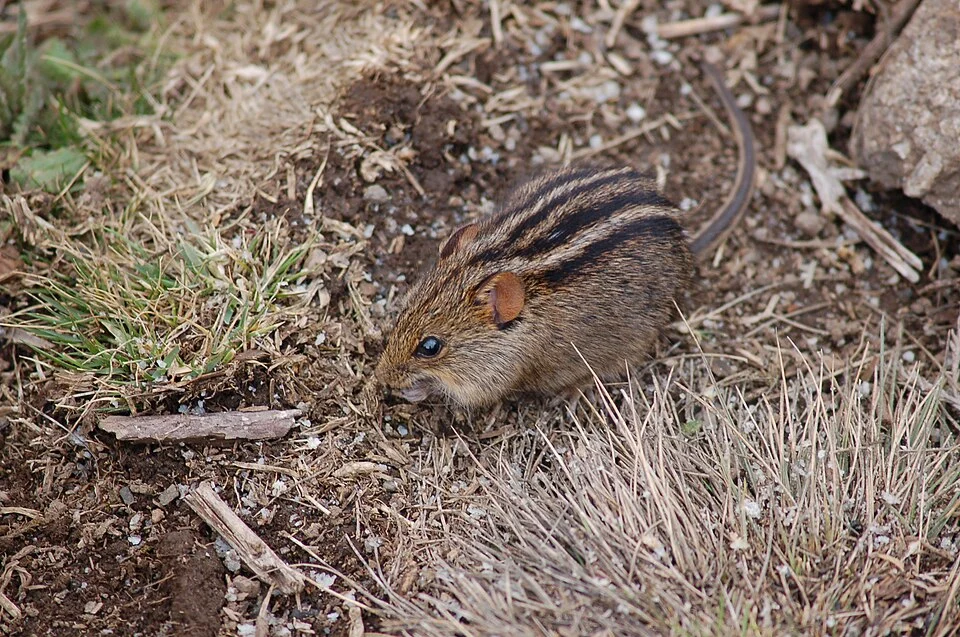
Four-striped Grass Mouse photographed on February 14, 2009, in Lemosho route while climbing Mount Kilimanjaro. Place: Lava Tower, Kilimanjaro, Tanzania.
C.R.Selvakumar செல்வா · CC BY-SA 3.0 · Image sourceProvider-generated thumbnail requested at 800 pixels; no local editing Local WebP display rendition; resized without cropping.
Open encyclopedia reference
The four-striped grass mouse (Rhabdomys pumilio) or four-striped grass rat is a species of rodent in the family Muridae.
It is found throughout the southern half of Africa up to 2,300 metres (7,500 ft) above sea level, extending as far north as the Democratic Republic of the Congo. Its has many natural habitats such as savannas, shrublands, Mediterranean-type shrubby vegetation, hot deserts, arable land, rural gardens, and urban areas. The presence of grass is the only essential component of its habitat. The four stripes running down its back, along with its red-brown ears, are its most distinct characteristics. Diet consists largely of seeds and plants, and occasionally insects. It nests in self-built burrows.
Wikipedia contributors, Four-striped grass mouse; see linked history · CC BY-SA 4.0 . Plain-text lead excerpt, at most 180 words; no infobox or later sections Retrieved 2026-10-05T12:50:12.679368+00:00. This reference remains separate from the taxonomic record.
Identity & source status
- Scientific name
- Rhabdomys pumilio (Sparrman, 1784)
- Name authority
- (Sparrman, 1784)
- Common name
- Xeric Four-striped Grass Rat
- Rank
- species
- Accepted status
- accepted
- Kingdom
- Animalia
- Phylum
- Chordata
- Class
- Mammalia
- Order
- Rodentia
- Family
- Muridae
- Genus
- Rhabdomys
- Extinction status
- Recorded extant
Classification family tree
Nested taxonomic groups from the source. This is not a direct-ancestor chain, a dated evolutionary tree or a phylogenetic reconstruction.
- domainEukaryota (Chatton, 1925) Whittaker & Margulis, 1978
- kingdomAnimalia
- phylumChordata
- subphylumVertebrata
- infraphylumGnathostomata
- parvphylumOsteichthyes
- megaclassTetrapoda
- classMammalia Linnaeus, 1758
- subclassTheria Parker & Haswell, 1897
- infraclassEutheria Gill, 1872
- orderRodentia Bowdich, 1821
- suborderMyomorpha Brandt, 1855
- superfamilyMuroidea Illiger, 1811
- familyMuridae Illiger, 1811
- subfamilyMurinae Illiger, 1811
- genusRhabdomys Thomas, 1916
- speciesRhabdomys pumilio (Sparrman, 1784)
Close classified relatives
These entries share the source’s genus, Rhabdomys. They are not necessarily the closest relatives established by molecular evidence.
| Species | Classification | Source status |
|---|---|---|
| Mesic Four-striped Grass RatRhabdomys dilectus (de Winton, 1897) | MuridaeChordata | Accepted speciesRecorded extant |
Names & synonyms
Names explicitly linked to this accepted taxon in the source. Synonymy can change with revision.
| Recorded name | Source status |
|---|---|
| Mus septemvittatus Schinz, 1845 Schinz, 1845 | synonym |
| Mus vittatus Wagner, 1842 Wagner, 1842 | synonym |
| Arvicanthis pumilio deserti Dollman, 1910 Dollman, 1910 | synonym |
| Arvicanthis pumilio griquae Wroughton, 1905 Wroughton, 1905 | synonym |
| Arvicanthis pumilio intermedius Wroughton, 1905 Wroughton, 1905 | synonym |
| Arvicanthis pumilio meridionalis Wroughton, 1905 Wroughton, 1905 | synonym |
| Isomys pumilio bechuanae Thomas, 1893 Thomas, 1893 | synonym |
| Mus pumilio major Brants, 1827 Brants, 1827 | synonym |
| Rhabdomys pumilio namibensis Roberts, 1926 Roberts, 1926 | synonym |
| Rhabdomys pumilio prieskae Roberts, 1946 Roberts, 1946 | synonym |
| Mus lineatus F. Cuvier, 1829 F. Cuvier, 1829 | ambiguous synonym |
| Arvicanthis pumilio cinereus Thomas & Schwann, 1904 Thomas & Schwann, 1904 | synonym |
| Rhabdomys pumilio namaquensis Roberts, 1946 Roberts, 1946 | synonym |
| Rhabdomys pumilio orangiae Roberts, 1946 Roberts, 1946 | synonym |
| Mus donavani Lesson, 1827 Lesson, 1827 | synonym |
| Rhabdomys pumilio fouriei Roberts, 1946 Roberts, 1946 | synonym |
Documented distribution
Source distribution statements, not a complete range map. A listed locality is not necessarily a place of origin.
Source literature & publication evidence
References attached to this source record, including nomenclatural citations where supplied. This is a selected bibliography; abbreviated citations remain in the source’s form.
- https://www.itis.gov/servlet/SingleRpt/SingleRpt?search_topic=TSN&search_value=585562 Source fields: Taxon.tsv dwc:namePublishedIn, Taxon.tsv dcterms:references
Origins, evidence & remaining research
Name authority and publication references document nomenclature where the source supplies it. They do not establish evolutionary origins or the earliest fossil occurrence.
Specimen-level evidence, morphology, ecological research, phylogenetic studies, a comprehensive bibliography and a located literary passage have not yet been compiled for this record.
Dataset citation & attribution
This exact taxon in ChecklistBank · Catalogue of Life 2026-09-11
Catalogue of Life 2026-09-11; dataset 316321; doi:10.48580/dgz5n. https://creativecommons.org/licenses/by/4.0/ . Retrieved 5 October 2026.
Stable key: col:4RW37. Classification follows source parent identifiers. English common names may vary by region.