
Rana arvalis Nilsson, 1842
Accepted species in Catalogue of Life’s 11 September 2026 base release. This preserves the source classification and available supporting data; it is not a completed species monograph.
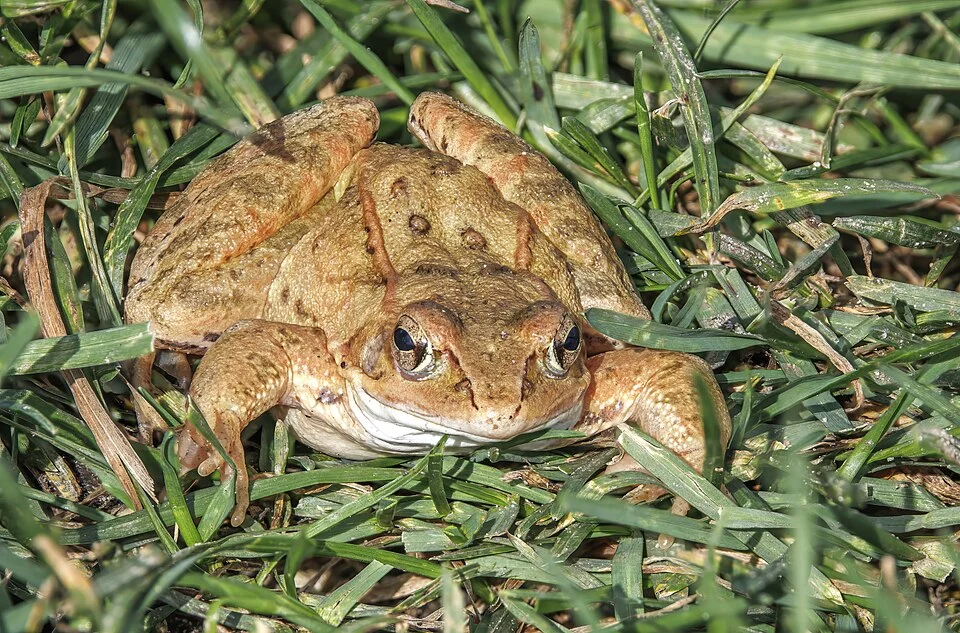
Moor frog (Rana arvalis), Glambecksee, Naturpark Uckermärkische, Germany
Charles J. Sharp · CC BY-SA 4.0 · Image sourceProvider-generated thumbnail requested at 800 pixels; no local editing Local WebP display rendition; resized without cropping.
Open encyclopedia reference
The moor frog (Rana arvalis) is a slim, reddish-brown, semiaquatic amphibian native to Europe and Asia. Moor frogs are known for their ability to freeze solid and survive thawing. The frog makes use of various cryoprotectants i.e. antifreeze that decrease its internal freezing temperature. The species is distributed over a large range, covering a significant portion of Eurasia. Male moor frogs are known to turn blue temporarily during the height of mating season. This coloration is assumed to signal a mate's fitness. Moor frogs typically mate through multimale amplexus, a form of polyandry. The moor frog spawns its eggs in large batches in still bodies of acidic waters. Human-caused pollution is causing excessive acidification of habitat which harms egg health. The moor frog's habitat is also under destruction due to a variety of other anthropogenic means. The species has an IUCN listing of Least Concern. However, a majority of European states independently consider the conservation status of the moor frog to be unfavorable.
Wikipedia contributors, Moor frog; see linked history · CC BY-SA 4.0 . Plain-text lead excerpt, at most 180 words; no infobox or later sections Retrieved 2026-10-05T18:24:20.079880+00:00. This reference remains separate from the taxonomic record.
Identity & source status
- Scientific name
- Rana arvalis Nilsson, 1842
- Name authority
- Nilsson, 1842
- Rank
- species
- Accepted status
- accepted
- Kingdom
- Animalia
- Phylum
- Chordata
- Class
- Amphibia
- Order
- Anura
- Family
- Ranidae
- Genus
- Rana
- Extinction status
- Recorded extant
Classification family tree
Nested taxonomic groups from the source. This is not a direct-ancestor chain, a dated evolutionary tree or a phylogenetic reconstruction.
- domainEukaryota (Chatton, 1925) Whittaker & Margulis, 1978
- kingdomAnimalia
- phylumChordata
- subphylumVertebrata
- infraphylumGnathostomata
- parvphylumOsteichthyes
- megaclassTetrapoda
- classAmphibia
- orderAnura
- familyRanidae Batsch, 1796
- genusRana Linnaeus, 1758
- speciesRana arvalis Nilsson, 1842
Close classified relatives
These entries share the source’s genus, Rana. They are not necessarily the closest relatives established by molecular evidence.
| Species | Classification | Source status |
|---|---|---|
| Rana asiatica Bedriaga, 1898 | RanidaeChordata | Accepted speciesRecorded extant |
| Rana chaochiaoensis Liu, 1946 | RanidaeChordata | Accepted speciesRecorded extant |
| Rana chevronta Hu & Ye, 1978 | RanidaeChordata | Accepted speciesRecorded extant |
| Rana culaiensis Li, Lu & Li, 2008 | RanidaeChordata | Accepted speciesRecorded extant |
| Rana huanrensis Fei, Ye & Huang, 1990 | RanidaeChordata | Accepted speciesRecorded extant |
| Rana iberica Boulenger, 1879 | RanidaeChordata | Accepted speciesRecorded extant |
| Rana japonica Boulenger, 1879 | RanidaeChordata | Accepted speciesRecorded extant |
| Rana maoershanensis Lu, Li & Jiang, 2007 | RanidaeChordata | Accepted speciesRecorded extant |
| Rana neba Ryuzaki, Hasegawa & Kuramoto, 2014 | RanidaeChordata | Accepted speciesRecorded extant |
| Rana macrocnemis Boulenger, 1885 | RanidaeChordata | Accepted speciesRecorded extant |
| European frogRana temporaria Linnaeus, 1758 | RanidaeChordata | Accepted speciesRecorded extant |
| Rana sakuraii Matsui & Matsui, 1990 | RanidaeChordata | Accepted speciesRecorded extant |
Names & synonyms
Names explicitly linked to this accepted taxon in the source. Synonymy can change with revision.
| Recorded name | Source status |
|---|---|
| Rana altaica Kashchenko, 1899 Kashchenko, 1899 | synonym |
| Rana oxyrrhinus Steenstrup, 1846 Steenstrup, 1846 | synonym |
| Rana asiatica oxyrrhinus Steenstrup, 1846 Steenstrup, 1846 | synonym |
| Rana arvalis arvalis Nilsson, 1842 Nilsson, 1842 | synonym |
| Rana arvalis striata Koch, 1872 Koch, 1872 | synonym |
| Rana temporaria arvalis Nilsson, 1842 Nilsson, 1842 | synonym |
| Rana terrestris wolterstorffi Fejérváry, 1919 Fejérváry, 1919 | synonym |
| Rana arvalis wolterstorffi Fejérváry, 1919 Fejérváry, 1919 | synonym |
| Rana temporaria oxyrrhina Steenstrup, 1846 Steenstrup, 1846 | synonym |
| Rana angustifrongs Schiff in Thomas, 1855 Schiff in Thomas, 1855 | synonym |
| Rana wolterstorffi Fejérváry, 1919 Fejérváry, 1919 | synonym |
| Rana oxyrhina Steenstrup, 1846 Steenstrup, 1846 | synonym |
| Rana oxyrhinus striatus Koch, 1872 Koch, 1872 | synonym |
| Rana arvalis issaltschikovi Terentjev, 1927 Terentjev, 1927 | synonym |
| Rana arvalis altaica Kashchenko, 1899 Kashchenko, 1899 | synonym |
Source literature & publication evidence
References attached to this source record, including nomenclatural citations where supplied. This is a selected bibliography; abbreviated citations remain in the source’s form.
- https://www.itis.gov/servlet/SingleRpt/SingleRpt?search_topic=TSN&search_value=665263 Source fields: Taxon.tsv dwc:namePublishedIn, Taxon.tsv dcterms:references
Origins, evidence & remaining research
Name authority and publication references document nomenclature where the source supplies it. They do not establish evolutionary origins or the earliest fossil occurrence.
Specimen-level evidence, morphology, ecological research, phylogenetic studies, a comprehensive bibliography and a located literary passage have not yet been compiled for this record.
Dataset citation & attribution
This exact taxon in ChecklistBank · Catalogue of Life 2026-09-11
Catalogue of Life 2026-09-11; dataset 316321; doi:10.48580/dgz5n. https://creativecommons.org/licenses/by/4.0/ . Retrieved 5 October 2026.
Stable key: col:4RDHG. Classification follows source parent identifiers. English common names may vary by region.