
Pseudophilautus popularis (Manamendra-Arachchi & Pethiyagoda, 2005)
Accepted species in Catalogue of Life’s 11 September 2026 base release. This preserves the source classification and available supporting data; it is not a completed species monograph.
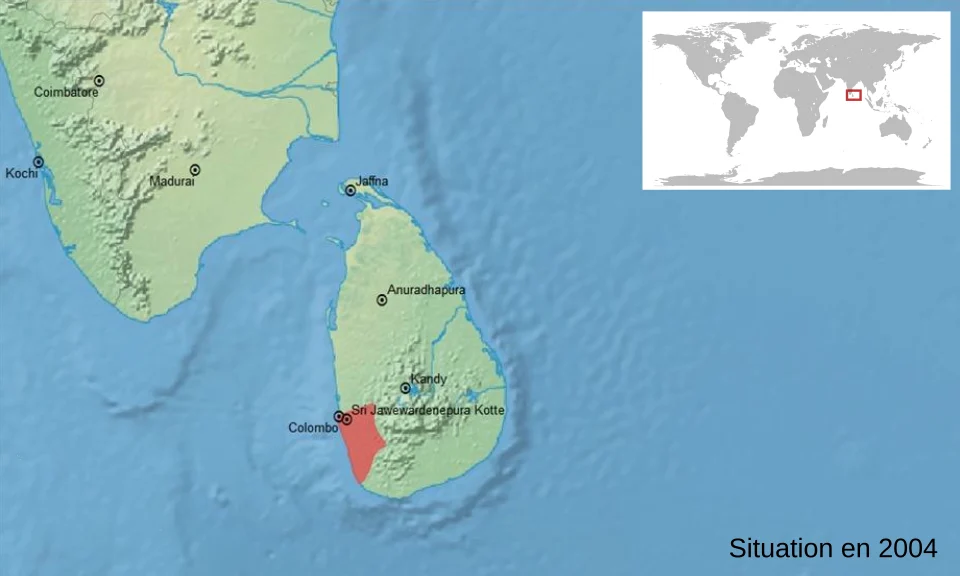
geographic distribution of Pseudophilautus popularis
map data: Made with Natural Earth. Free vector and raster map data @ naturalearthdata.com. distribution: Kelum Manamendra-Arachchi, Rohan Pethiyagoda 2004. Pseudophilautus popularis. In: IUCN 2012. IUCN Red List of Threatened Species. Version 2012.2. <www.iucnredlist.org>. Downloaded on 06 December 2012. compilation: Givet · CC BY-SA 3.0 · Image sourceProvider-generated thumbnail requested at 800 pixels; no local editing Local WebP display rendition; resized without cropping.
Open encyclopedia reference
Pseudophilautus popularis, the common shrub frog, is a species of frogs in the family Rhacophoridae. It is endemic to Sri Lanka. Its natural habitats are subtropical or tropical moist lowland forests, arable land, pastureland, rural gardens, and heavily degraded former forest. Scientists have seen it between 0 and 1067 meters above sea level. The adult male frog measures about 17.7 – 21.3 mm in snout-vent length and the adult female frog about 23.0 – 25.6 mm when full of eggs. The top of the frog's head and the skin of the dorsum are brown in color. The flanks are dark brown or black in color with some white or light blue marks. The inguinal area is gray-brown in color. The area around the tympanum has blue dots. The legs are brown with darker brown bars. The ventrum is gray-brown in color. The bottoms of the hind legs are yellow in color. The webbed skin is yellow in color. This frog is classified as vulnerable. Scientists attribute this to habitat loss from urbanization and to pollution, fertilizers, and pesticides.
Wikipedia contributors, Pseudophilautus popularis; see linked history · CC BY-SA 4.0 . Plain-text lead excerpt, at most 180 words; no infobox or later sections Retrieved 2026-10-05T18:18:07.368617+00:00. This reference remains separate from the taxonomic record.
Identity & source status
- Scientific name
- Pseudophilautus popularis (Manamendra-Arachchi & Pethiyagoda, 2005)
- Name authority
- (Manamendra-Arachchi & Pethiyagoda, 2005)
- Rank
- species
- Accepted status
- accepted
- Kingdom
- Animalia
- Phylum
- Chordata
- Class
- Amphibia
- Order
- Anura
- Family
- Rhacophoridae
- Genus
- Pseudophilautus
- Extinction status
- Recorded extant
Classification family tree
Nested taxonomic groups from the source. This is not a direct-ancestor chain, a dated evolutionary tree or a phylogenetic reconstruction.
- domainEukaryota (Chatton, 1925) Whittaker & Margulis, 1978
- kingdomAnimalia
- phylumChordata
- subphylumVertebrata
- infraphylumGnathostomata
- parvphylumOsteichthyes
- megaclassTetrapoda
- classAmphibia
- orderAnura
- familyRhacophoridae Hoffman, 1932
- subfamilyRhacophorinae Hoffman, 1932
- genusPseudophilautus Laurent, 1943
- speciesPseudophilautus popularis (Manamendra-Arachchi & Pethiyagoda, 2005)
Close classified relatives
These entries share the source’s genus, Pseudophilautus. They are not necessarily the closest relatives established by molecular evidence.
Names & synonyms
Names explicitly linked to this accepted taxon in the source. Synonymy can change with revision.
| Recorded name | Source status |
|---|---|
| Philautus popularis Manamendra-Arachchi & Pethiyagoda, 2005 Manamendra-Arachchi & Pethiyagoda, 2005 | synonym |
Source literature & publication evidence
References attached to this source record, including nomenclatural citations where supplied. This is a selected bibliography; abbreviated citations remain in the source’s form.
- https://www.itis.gov/servlet/SingleRpt/SingleRpt?search_topic=TSN&search_value=1102321 Source fields: Taxon.tsv dwc:namePublishedIn, Taxon.tsv dcterms:references
Origins, evidence & remaining research
Name authority and publication references document nomenclature where the source supplies it. They do not establish evolutionary origins or the earliest fossil occurrence.
Specimen-level evidence, morphology, ecological research, phylogenetic studies, a comprehensive bibliography and a located literary passage have not yet been compiled for this record.
Dataset citation & attribution
This exact taxon in ChecklistBank · Catalogue of Life 2026-09-11
Catalogue of Life 2026-09-11; dataset 316321; doi:10.48580/dgz5n. https://creativecommons.org/licenses/by/4.0/ . Retrieved 5 October 2026.
Stable key: col:4P748. Classification follows source parent identifiers. English common names may vary by region.