
NATURAL HISTORY · CATALOGUE RECORD
Tui
Prosthemadera novaeseelandiae (J. F. Gmelin, 1788)
Source-backed taxonomic record
Accepted species in Catalogue of Life’s 11 September 2026 base release. This preserves the source classification and available supporting data; it is not a completed species monograph.
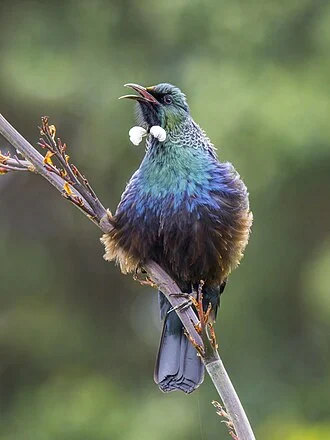
Tui (Prosthemadera novaeseelandiae), Tiritiri Matangi, off North Island, New Zealand
Charles J. Sharp · CC BY-SA 4.0 · Image sourceProvider-generated thumbnail requested at 320 pixels; no local editing Local WebP display rendition; resized without cropping.
Open encyclopedia reference
The tūī (Prosthemadera novaeseelandiae) is a medium-sized bird native to New Zealand. It is blue, green, and bronze coloured with a distinctive white throat tuft (poi). It is an endemic passerine bird of New Zealand, and the only species in the genus Prosthemadera. It is one of the largest species in the diverse Australasian honeyeater family Meliphagidae, and one of two living species of that family found in New Zealand, the other being the New Zealand bellbird (Anthornis melanura). The tūī has a wide distribution in the archipelago, ranging from the subtropical Kermadec Islands to the sub-Antarctic Auckland Islands, as well as the main islands.
Wikipedia contributors, Tūī; see linked history · CC BY-SA 4.0 . Plain-text lead excerpt, at most 180 words; no infobox or later sections Retrieved 2026-10-05T01:19:51.289660+00:00. This reference remains separate from the taxonomic record.
Identity & source status
- Scientific name
- Prosthemadera novaeseelandiae (J. F. Gmelin, 1788)
- Name authority
- (J. F. Gmelin, 1788)
- Common name
- Tui
- Rank
- species
- Accepted status
- accepted
- Kingdom
- Animalia
- Phylum
- Chordata
- Class
- Aves
- Order
- Passeriformes
- Family
- Meliphagidae
- Genus
- Prosthemadera
- Extinction status
- Recorded extant
Classification family tree
Nested taxonomic groups from the source. This is not a direct-ancestor chain, a dated evolutionary tree or a phylogenetic reconstruction.
- domainEukaryota (Chatton, 1925) Whittaker & Margulis, 1978
- kingdomAnimalia
- phylumChordata
- subphylumVertebrata
- infraphylumGnathostomata
- parvphylumOsteichthyes
- megaclassTetrapoda
- classAves
- orderPasseriformes
- familyMeliphagidae
- genusProsthemadera G. R. Gray, 1840
- speciesProsthemadera novaeseelandiae (J. F. Gmelin, 1788)
Close classified relatives
No other member of this genus is present in the selected snapshot.
Names & synonyms
Names explicitly linked to this accepted taxon in the source. Synonymy can change with revision.
| Recorded name | Source status |
|---|---|
| Prosthemadera novaeseelandiae kermadecensis Mathews & Iredale, 1914 Mathews & Iredale, 1914 | synonym |
Documented distribution
Source distribution statements, not a complete range map. A listed locality is not necessarily a place of origin.
Source literature & publication evidence
References attached to this source record, including nomenclatural citations where supplied. This is a selected bibliography; abbreviated citations remain in the source’s form.
- https://www.itis.gov/servlet/SingleRpt/SingleRpt?search_topic=TSN&search_value=562481 Source fields: Taxon.tsv dwc:namePublishedIn, Taxon.tsv dcterms:references
Origins, evidence & remaining research
Name authority and publication references document nomenclature where the source supplies it. They do not establish evolutionary origins or the earliest fossil occurrence.
Specimen-level evidence, morphology, ecological research, phylogenetic studies, a comprehensive bibliography and a located literary passage have not yet been compiled for this record.
Dataset citation & attribution
This exact taxon in ChecklistBank · Catalogue of Life 2026-09-11
Catalogue of Life 2026-09-11; dataset 316321; doi:10.48580/dgz5n. https://creativecommons.org/licenses/by/4.0/ . Retrieved 5 October 2026.
Stable key: col:4MYM3. Classification follows source parent identifiers. English common names may vary by region.