
Pristimantis erythros Sánchez-Nivicela, Celi-Piedra, Posse-Sarmiento, Urgilés, Yánez-Muñoz & Cisneros-Heredia, 2018
Accepted species in Catalogue of Life’s 11 September 2026 base release. This preserves the source classification and available supporting data; it is not a completed species monograph.
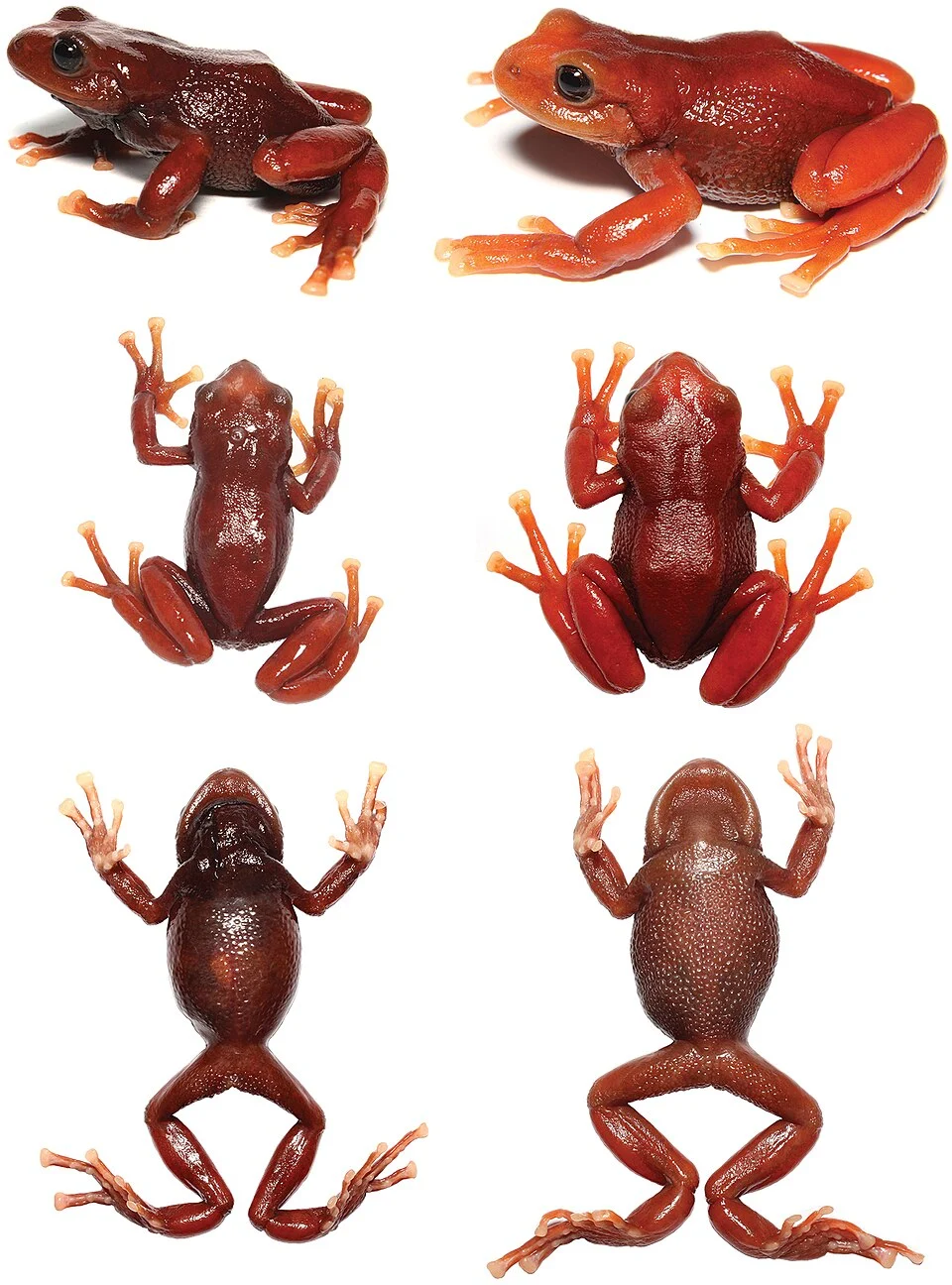
Lateral, dorsal and ventral views of living specimens of Pristimantis erythros. Left: Male paratype (DHMECN 12102, SVL: 37.1 mm); right: Female holotype (DHMECN 12103, SVL: 39.1 mm).
Juan C. Sánchez-Nivicela, Elvis Celi-Piedra, Valentina Posse-Sarmiento, Verónica L. Urgilés, Mario Yánez-Muñoz, Diego F. Cisneros-Heredia · CC BY-SA 4.0 · Image sourceProvider-generated thumbnail requested at 800 pixels; no local editing Local WebP display rendition; resized without cropping.
Open encyclopedia reference
Pristimantis erythros is a species of amphibian in the family Craugastoridae, and can be found in Cajas National Park in Chiquintad parish, Ecuador.
Its striking characteristics are its scarlet red coloration, which differentiates it from all the species of the genus Pristimantis, and the presence of parotid glands on the trapezius and suprascapular muscles. It has an average length of 38 to 42 millimeters in females and 37 millimeters in males. It has direct development, as do all the species of its genus, and does not have an aquatic larval stage.
It was described on April 20, 2018, in the scientific journal ZooKeys by a group of six researchers. Its specific epithet derives from the Greek word ἐρυθρός (erythros), meaning red, an allusion to its unique coloration. It has not yet been catalogued by the International Union for Conservation of Nature, but because it is losing habitat and occupies an area smaller than one square kilometer, researchers classify it as a critically endangered species.
Wikipedia contributors, Pristimantis erythros; see linked history · CC BY-SA 4.0 . Plain-text lead excerpt, at most 180 words; no infobox or later sections Retrieved 2026-10-05T18:00:23.087562+00:00. This reference remains separate from the taxonomic record.
Identity & source status
- Scientific name
- Pristimantis erythros Sánchez-Nivicela, Celi-Piedra, Posse-Sarmiento, Urgilés, Yánez-Muñoz & Cisneros-Heredia, 2018
- Name authority
- Sánchez-Nivicela, Celi-Piedra, Posse-Sarmiento, Urgilés, Yánez-Muñoz & Cisneros-Heredia, 2018
- Rank
- species
- Accepted status
- accepted
- Kingdom
- Animalia
- Phylum
- Chordata
- Class
- Amphibia
- Order
- Anura
- Family
- Strabomantidae
- Genus
- Pristimantis
- Extinction status
- Recorded extant
Classification family tree
Nested taxonomic groups from the source. This is not a direct-ancestor chain, a dated evolutionary tree or a phylogenetic reconstruction.
- domainEukaryota (Chatton, 1925) Whittaker & Margulis, 1978
- kingdomAnimalia
- phylumChordata
- subphylumVertebrata
- infraphylumGnathostomata
- parvphylumOsteichthyes
- megaclassTetrapoda
- classAmphibia
- orderAnura
- superfamilyBrachycephaloidea Günther, 1858
- familyStrabomantidae Hedges, Duellman & Heinecke, 2008
- subfamilyPristimantinae Ohler & Dubois, 2012
- genusPristimantis Jiménez de la Espada, 1870
- speciesPristimantis erythros Sánchez-Nivicela, Celi-Piedra, Posse-Sarmiento, Urgilés, Yánez-Muñoz & Cisneros-Heredia, 2018
Close classified relatives
These entries share the source’s genus, Pristimantis. They are not necessarily the closest relatives established by molecular evidence.
| Species | Classification | Source status |
|---|---|---|
| Pristimantis aaptus (Lynch & Lescure, 1980) | StrabomantidaeChordata | Accepted speciesRecorded extant |
| Pristimantis academicus Lehr, Moravec & Gagliardi-Urrutia, 2010 | StrabomantidaeChordata | Accepted speciesRecorded extant |
| Pristimantis acatallelus (Lynch & Ruiz-Carranza, 1983) | StrabomantidaeChordata | Accepted speciesRecorded extant |
| Pristimantis acerus (Lynch & Duellman, 1980) | StrabomantidaeChordata | Accepted speciesRecorded extant |
| Pristimantis achatinus (Boulenger, 1898) | StrabomantidaeChordata | Accepted speciesRecorded extant |
| Pristimantis actinolaimus (Lynch & Rueda-Almonacid, 1998) | StrabomantidaeChordata | Accepted speciesRecorded extant |
| Pristimantis acuminatus (Shreve, 1935) | StrabomantidaeChordata | Accepted speciesRecorded extant |
| Pristimantis acutirostris (Lynch, 1984) | StrabomantidaeChordata | Accepted speciesRecorded extant |
| Pristimantis aemulatus (Ruiz-Carranza, Lynch & Ardila-Robayo, 1997) | StrabomantidaeChordata | Accepted speciesRecorded extant |
| Pristimantis albujai Brito-M., Batallas-R. & Yánez-Muñoz, 2017 | StrabomantidaeChordata | Accepted speciesRecorded extant |
| Pristimantis allpapuyu Yánez-Muñoz, Sánchez-Nivicela & Reyes-Puig, 2016 | StrabomantidaeChordata | Accepted speciesRecorded extant |
| Pristimantis altae (Dunn, 1942) | StrabomantidaeChordata | Accepted speciesRecorded extant |
Source literature & publication evidence
References attached to this source record, including nomenclatural citations where supplied. This is a selected bibliography; abbreviated citations remain in the source’s form.
- https://www.itis.gov/servlet/SingleRpt/SingleRpt?search_topic=TSN&search_value=1104150 Source fields: Taxon.tsv dwc:namePublishedIn, Taxon.tsv dcterms:references
Origins, evidence & remaining research
Name authority and publication references document nomenclature where the source supplies it. They do not establish evolutionary origins or the earliest fossil occurrence.
Specimen-level evidence, morphology, ecological research, phylogenetic studies, a comprehensive bibliography and a located literary passage have not yet been compiled for this record.
Dataset citation & attribution
This exact taxon in ChecklistBank · Catalogue of Life 2026-09-11
Catalogue of Life 2026-09-11; dataset 316321; doi:10.48580/dgz5n. https://creativecommons.org/licenses/by/4.0/ . Retrieved 5 October 2026.
Stable key: col:4MJDR. Classification follows source parent identifiers. English common names may vary by region.