
NATURAL HISTORY · CATALOGUE RECORD
Red-bellied Titi
Plecturocebus moloch (Hoffmannsegg, 1807)
Source-backed taxonomic record
Accepted species in Catalogue of Life’s 11 September 2026 base release. This preserves the source classification and available supporting data; it is not a completed species monograph.
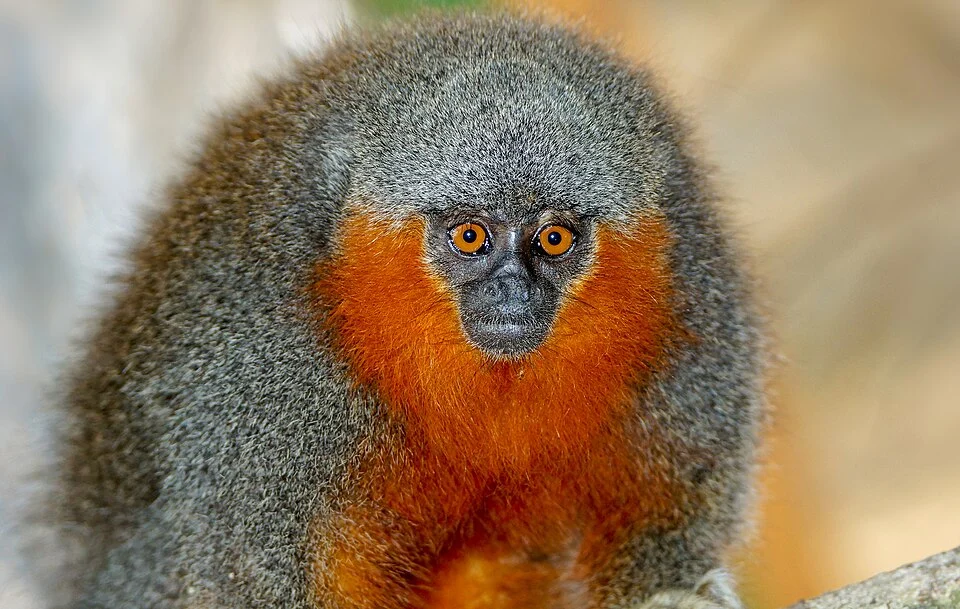
Picture of Plecturocebus moloch from iNaturalist.
....Christopher Borges.... · CC BY-SA 4.0 · Image sourceProvider-generated thumbnail requested at 800 pixels; no local editing Local WebP display rendition; resized without cropping.
Open encyclopedia reference
The red-bellied titi monkey or dusky titi (Plecturocebus moloch) is a species of titi monkey, a type of New World monkey, endemic to Brazil. It lives in forests and thickets.
It has a rounded head and a thick, soft coat and frequently adopts a characteristic posture with the body hunched, limbs close together, and a tail hanging down. The body is 28–39 cm (11–15 in) long, and the tail is 33–49 cm (13–19 in).
It can move quite fast if necessary but rarely does so and generally stays within a fairly small area, feeding on fruit, insects, spiders, small birds, and bird's eggs. It is diurnal and moves in pairs or family groups, which communicate by means of a wide repertoire of sounds. The female gives birth to a single offspring.
Wikipedia contributors, Red-bellied titi monkey; see linked history · CC BY-SA 4.0 . Plain-text lead excerpt, at most 180 words; no infobox or later sections Retrieved 2026-10-05T05:21:17.073880+00:00. This reference remains separate from the taxonomic record.
Identity & source status
- Scientific name
- Plecturocebus moloch (Hoffmannsegg, 1807)
- Name authority
- (Hoffmannsegg, 1807)
- Common name
- Red-bellied Titi
- Rank
- species
- Accepted status
- accepted
- Kingdom
- Animalia
- Phylum
- Chordata
- Class
- Mammalia
- Order
- Primates
- Family
- Pitheciidae
- Genus
- Plecturocebus
- Extinction status
- Recorded extant
Classification family tree
Nested taxonomic groups from the source. This is not a direct-ancestor chain, a dated evolutionary tree or a phylogenetic reconstruction.
- domainEukaryota (Chatton, 1925) Whittaker & Margulis, 1978
- kingdomAnimalia
- phylumChordata
- subphylumVertebrata
- infraphylumGnathostomata
- parvphylumOsteichthyes
- megaclassTetrapoda
- classMammalia Linnaeus, 1758
- subclassTheria Parker & Haswell, 1897
- infraclassEutheria Gill, 1872
- orderPrimates Linnaeus, 1758
- suborderHaplorrhini Pocock, 1918
- infraorderSimiiformes Haeckel, 1866
- familyPitheciidae Mivart, 1865
- subfamilyCallicebinae Pocock, 1925
- genusPlecturocebus Byrne, Rylands, Carneiro, Lynch Alfaro et al., 2016
- speciesPlecturocebus moloch (Hoffmannsegg, 1807)
Close classified relatives
These entries share the source’s genus, Plecturocebus. They are not necessarily the closest relatives established by molecular evidence.
| Species | Classification | Source status |
|---|---|---|
| Lake Baptista TitiPlecturocebus baptista (Lönnberg, 1939) | PitheciidaeChordata | Accepted speciesRecorded extant |
| Brown TitiPlecturocebus brunneus (Wagner, 1842) | PitheciidaeChordata | Accepted speciesRecorded extant |
| Caquetá TitiPlecturocebus caquetensis (Defler, Bueno & Garcia, 2010) | PitheciidaeChordata | Accepted speciesRecorded extant |
| Ashy TitiPlecturocebus cinerascens (Spix, 1823) | PitheciidaeChordata | Accepted speciesRecorded extant |
| Rio Mayo TitiPlecturocebus oenanthe (Thomas, 1924) | PitheciidaeChordata | Accepted speciesRecorded extant |
| Olalla Brother's TitiPlecturocebus olallae (Lönnberg, 1939) | PitheciidaeChordata | Accepted speciesRecorded extant |
| Stephen Nash's TitiPlecturocebus stephennashi (M. van Roosmalen, T. van Roosmalen & Mittermeier, 2002) | PitheciidaeChordata | Accepted speciesRecorded extant |
| Toppin's TitiPlecturocebus toppini (Thomas, 1914) | PitheciidaeChordata | Accepted speciesRecorded extant |
| Urubamba Brown TitiPlecturocebus urubambensis (Vermeer & Tello-Alvarado, 2015) | PitheciidaeChordata | Accepted speciesRecorded extant |
| Vieira's TitiPlecturocebus vieirai (Gualda-Barros, Nascimento & Amaral, 2012) | PitheciidaeChordata | Accepted speciesRecorded extant |
| Ornate TitiPlecturocebus ornatus (Gray, 1866) | PitheciidaeChordata | Accepted speciesRecorded extant |
| Groves' TitiPlecturocebus grovesi Boubli, Byrne, Silva, Silva-Júnior, Costa Araujo, Bertuol, Gonçalves, Melo, Rylands et al., 2019 | PitheciidaeChordata | Accepted speciesRecorded extant |
Names & synonyms
Names explicitly linked to this accepted taxon in the source. Synonymy can change with revision.
| Recorded name | Source status |
|---|---|
| Simia sakir Giebel, 1855 Giebel, 1855 | synonym |
| Callicebus emiliae Thomas, 1911 Thomas, 1911 | synonym |
| Callithrix hypokantha Olfers, 1819 Olfers, 1819 | synonym |
| Callicebus moloch (Hoffmannsegg, 1807) (Hoffmannsegg, 1807) | synonym |
| Callicebus remulus Thomas, 1908 Thomas, 1908 | synonym |
Documented distribution
Source distribution statements, not a complete range map. A listed locality is not necessarily a place of origin.
Source literature & publication evidence
References attached to this source record, including nomenclatural citations where supplied. This is a selected bibliography; abbreviated citations remain in the source’s form.
- https://www.itis.gov/servlet/SingleRpt/SingleRpt?search_topic=TSN&search_value=1025119 Source fields: Taxon.tsv dwc:namePublishedIn, Taxon.tsv dcterms:references
Origins, evidence & remaining research
Name authority and publication references document nomenclature where the source supplies it. They do not establish evolutionary origins or the earliest fossil occurrence.
Specimen-level evidence, morphology, ecological research, phylogenetic studies, a comprehensive bibliography and a located literary passage have not yet been compiled for this record.
Dataset citation & attribution
This exact taxon in ChecklistBank · Catalogue of Life 2026-09-11
Catalogue of Life 2026-09-11; dataset 316321; doi:10.48580/dgz5n. https://creativecommons.org/licenses/by/4.0/ . Retrieved 5 October 2026.
Stable key: col:4K5YB. Classification follows source parent identifiers. English common names may vary by region.