
Pithecopus araguaius Haga, Andrade, Bruschi, Recco-Pimentel & Giaretta, 2017
Accepted species in Catalogue of Life’s 11 September 2026 base release. This preserves the source classification and available supporting data; it is not a completed species monograph.
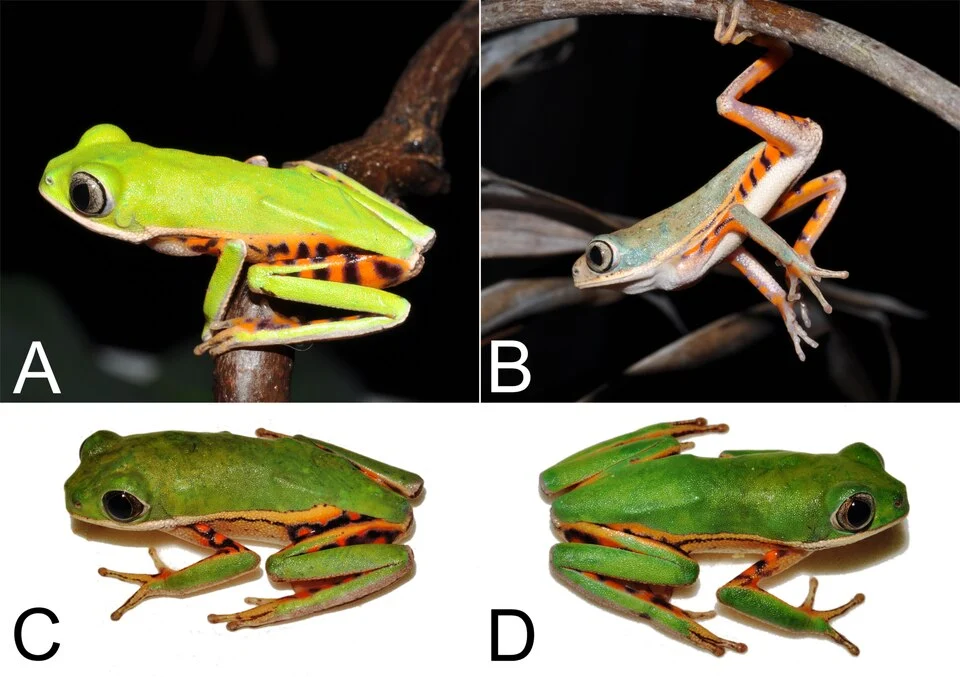
Paratopotypes of Pithecopus araguaius sp. n. in life. Specimens from Pontal do Araguaia, Mato Grosso state, Brazil. Adult males (A) AAG-UFU 4877, SVL = 31.4 mm; (B) AAG-UFU 4878, SVL = 33.6 mm; (C) AAG-UFU 3442, SVL = 32.8 mm and (D) AAG-UFU 3443, SVL = 31.0 mm.
Isabelle Aquemi Haga, Felipe Silva de Andrade, Daniel Pacheco Bruschi, Shirlei Maria Recco-Pimentel, Ariovaldo Antonio Giaretta · CC BY-SA 4.0 · Image sourceProvider-generated thumbnail requested at 800 pixels; no local editing Local WebP display rendition; resized without cropping.
Open encyclopedia reference
Pithecopus araguaius is a species of frog in the family Hylidae, endemic to Brazil. It has been observed in Mato Grasso. This frog has been observed 418 meters above sea level.
The holotype male measured 30.6 mm long in snout-vent length. The skin of the dorsum and backs of the legs and feet is green in color. This frog has a green stripe on each hind leg and a dark stripe on each flank. There is orange coloration on the front legs and hidden parts of the thighs. Portions of the lips are white in color.
Scientists named this frog araguaius after the nearby Araguaia River. The female frog lays eggs on leaves overhanging temporary bodies of water. When the tadpoles hatch, they fall into the water below.
This frog is not considered to be in danger of dying out because of its large and variegated habitat. This frog has been found in Brazil's Cerrado habitat. It lives in grasslands, including pastureland, and it has been observed in urban areas.
Wikipedia contributors, Pithecopus araguaius; see linked history · CC BY-SA 4.0 . Plain-text lead excerpt, at most 180 words; no infobox or later sections Retrieved 2026-10-05T17:47:51.241196+00:00. This reference remains separate from the taxonomic record.
Identity & source status
- Scientific name
- Pithecopus araguaius Haga, Andrade, Bruschi, Recco-Pimentel & Giaretta, 2017
- Name authority
- Haga, Andrade, Bruschi, Recco-Pimentel & Giaretta, 2017
- Rank
- species
- Accepted status
- accepted
- Kingdom
- Animalia
- Phylum
- Chordata
- Class
- Amphibia
- Order
- Anura
- Family
- Phyllomedusidae
- Genus
- Pithecopus
- Extinction status
- Recorded extant
Classification family tree
Nested taxonomic groups from the source. This is not a direct-ancestor chain, a dated evolutionary tree or a phylogenetic reconstruction.
- domainEukaryota (Chatton, 1925) Whittaker & Margulis, 1978
- kingdomAnimalia
- phylumChordata
- subphylumVertebrata
- infraphylumGnathostomata
- parvphylumOsteichthyes
- megaclassTetrapoda
- classAmphibia
- orderAnura
- familyPhyllomedusidae Günther, 1858
- genusPithecopus Cope, 1866
- speciesPithecopus araguaius Haga, Andrade, Bruschi, Recco-Pimentel & Giaretta, 2017
Close classified relatives
These entries share the source’s genus, Pithecopus. They are not necessarily the closest relatives established by molecular evidence.
| Species | Classification | Source status |
|---|---|---|
| Pithecopus ayeaye Lutz, 1966 | PhyllomedusidaeChordata | Accepted speciesRecorded extant |
| Pithecopus centralis (Bokermann, 1965) | PhyllomedusidaeChordata | Accepted speciesRecorded extant |
| Pithecopus megacephalus (Miranda-Ribeiro, 1926) | PhyllomedusidaeChordata | Accepted speciesRecorded extant |
| Pithecopus oreades (Brandão, 2002) | PhyllomedusidaeChordata | Accepted speciesRecorded extant |
| Pithecopus hypochondrialis (Daudin, 1800) | PhyllomedusidaeChordata | Accepted speciesRecorded extant |
| Pithecopus nordestinus (Caramaschi, 2006) | PhyllomedusidaeChordata | Accepted speciesRecorded extant |
| Pithecopus palliatus (Peters, 1873) | PhyllomedusidaeChordata | Accepted speciesRecorded extant |
| Pithecopus rohdei (Mertens, 1926) | PhyllomedusidaeChordata | Accepted speciesRecorded extant |
| Pithecopus rusticus (Bruschi, Lucas, Garcia & Recco-Pimentel, 2014) | PhyllomedusidaeChordata | Accepted speciesRecorded extant |
Source literature & publication evidence
References attached to this source record, including nomenclatural citations where supplied. This is a selected bibliography; abbreviated citations remain in the source’s form.
- https://www.itis.gov/servlet/SingleRpt/SingleRpt?search_topic=TSN&search_value=1104447 Source fields: Taxon.tsv dwc:namePublishedIn, Taxon.tsv dcterms:references
Origins, evidence & remaining research
Name authority and publication references document nomenclature where the source supplies it. They do not establish evolutionary origins or the earliest fossil occurrence.
Specimen-level evidence, morphology, ecological research, phylogenetic studies, a comprehensive bibliography and a located literary passage have not yet been compiled for this record.
Dataset citation & attribution
This exact taxon in ChecklistBank · Catalogue of Life 2026-09-11
Catalogue of Life 2026-09-11; dataset 316321; doi:10.48580/dgz5n. https://creativecommons.org/licenses/by/4.0/ . Retrieved 5 October 2026.
Stable key: col:4JBP8. Classification follows source parent identifiers. English common names may vary by region.