
NATURAL HISTORY · CATALOGUE RECORD
Vanzolini's Bald-faced Saki
Pithecia vanzolinii Hershkovitz, 1987
Source-backed taxonomic record
Accepted species in Catalogue of Life’s 11 September 2026 base release. This preserves the source classification and available supporting data; it is not a completed species monograph.
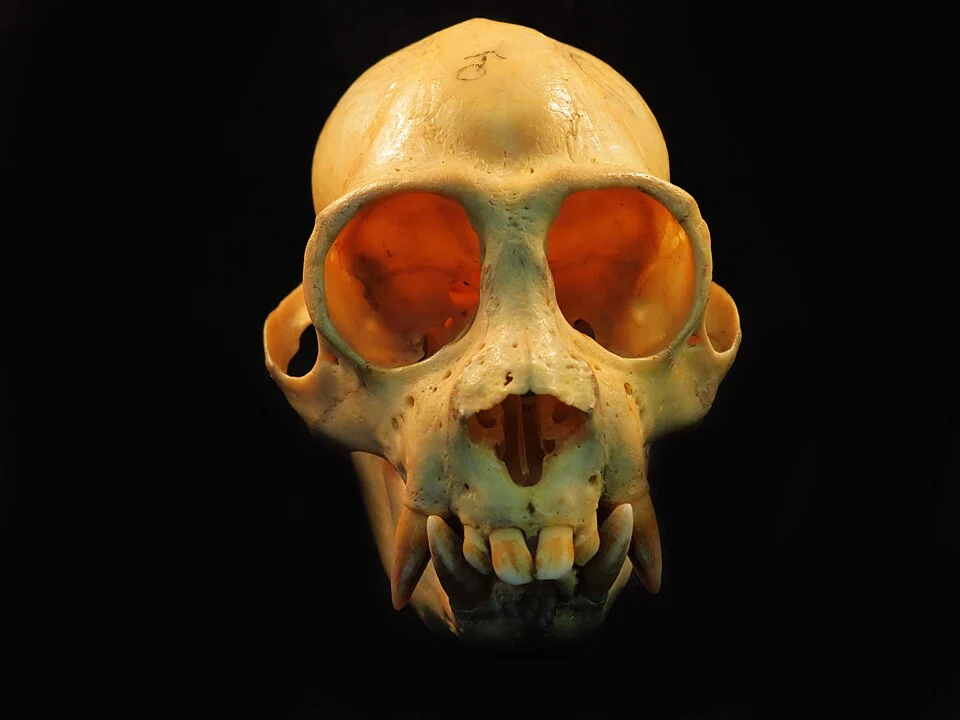
Skull of Pithecia irrorata vanzolinii from Santa Cruz, Eiru river, Amazonas, Brazil. Zoology Museum of University of São Paulo (Museu de Zoologia da USP).
Miguelrangeljr · CC BY-SA 3.0 · Image sourceProvider-generated thumbnail requested at 800 pixels; no local editing Local WebP display rendition; resized without cropping.
Open encyclopedia reference
Vanzolini's bald-faced saki (Pithecia vanzolinii) is a species of saki monkey, a type of New World monkey. Its range is in western Brazil. The monkey is named after Brazilian zoologist Paulo Vanzolini. This species was originally described by Hershkovitz as the subspecies Pithecia irrorata vanzolinii based on individuals collected in 1936 by Alfonso M. Olalla, but it was raised to full species status in 2014. For many years, there had been no record of the species in nature. Further specimens were collected in 1956 by Fernando Novaes (the then director of the Goeldi Museum in Pará) and his assistant Miguel Moreira. The mammals in this expedition were collected alive and prepared as museum specimens, as described by Cory T. Carvalho, the mammalogist working at the Goeldi museum at the time. After 61 years, in 2017, one individual was collected after being hunted for bush meat in an extractive community in the state of Acre, Brazil. After not being seen alive for more than 60 years, as F. Novaes and M.
Wikipedia contributors, Vanzolini's bald-faced saki; see linked history · CC BY-SA 4.0 . Plain-text lead excerpt, at most 180 words; no infobox or later sections Retrieved 2026-10-05T11:47:57.715934+00:00. This reference remains separate from the taxonomic record.
Identity & source status
- Scientific name
- Pithecia vanzolinii Hershkovitz, 1987
- Name authority
- Hershkovitz, 1987
- Common name
- Vanzolini's Bald-faced Saki
- Rank
- species
- Accepted status
- accepted
- Kingdom
- Animalia
- Phylum
- Chordata
- Class
- Mammalia
- Order
- Primates
- Family
- Pitheciidae
- Genus
- Pithecia
- Extinction status
- Recorded extant
Classification family tree
Nested taxonomic groups from the source. This is not a direct-ancestor chain, a dated evolutionary tree or a phylogenetic reconstruction.
- domainEukaryota (Chatton, 1925) Whittaker & Margulis, 1978
- kingdomAnimalia
- phylumChordata
- subphylumVertebrata
- infraphylumGnathostomata
- parvphylumOsteichthyes
- megaclassTetrapoda
- classMammalia Linnaeus, 1758
- subclassTheria Parker & Haswell, 1897
- infraclassEutheria Gill, 1872
- orderPrimates Linnaeus, 1758
- suborderHaplorrhini Pocock, 1918
- infraorderSimiiformes Haeckel, 1866
- familyPitheciidae Mivart, 1865
- subfamilyPitheciinae Mivart, 1865
- genusPithecia Desmarest, 1804
- speciesPithecia vanzolinii Hershkovitz, 1987
Close classified relatives
These entries share the source’s genus, Pithecia. They are not necessarily the closest relatives established by molecular evidence.
| Species | Classification | Source status |
|---|---|---|
| Golden-faced SakiPithecia chrysocephala I. Geoffroy Saint-Hilaire, 1850 | PitheciidaeChordata | Accepted speciesRecorded extant |
| Gray Monk SakiPithecia irrorata Gray, 1842 | PitheciidaeChordata | Accepted speciesRecorded extant |
| Isabel's SakiPithecia isabela Marsh, 2014 | PitheciidaeChordata | Accepted speciesRecorded extant |
| Mittermeier's Tapajós SakiPithecia mittermeieri Marsh, 2014 | PitheciidaeChordata | Accepted speciesRecorded extant |
| Guianan SakiPithecia pithecia (Linnaeus, 1766) | PitheciidaeChordata | Accepted speciesRecorded extant |
| Geoffroy's Monk SakiPithecia monachus (É. Geoffroy Saint-Hilaire, 1812) | PitheciidaeChordata | Accepted speciesRecorded extant |
| Equatorial SakiPithecia aequatorialis Hershkovitz, 1987 | PitheciidaeChordata | Accepted speciesRecorded extant |
| Cazuza's SakiPithecia cazuzai Marsh, 2014 | PitheciidaeChordata | Accepted speciesRecorded extant |
| Hairy SakiPithecia hirsuta Spix, 1823 | PitheciidaeChordata | Accepted speciesRecorded extant |
| Burnished SakiPithecia inusta Spix, 1823 | PitheciidaeChordata | Accepted speciesRecorded extant |
| Miller's SakiPithecia milleri Allen, 1914 | PitheciidaeChordata | Accepted speciesRecorded extant |
| Napo SakiPithecia napensis Lönnberg, 1938 | PitheciidaeChordata | Accepted speciesRecorded extant |
Names & synonyms
Names explicitly linked to this accepted taxon in the source. Synonymy can change with revision.
| Recorded name | Source status |
|---|---|
| Pithecia irrorata vanzolinii Hershkovitz, 1987 Hershkovitz, 1987 | synonym |
Documented distribution
Source distribution statements, not a complete range map. A listed locality is not necessarily a place of origin.
Source literature & publication evidence
References attached to this source record, including nomenclatural citations where supplied. This is a selected bibliography; abbreviated citations remain in the source’s form.
- https://www.itis.gov/servlet/SingleRpt/SingleRpt?search_topic=TSN&search_value=998626 Source fields: Taxon.tsv dwc:namePublishedIn, Taxon.tsv dcterms:references
Origins, evidence & remaining research
Name authority and publication references document nomenclature where the source supplies it. They do not establish evolutionary origins or the earliest fossil occurrence.
Specimen-level evidence, morphology, ecological research, phylogenetic studies, a comprehensive bibliography and a located literary passage have not yet been compiled for this record.
Dataset citation & attribution
This exact taxon in ChecklistBank · Catalogue of Life 2026-09-11
Catalogue of Life 2026-09-11; dataset 316321; doi:10.48580/dgz5n. https://creativecommons.org/licenses/by/4.0/ . Retrieved 5 October 2026.
Stable key: col:4JBHL. Classification follows source parent identifiers. English common names may vary by region.