
NATURAL HISTORY · CATALOGUE RECORD
Great Auk
Pinguinus impennis (Linnaeus, 1758)
Source-backed taxonomic record
Accepted species in Catalogue of Life’s 11 September 2026 base release. This preserves the source classification and available supporting data; it is not a completed species monograph.
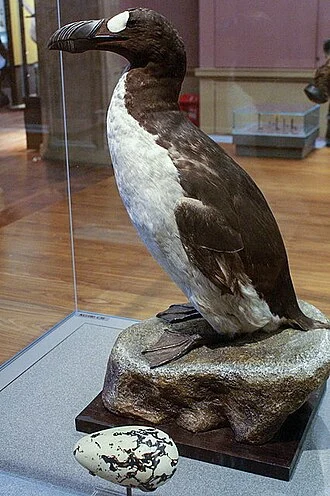
Great Auk (Pinguinis impennis) specimen (Bird no. 8, the Glasgow Auk) and replica egg, Kelvingrove, Glasgow. A lost part of the biogeography of Britain, and the only flightless bird that has bred in Europe in historical times. The last Great Auk in Britain was killed on Stac-an-Armin, St Kilda, in about 1840 and the last pair seen alive in the world was caught and throttled on the island of Eldey, Iceland, in 1844. Proven breeding sites for the Great Auk are few: in Britain, St Kilda was the only certain site and much of our knowledge of the species in life comes from the description given by Martin Martin following his visit there in 1697. Papa Westray in Orkney was another known haunt, with William Bullock gaining some infamy in the early 19th century for his attempts to capture the pair there, although there is no actual proof that they bred there. Bones are, however, common around early human habitations in Scotland and while these could have been brought from elsewhere, many paleozoologists suspect that there were several large colonies in Scotland which were largely wiped out by early Neolithic hunter-gatherers. As suggested by the scientific name, the Great Auk is also probably the original 'penguin', the name assumed to be from the Welsh for white head, referring to the white flash on the forehead. Early visitors to the Antarctic presumably transferred the name to the superficially similar but unrelated birds they found there. Nowadays, according to Errol Fuller in his book on Extinct Birds, there are just 78 Great Auk skins and about 75 eggs left in existence.
Mike Pennington · CC BY-SA 2.0 · Image sourceProvider-generated thumbnail requested at 320 pixels; no local editing Local WebP display rendition; resized without cropping.
Open encyclopedia reference
The great auk (Pinguinus impennis), also known as the penguin or garefowl, is an extinct species of flightless alcid that first appeared around 400,000 years ago and was driven to extinction by human exploitation in the mid-19th century. It was the only modern species in the genus Pinguinus. It was not closely related to the penguins of the Southern Hemisphere, which were named for their resemblance to this species. It bred on rocky, remote islands with easy access to the ocean and a plentiful food supply, a rarity in nature that provided only a few breeding sites for the great auks. During the non-breeding season, the auk foraged in the waters of the North Atlantic, ranging as far south as northern Spain and along the coastlines of Canada, Greenland, Iceland, the Faroe Islands, Norway, Ireland, and Great Britain. The bird was about 75 centimetres (29.5 inches) tall and weighed about 5 kilograms (11 pounds), making it the largest alcid to survive into the modern era, and the second-largest member of the alcid family overall (the prehistoric Miomancalla was larger).
Wikipedia contributors, Great auk; see linked history · CC BY-SA 4.0 . Plain-text lead excerpt, at most 180 words; no infobox or later sections Retrieved 2026-10-05T01:44:55.722700+00:00. This reference remains separate from the taxonomic record.
Identity & source status
- Scientific name
- Pinguinus impennis (Linnaeus, 1758)
- Name authority
- (Linnaeus, 1758)
- Common name
- Great Auk
- Rank
- species
- Accepted status
- accepted
- Kingdom
- Animalia
- Phylum
- Chordata
- Class
- Aves
- Order
- Charadriiformes
- Family
- Alcidae
- Genus
- Pinguinus
- Extinction status
- Recorded extinct
Classification family tree
Nested taxonomic groups from the source. This is not a direct-ancestor chain, a dated evolutionary tree or a phylogenetic reconstruction.
- domainEukaryota (Chatton, 1925) Whittaker & Margulis, 1978
- kingdomAnimalia
- phylumChordata
- subphylumVertebrata
- infraphylumGnathostomata
- parvphylumOsteichthyes
- megaclassTetrapoda
- classAves
- orderCharadriiformes
- familyAlcidae
- genusPinguinus Bonnaterre, 1791
- speciesPinguinus impennis (Linnaeus, 1758)
Close classified relatives
No other member of this genus is present in the selected snapshot.
Names & synonyms
Names explicitly linked to this accepted taxon in the source. Synonymy can change with revision.
| Recorded name | Source status |
|---|---|
| Alca impennis Linnaeus, 1758 Linnaeus, 1758 | synonym |
| Penguinus impennis (Linnaeus, 1758) (Linnaeus, 1758) | synonym |
Documented distribution
Source distribution statements, not a complete range map. A listed locality is not necessarily a place of origin.
Source literature & publication evidence
References attached to this source record, including nomenclatural citations where supplied. This is a selected bibliography; abbreviated citations remain in the source’s form.
- https://www.itis.gov/servlet/SingleRpt/SingleRpt?search_topic=TSN&search_value=177037 Source fields: Taxon.tsv dwc:namePublishedIn, Taxon.tsv dcterms:references
Origins, evidence & remaining research
Name authority and publication references document nomenclature where the source supplies it. They do not establish evolutionary origins or the earliest fossil occurrence.
Specimen-level evidence, morphology, ecological research, phylogenetic studies, a comprehensive bibliography and a located literary passage have not yet been compiled for this record.
Dataset citation & attribution
This exact taxon in ChecklistBank · Catalogue of Life 2026-09-11
Catalogue of Life 2026-09-11; dataset 316321; doi:10.48580/dgz5n. https://creativecommons.org/licenses/by/4.0/ . Retrieved 5 October 2026.
Stable key: col:4HYNF. Classification follows source parent identifiers. English common names may vary by region.