
NATURAL HISTORY · CATALOGUE RECORD
Tricolored Bat
Perimyotis subflavus (F. Cuvier, 1832)
Source-backed taxonomic record
Accepted species in Catalogue of Life’s 11 September 2026 base release. This preserves the source classification and available supporting data; it is not a completed species monograph.
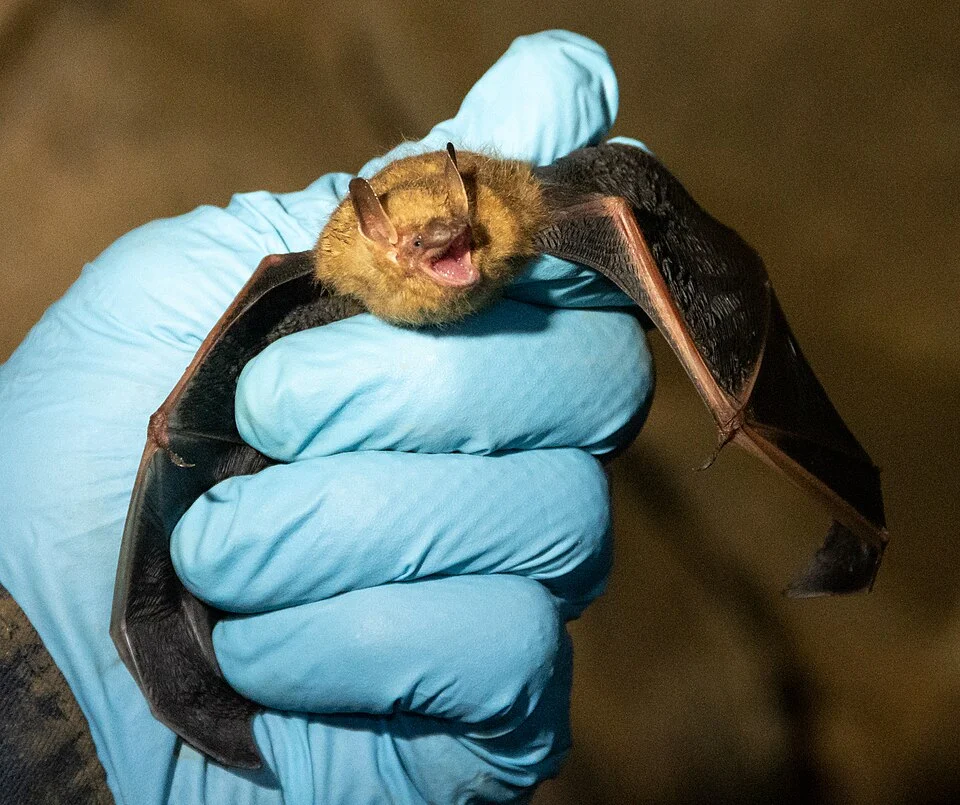
A tricolored bat after being swabbed is ready to be banded before being returned to the area it was found in a cave near Arnold Air Force Base, Tennessee, Dec. 5, 2022. The bands allow researchers to identify the bat if it is recaptured on a subsequent trip into the cave. (U.S. Air Force photo by Jill Pickett)
U.S. Air Force photo by Jill Pickett · Public domain · Image sourceProvider-generated thumbnail requested at 800 pixels; no local editing Local WebP display rendition; resized without cropping.
Open encyclopedia reference
The tricolored bat (Perimyotis subflavus) or American perimyotis is a species of microbat native to eastern North America. Formerly known as the eastern pipistrelle, based on the incorrect belief that it was closely related to European Pipistrellus species, the closest known relative of the tricolored bat is now recognized as the canyon bat. Its common name "tricolored bat" derives from the coloration of the hairs on its back, which have three distinct color bands. It is the smallest bat species in the eastern and midwestern US, with individuals weighing only 4.6–7.9 g (0.16–0.28 oz). This species mates in the fall before hibernation, though due to sperm storage, females do not become pregnant until the spring. Young are born helpless, though rapidly develop, flying and foraging for themselves by four weeks old. It has a relatively long lifespan, and can live nearly fifteen years. In the summer, females roost in small groups and males roost solitarily in tree foliage or beard lichen. It eats a diverse array of insects, foraging with a slow, erratic flight and navigating via echolocation.
Wikipedia contributors, Tricolored bat; see linked history · CC BY-SA 4.0 . Plain-text lead excerpt, at most 180 words; no infobox or later sections Retrieved 2026-10-05T03:47:29.860365+00:00. This reference remains separate from the taxonomic record.
Identity & source status
- Scientific name
- Perimyotis subflavus (F. Cuvier, 1832)
- Name authority
- (F. Cuvier, 1832)
- Common name
- Tricolored Bat
- Rank
- species
- Accepted status
- accepted
- Kingdom
- Animalia
- Phylum
- Chordata
- Class
- Mammalia
- Order
- Chiroptera
- Family
- Vespertilionidae
- Genus
- Perimyotis
- Extinction status
- Recorded extant
Classification family tree
Nested taxonomic groups from the source. This is not a direct-ancestor chain, a dated evolutionary tree or a phylogenetic reconstruction.
- domainEukaryota (Chatton, 1925) Whittaker & Margulis, 1978
- kingdomAnimalia
- phylumChordata
- subphylumVertebrata
- infraphylumGnathostomata
- parvphylumOsteichthyes
- megaclassTetrapoda
- classMammalia Linnaeus, 1758
- subclassTheria Parker & Haswell, 1897
- infraclassEutheria Gill, 1872
- orderChiroptera Blumenbach, 1779
- suborderYangochiroptera Koopman, 1984
- superfamilyVespertilionoidea Gray, 1821
- familyVespertilionidae Gray, 1821
- subfamilyVespertilioninae Gray, 1821
- tribePerimyotini
- genusPerimyotis Menu, 1984
- speciesPerimyotis subflavus (F. Cuvier, 1832)
Close classified relatives
No other member of this genus is present in the selected snapshot.
Documented distribution
Source distribution statements, not a complete range map. A listed locality is not necessarily a place of origin.
North America
Source literature & publication evidence
References attached to this source record, including nomenclatural citations where supplied. This is a selected bibliography; abbreviated citations remain in the source’s form.
- https://www.itis.gov/servlet/SingleRpt/SingleRpt?search_topic=TSN&search_value=947299 Source fields: Taxon.tsv dwc:namePublishedIn, Taxon.tsv dcterms:references
Origins, evidence & remaining research
Name authority and publication references document nomenclature where the source supplies it. They do not establish evolutionary origins or the earliest fossil occurrence.
Specimen-level evidence, morphology, ecological research, phylogenetic studies, a comprehensive bibliography and a located literary passage have not yet been compiled for this record.
Dataset citation & attribution
This exact taxon in ChecklistBank · Catalogue of Life 2026-09-11
Catalogue of Life 2026-09-11; dataset 316321; doi:10.48580/dgz5n. https://creativecommons.org/licenses/by/4.0/ . Retrieved 5 October 2026.
Stable key: col:4F2FM. Classification follows source parent identifiers. English common names may vary by region.