
NATURAL HISTORY · CATALOGUE RECORD
Cuvier's smooth-fronted caiman
Paleosuchus palpebrosus (Cuvier, 1807)
Source-backed taxonomic record
Accepted species in Catalogue of Life’s 11 September 2026 base release. This preserves the source classification and available supporting data; it is not a completed species monograph.
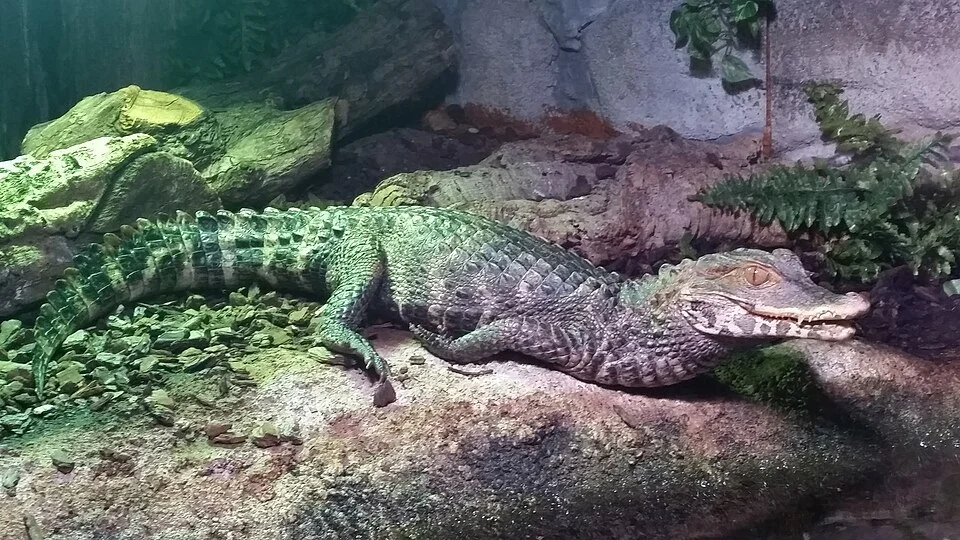
Cuvier's dwarf caiman (Paleosuchus palpebrosus) in Southend-on-Sea aquarium, England.
Emőke Dénes · CC BY-SA 4.0 · Image sourceProvider-generated thumbnail requested at 800 pixels; no local editing Local WebP display rendition; resized without cropping.
Open encyclopedia reference
Cuvier's dwarf caiman (Paleosuchus palpebrosus) is a small crocodilian in the alligator family from northern and central South America. It is found in Bolivia, Brazil, Colombia, Ecuador, French Guiana, Guyana, Paraguay, Peru, Suriname, Trinidad and Venezuela. It lives in riverine forests, flooded forests near lakes, and near fast-flowing rivers and streams. It can traverse dry land to reach temporary pools and tolerates colder water than other species of caimans. Other common names for this species include the musky caiman, the dwarf caiman, Cuvier's caiman, and the smooth-fronted caiman (the latter name is also used for P. trigonatus). It is sometimes kept in captivity as a pet and may be referred to as the wedge-head caiman by the pet trade community. Cuvier's dwarf caiman was first described by the French zoologist Georges Cuvier in 1807 and is one of only two species in the genus Paleosuchus, the other species being P. trigonatus. Their closest relatives are the other caimans in the subfamily Caimaninae.
Wikipedia contributors, Cuvier's dwarf caiman; see linked history · CC BY-SA 4.0 . Plain-text lead excerpt, at most 180 words; no infobox or later sections Retrieved 2026-10-05T12:13:53.641347+00:00. This reference remains separate from the taxonomic record.
Identity & source status
- Scientific name
- Paleosuchus palpebrosus (Cuvier, 1807)
- Name authority
- (Cuvier, 1807)
- Common name
- Cuvier's smooth-fronted caiman
- Rank
- species
- Accepted status
- accepted
- Kingdom
- Animalia
- Phylum
- Chordata
- Class
- Reptilia
- Order
- Crocodylia
- Family
- Alligatoridae
- Genus
- Paleosuchus
- Extinction status
- Not supplied by this source
Classification family tree
Nested taxonomic groups from the source. This is not a direct-ancestor chain, a dated evolutionary tree or a phylogenetic reconstruction.
- domainEukaryota (Chatton, 1925) Whittaker & Margulis, 1978
- kingdomAnimalia
- phylumChordata
- subphylumVertebrata
- infraphylumGnathostomata
- parvphylumOsteichthyes
- megaclassTetrapoda
- classReptilia Laurenti, 1768
- orderCrocodylia
- familyAlligatoridae
- genusPaleosuchus
- speciesPaleosuchus palpebrosus (Cuvier, 1807)
Close classified relatives
These entries share the source’s genus, Paleosuchus. They are not necessarily the closest relatives established by molecular evidence.
| Species | Classification | Source status |
|---|---|---|
| CachirrePaleosuchus trigonatus (Schneider, 1801) | AlligatoridaeChordata | Accepted speciesExtinction status not supplied |
Names & synonyms
Names explicitly linked to this accepted taxon in the source. Synonymy can change with revision.
| Recorded name | Source status |
|---|---|
| Crocodilus palpebrosus Cuvier, 1807 Cuvier, 1807 | synonym |
| Champsa gibbiceps Natterer, 1840 Natterer, 1840 | synonym |
| Jacaretinga moschifer Spix, 1825 Spix, 1825 | synonym |
Documented distribution
Source distribution statements, not a complete range map. A listed locality is not necessarily a place of origin.
Source literature & publication evidence
References attached to this source record, including nomenclatural citations where supplied. This is a selected bibliography; abbreviated citations remain in the source’s form.
- https://reptile-database.reptarium.cz/species?genus=Paleosuchus&species=palpebrosus Source fields: Taxon.tsv dwc:namePublishedIn, Taxon.tsv dcterms:references
Origins, evidence & remaining research
Name authority and publication references document nomenclature where the source supplies it. They do not establish evolutionary origins or the earliest fossil occurrence.
Specimen-level evidence, morphology, ecological research, phylogenetic studies, a comprehensive bibliography and a located literary passage have not yet been compiled for this record.
Dataset citation & attribution
This exact taxon in ChecklistBank · Catalogue of Life 2026-09-11
Catalogue of Life 2026-09-11; dataset 316321; doi:10.48580/dgz5n. https://creativecommons.org/licenses/by/4.0/ . Retrieved 5 October 2026.
Stable key: col:4C47J. Classification follows source parent identifiers. English common names may vary by region.