
Nyctibatrachus pulivijayani Garg, Suyesh, Sukesan & Biju, 2017
Accepted species in Catalogue of Life’s 11 September 2026 base release. This preserves the source classification and available supporting data; it is not a completed species monograph.
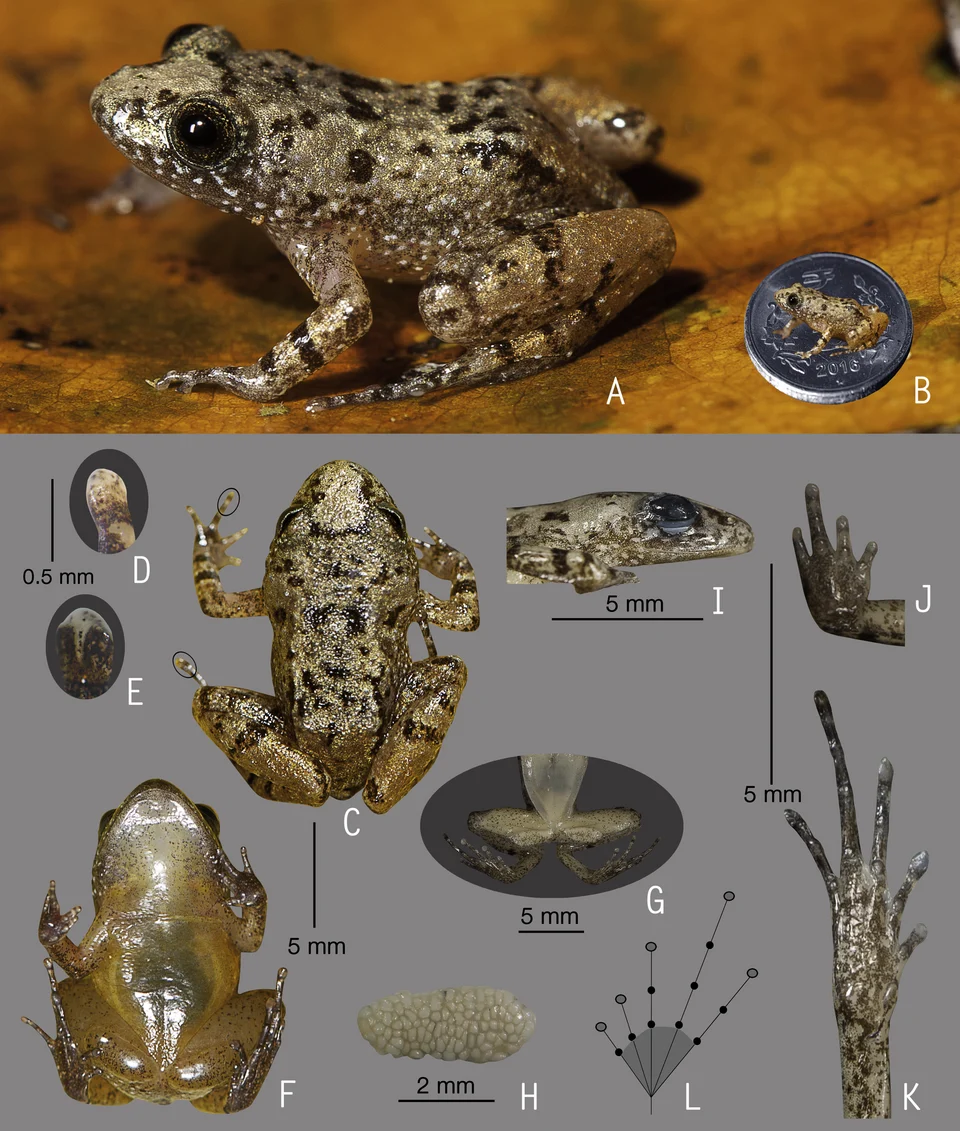
Holotype of Nyctibatrachus pulivijayani sp. nov. (ZSI/WGRC/V/A/902). (A) Dorsolateral view, in life. (B) Size (SVL 13.3 mm) in comparison to the Indian five-rupee coin (24 mm diameter). (C) Dorsal view, in life. (D) Dorsal surface third finger disc, in preservation. (E) Dorsal surface of fourth toe disc, in preservation. (F) Ventral view, in life. (G) Femoral glands, in preservation. (H) Close-up of femoral glands after removal of skin showing multiple glands. (I) Lateral view of head, in preservation. (J) Ventral view of hand, in preservation. (K) Ventral view of foot, in preservation. (L) Schematic illustration of foot webbing.
Garg S, Suyesh R, Sukesan S, Biju S. · CC BY-SA 4.0 · Image sourceProvider-generated thumbnail requested at 800 pixels; no local editing Local WebP display rendition; resized without cropping.
Open encyclopedia reference
Nyctibatrachus pulivijayani, or Vijayan's night frog, is a species of night frogs, family Nyctibatrachidae. The frog is endemic to the Western Ghats, India, and is only known from its type locality, Pandipath, in the Agasthyamalai Hills, Thiruvananthapuram district, Kerala. Smaller than a human fingernail, it is among the smallest frog species in the world. Nyctibatrachus pulivijayani is part of a genus that evolved in India around 70–80 million years ago. The species of frog was discovered by scientists from the University of Delhi.
Wikipedia contributors, Nyctibatrachus pulivijayani; see linked history · CC BY-SA 4.0 . Plain-text lead excerpt, at most 180 words; no infobox or later sections Retrieved 2026-10-05T17:22:35.598373+00:00. This reference remains separate from the taxonomic record.
Identity & source status
- Scientific name
- Nyctibatrachus pulivijayani Garg, Suyesh, Sukesan & Biju, 2017
- Name authority
- Garg, Suyesh, Sukesan & Biju, 2017
- Rank
- species
- Accepted status
- accepted
- Kingdom
- Animalia
- Phylum
- Chordata
- Class
- Amphibia
- Order
- Anura
- Family
- Nyctibatrachidae
- Genus
- Nyctibatrachus
- Extinction status
- Recorded extant
Classification family tree
Nested taxonomic groups from the source. This is not a direct-ancestor chain, a dated evolutionary tree or a phylogenetic reconstruction.
- domainEukaryota (Chatton, 1925) Whittaker & Margulis, 1978
- kingdomAnimalia
- phylumChordata
- subphylumVertebrata
- infraphylumGnathostomata
- parvphylumOsteichthyes
- megaclassTetrapoda
- classAmphibia
- orderAnura
- familyNyctibatrachidae Blommers-Schlösser, 1993
- subfamilyNyctibatrachinae Blommers-Schlösser, 1993
- genusNyctibatrachus Boulenger, 1882
- speciesNyctibatrachus pulivijayani Garg, Suyesh, Sukesan & Biju, 2017
Close classified relatives
These entries share the source’s genus, Nyctibatrachus. They are not necessarily the closest relatives established by molecular evidence.
Source literature & publication evidence
References attached to this source record, including nomenclatural citations where supplied. This is a selected bibliography; abbreviated citations remain in the source’s form.
- https://www.itis.gov/servlet/SingleRpt/SingleRpt?search_topic=TSN&search_value=1104518 Source fields: Taxon.tsv dwc:namePublishedIn, Taxon.tsv dcterms:references
Origins, evidence & remaining research
Name authority and publication references document nomenclature where the source supplies it. They do not establish evolutionary origins or the earliest fossil occurrence.
Specimen-level evidence, morphology, ecological research, phylogenetic studies, a comprehensive bibliography and a located literary passage have not yet been compiled for this record.
Dataset citation & attribution
This exact taxon in ChecklistBank · Catalogue of Life 2026-09-11
Catalogue of Life 2026-09-11; dataset 316321; doi:10.48580/dgz5n. https://creativecommons.org/licenses/by/4.0/ . Retrieved 5 October 2026.
Stable key: col:485GN. Classification follows source parent identifiers. English common names may vary by region.